
Soap film between coaxial rings 2026-10-14
Two equal circular rings of radius in parallel planes at provide a boundary for an open film. In the ideal axisymmetric model, a stationary connected film has the catenoid profileThe catenoid existence threshold for equal rings explains why this equation can have two solutions, one solution, or none. The cancellation of principal curvatures holds for both solutions whenever they exist; the mean curvature equation alone does not select a stable minimal surface.
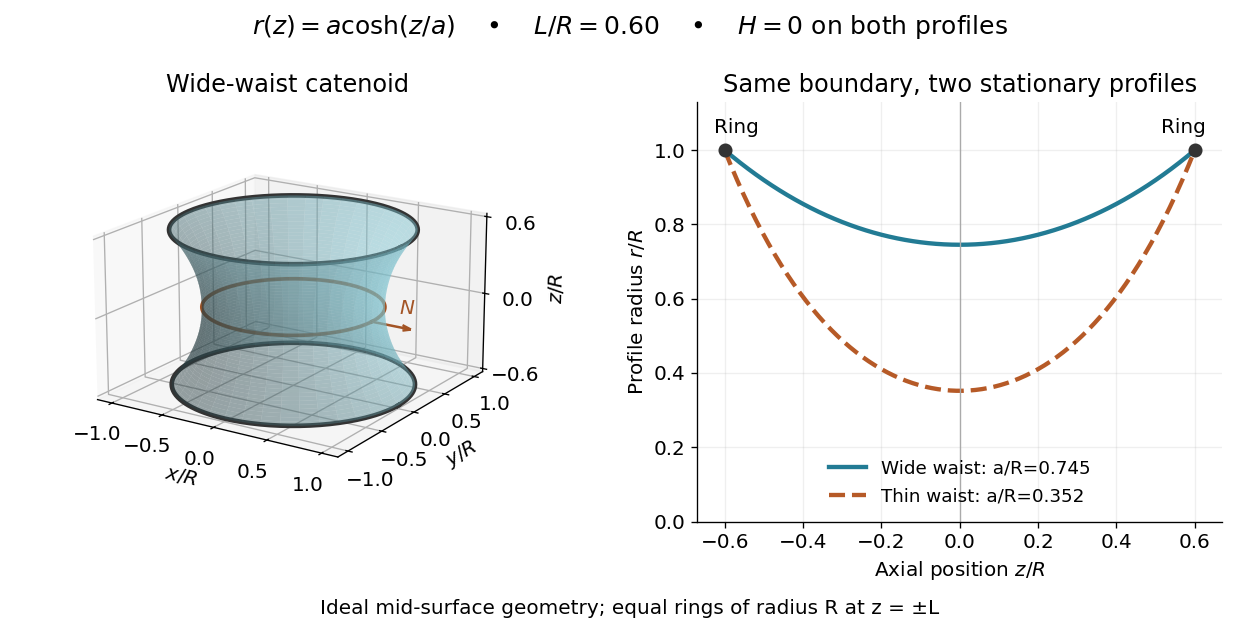

This ideal geometry uses and . The two profiles have different waist radii , although both have . For either profile the surface area follows by integration:At this illustrated separation both profiles have greater surface area than the two disconnected disks, whose total is . This comparison disproves a claim of global area minimization in a class allowing disconnected competitors; it does not determine the sign of the second variation for small variations of a connected film.
A reported experiment used coaxial wire rings of radius , drawn from a surfactant solution and slowly separated until collapse. The solution contained tetradecyltrimethylammonium bromide in deionized water, with glycerol added to vary viscosity. Fluorescein enabled fluorescence imaging under cyan LED arrays; a Phantom V641 camera recorded 4,000 or 5,600 frames per second. Extracted contours gave neck radius, attachment angle, and inferred surface area. They showed neck narrowing and eventual breakup, rather than indefinite persistence of a stationary catenoid. Comparing solutions across viscosities helped distinguish liquid dissipation from the surrounding air's inertia, but the ring displacement beyond the last stable state was not precisely controlled. These are collapse observations, not direct measurements of equilibrium . [ref]
Geometry of catenoidal soap film collapse induced by boundary deformation by Raymond E. Goldstein and others. Geometry of Catenoidal Soap Film Collapse Induced by Boundary Deformation, §II, manuscript pp. 3–4, Figs. 1–3: apparatus, contour readouts, viscosity comparison, and displacement limitation
A proposed classroom measurement would instead hold two equal rings coaxial on a translation stage, leave both sides open to the same gas, and photograph the settled silhouette beside a scale. Fit and inspect fit residuals before inferring cancellation of the principal curvatures. Repeat at several separations and with the camera rotated about the axis to test rotational symmetry. Keep solution composition, ring wetting, and elapsed drainage time comparable, and shield the film from drafts. Film weight, drainage, evaporation, surfactant gradients, and rupture can invalidate the ideal soap film pressure balance. A silhouette fit alone neither measures the pressure jump nor tests all possible perturbations of a stable minimal surface.
Let be the average of on successive knot intervals. Minimizing the displayed loss over gives a quadratic spline with constant tails outside the first and last knots. To prove the reduction, choose the unique constant-tail quadratic spline with the same interval averages as a candidate , and put . Since is constant on every knot interval, is continuous and vanishes on both tails, integration by parts gives . Consequently the data loss is unchanged and . The penalty decreases strictly unless is constant; its zero interval averages then force . The finite-dimensional quadratic optimization on this spline space also gives a unique minimizer because the interval-average map is injective.
Negative curve on a projective surface 2026-10-14
A negative curve is an irreducible algebraic curve on a smooth projective surface whose self-intersection number is negative. The negativity prevents it from moving in a nontrivial effective linear system and constrains how many curves can represent a fixed numerical class.
Noether–Lefschetz theorem 2026-10-14
A very general smooth degree- surface with has Picard group generated by its hyperplane class. The exceptional surfaces lie in a countable union of proper closed loci. A proof is given by Griffiths and Harris, "On the Noether-Lefschetz Theorem".
Seiberg–Witten invariant of a four-manifold 2026-10-14
Fiber sum of four-manifolds 2026-10-14
Remove tubular neighborhoods of diffeomorphic embedded oriented surfaces with opposite normal Euler numbers, and glue their boundary circle bundles by a fiber-reversing identification. The resulting smooth manifold is a fiber sum. The square-zero case uses trivial normal bundles. Additional symplectic hypotheses give a symplectic fiber sum along a square-zero surface.
If one-dimensional smooth linear characters of a local multiplicative group have conductors tending to infinity, their direct sum can be admissible. Its algebraic dual is the product of inverse linear characters, but a smooth vector in this product has only finitely many nonzero coordinates. A common open stabilizer contains one fixed principal-unit subgroup, on which every sufficiently ramified linear character is nontrivial. Thus the smooth dual is again a direct sum.
Every projective line through on a smooth cubic surface lies in its projective tangent plane. Each is a distinct linear factor of the cubic plane section. There can therefore be at most three. Equality occurs when the tangent section consists of three concurrent lines.
Write a line as and the surface equation as . Smoothness says , have no common zero. Projection extends over by . Its fibres are the residual plane conics in the planes through , since substituting , gives . Different residual conics are disjoint everywhere, including their points on , because they are fibres of one morphism of algebraic varieties. The family is flat: over the smooth base curve its local rings are torsion-free over the corresponding discrete valuation ring; smoothness of the total surface supplies the reduced-fibre conclusions.
For two skew lines on a smooth cubic surface, their joining line meets the surface at a third point generically. In coordinates with and , write . The third point is whenever . Neither nor is identically zero, because that would make one of the two lines singular on the surface. The inverse records and of a general surface point. Thus the surface is birational to , hence to .
Internal-wave work in a phase-speed frame 2026-10-14
A right-going, boundary-forced internal gravity wave has horizontal momentum per unit inertial density . Its envelope-induced Eulerian mean acceleration is to leading slow order. In the frame moving at horizontal phase velocity , the change of mean kinetic energy relative to the initial current is at quadratic wave order. Its time derivative is minus the boundary work . The lab-frame mean kinetic energy alone is fourth order in wave amplitude; retaining the moving-frame cross term is essential.
Slice of a set-valued functor category 2026-10-14
A natural transformation assigns a set of points over every element . These fibers form a functor on the category of elements of . Conversely, a functor on the category of elements gives as the disjoint union of its values over all . The two constructions are inverse up to natural isomorphism. Smallness of makes the category of elements small and allows this description to transfer Cartesian closure to every slice.
For the Integer Heisenberg group, choose , and central . Every element has a unique form , and . The group algebra is therefore the displayed skew Laurent polynomial ring, with . The base is a commutative Laurent polynomial ring and an integral domain; the skew Hilbert basis theorem gives both-sided Noetherianity and the leading coefficient of a product proves that there are no zero divisors.
Let have no zero divisors and be an automorphism. For nonzero Laurent polynomials and with greatest exponents , the coefficient of in is . No other exponent pair contributes to that highest degree. Both factors are nonzero, so their product is nonzero, proving the noncommutative domain property in every characteristic.
Skew-adjoint nilpotent operators vanish 2026-10-14
On a finite-dimensional positive inner-product space, a skew-adjoint nilpotent operator is zero. In an orthonormal basis, , since a nilpotent matrix has zero trace and so does its square. The Frobenius norm therefore vanishes. In particular, a nonzero nilpotent adjoint map rules out a compact Lie algebra.
Even rank of a skew-adjoint linear map 2026-10-14
On a finite-dimensional real inner product space, a skew-adjoint operator has even rank. In an orthonormal basis its matrix is skew-symmetric, so an invertible such matrix must have even dimension by . Moreover , so the image and kernel intersect trivially. The restriction of to its image is an invertible skew-adjoint map, and its dimension, the rank, is therefore even.
The self-energy bubble diagram at loop order one in six-dimensional cubic scalar field theory has Feynman-diagram symmetry factor two. With positive Euclidean scalar propagators, its amputated Green's function is the displayed integral. Its superficial degree of divergence is two. Expanding at large internal momentum and taking the angular average shows that its divergent part is a constant plus a multiple of , precisely the mass counterterm and wave-function renormalization structures.
For a spherical ultraviolet cutoff and , its value at isThe divergent coefficient is . Finite terms depend on the regularization convention. Tadpole diagram insertions are excluded from the one-particle-irreducible Feynman diagram, and are removed from the connected two-point function by imposing a vanishing one-point function.
Cusp (algebraic geometry) 2026-10-14
A unibranch singular point of an algebraic variety on a plane algebraic curve. The ordinary cusp has local equation and parametrization ; its branch has a repeated tangent and a vanishing first derivative at the singular point. Higher-order cusps may have different local equations. A cuspidal cubic gives the basic projective example.
Cochain pullback 2026-10-14
For a continuous map , precomposition with the induced map on singular chains sends a singular cochain on to one on . It commutes with the coboundary and induces the induced map on cohomology.
Endpoint control of an XX spin chain 2026-10-14
In the single-excitation subspace, take a connected real nearest-neighbor hopping matrix with every coupling nonzero and endpoint control . Endpoint commutators isolate the first transition, then propagate along the chain to generate both off-diagonal skew-Hermitian directions and adjacent diagonal differences. These generate . For , supplies the central direction, giving . For the algebra is , which still gives full state controllability but omits an arbitrary global phase. A broken coupling separates an unreachable chain component.
There are unlisted articles, also show them or only show them.