
On a constant f-plane with finite Rossby deformation radius, a geostrophic uniform current has streamfunction and a sloping free surface. The full shallow-water quasi-geostrophic potential vorticity is , so a flat-bottom background has the displayed nonconstant value. Omitting its gradient is not a harmless streamfunction gauge choice. A uniform-current, constant-PV inversion must explicitly supply a compensating background, external balance, or a rigid-lid limit.
For a uniform upstream current whose free-surface and bottom slopes compensate, steady quasi-geostrophic approximation flow with uniform incoming potential vorticity obeys the displayed inversion equation. Let on and zero outside. With , the decaying even response is inside and outside. Continuity of and fixes the coefficients. Its streamlines satisfy , so the response extends beyond the compact ridge through exponentially decaying balanced tails.
The variable converts the shallow V-channel lubrication flux equation into a porous medium equation:Indeed . Its fixed-mass source-type solution gives and support length proportional to . Integrating the similarity equation once gives , and hence . The constant-volume similarity in a V-shaped channel fixes from the positive integral : .
The interior first temperature correction obeys , and . Hence , which integrates to the displayed polynomial. Its contribution to depth-integrated horizontal advective heat flux is . The leading conductive flux is . These statements apply away from the sidewall end layers at fixed Rayleigh number as the layer becomes shallow.
Branching form of the tree property 2026-10-14
For an uncountable cardinal , this convention requires a cofinal branch in every separated rooted tree of height with fewer than immediate successors per node, without bounding level sizes. It is stronger than the usual tree property away from inaccessible cardinals. If , attach chains of cofinally increasing lengths below above fewer than children of one root; this contradicts the property. If for , take a binary tree through level , choose distinct nodes there, and attach to the th a chain of length . It has height , binary branching, and no cofinal branch. Hence the property implies that is a strongly inaccessible cardinal. At such a cardinal a separated tree with small immediate branching has small levels, so this convention agrees with the usual tree property. It is not the different notion called the strong tree property in modern set theory.
Partition an infinite countable set into disjoint finite blocks of unbounded size. The union of their power sets consists entirely of finite sets and shatters each block, so it has unbounded finite VC dimension. Every infinite set meets two different blocks. The pair formed by one point from each can never occur as a trace, since each family member stays in one block. Thus no infinite set has traces realizing all its finite subsets.
For a Serre fibration over , cover the base by a contractible punctured sphere and a contractible ball. Excision relative to the preimage of the punctured sphere identifies the relative pair with the product of and up to homotopy. The base pair has a single free homology group in degree , so the Künneth theorem gives the displayed shift without a torsion term. The relative long exact sequence then gives . The connecting map retains the twisting of the original Serre fibration.
Relative homotopy of a Serre fibration 2026-10-14
For a based Serre fibration with fibre over the basepoint, lift a based cube in from its constant bottom face, keeping the side faces fixed. Its final face lies in , giving surjectivity of the relative map. Homotopies in lift; two lifts of the same cube are relatively homotopic by lifting with both side liftings prescribed. This gives injectivity. For this is a group isomorphism; at it is initially a bijection of pointed sets, unless the relative set is endowed with the group law transported through the fibration.
Tomita operator 2026-10-14
For a Von Neumann algebra with a cyclic separating vector, this is a densely defined antilinear operator. It is closable: the commutant orbit lies in the domain of its antilinear adjoint and is dense. Write for its closure and for its polar decomposition. In finite dimension it is everywhere defined and invertible. For a tracial vector, is isometric and extends to an antiunitary involution.
Gliding-hump continuity principle 2026-10-14
Let be linear between Banach spaces, let be bounded, and let be bounded. If is continuous whenever , then is continuous for all sufficiently large . After rescaling the bounded operators, assume their norms are at most one. If the conclusion failed, discontinuity would allow successively tiny vectors whose diagonal images dominate all previous contributions. Choose their norms also to control the continuous maps on subsequent tails. The convergent sum would then satisfy despite , a contradiction. The tail is factored through before applying , so no continuity of is assumed.
The lattice shear shifts the chain charts by and preserves . On the dense torus it acts as . For , translates of each chart of the formal completion of a scheme along are disjoint. Glue representative formal charts cyclically by the adjacent-chart formulas to obtain a formal scheme quotient. The two branch opens of each chart are disjoint because is empty on the formal support. The quotient fibre is an -gon of projective lines, and the quotient map is locally an isomorphism on each translated chart. Invariant morphisms descend uniquely through this gluing.
// Target: ringed-space.bigb
Weight (representation theory) 2026-10-14
A weight of a representation is a simultaneous eigenvalue functional for a commuting Cartan subalgebra. In general algebra representations it can be expressed as a one-dimensional character of the acting commutative algebra. A weight vector is an eigenvector carrying that functional; a weight space is the corresponding eigenspace, and weight multiplicity is its dimension.
A complex semisimple Lie algebra has an intrinsic Jordan–Chevalley decomposition characterized by , a diagonalizable Adjoint representation operator , and a nilpotent Adjoint representation operator . The Adjoint representation is faithful because the centre is zero. Closure of semisimple matrix Lie algebras are closed under additive Jordan decomposition applied to this faithful representation supplies the parts and their uniqueness. For every finite-dimensional Lie algebra representation , the operators and are the semisimple and nilpotent parts of . Thus the decomposition is independent of a matrix embedding; for a nonfaithful representation it passes to the semisimple quotient by its kernel.
Chevalley basis 2026-10-14
A Chevalley basis of a complex semisimple Lie algebra consists of suitable coroot elements and one vector in each root space, chosen so all Lie bracket structure constants are integers. In particular when the sum is a root, with where is the last negative-direction root in the root string. For independent roots with no root sum the bracket is zero. The integral lattice makes reduction to other fields possible.
Separating family of seminorms 2026-10-14
A family of seminorms separates points when every nonzero vector has for some member . Equivalently, its kernels of seminorms have intersection , or any two distinct vectors have for some . Individual seminorms can have large kernels of seminorms; the whole family must have no common invisible direction.
The associated seminorm topology is Hausdorff if and only if the family separates points. Indeed, if , the neighbourhoods and are disjoint by the triangle inequality. Conversely, if every vanishes on a nonzero , then zero and belong to exactly the same open sets and cannot be separated. This criterion keeps separation distinct from completeness: detecting all directions does not guarantee that all Cauchy sequences have limits.
Coordinate seminorms 2026-10-14
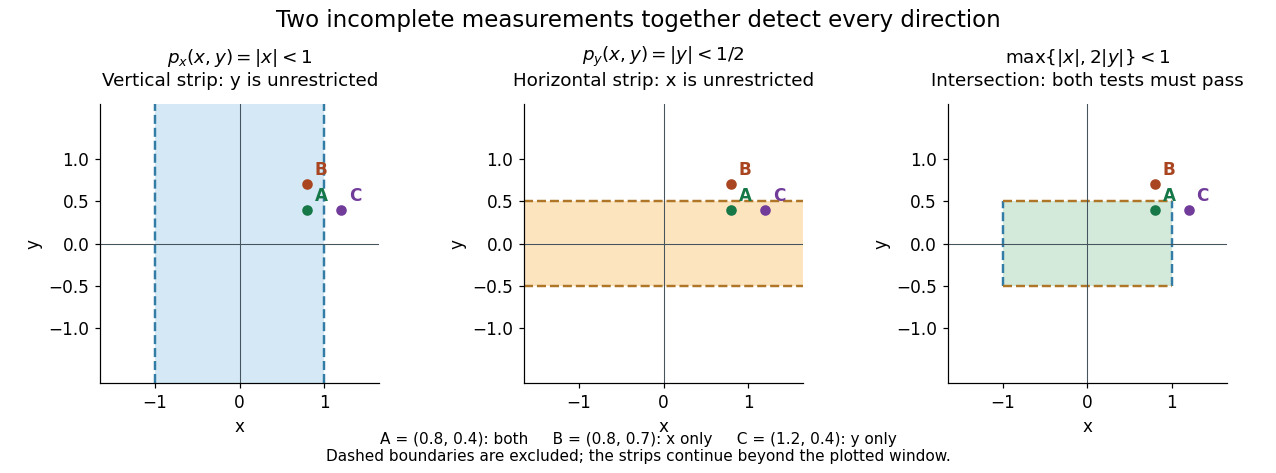
On , the coordinate seminorms and measure horizontal and vertical components separately. Their kernels of seminorms are the vertical and horizontal axes. Neither is a norm, but together they form a separating family of seminorms. A basic zero neighbourhood isEach condition alone is an unbounded strip; their intersection is an open rectangle. For , this is the unit open ball of the maximum norm . For unequal tolerances it is the unit open ball of the weighted norm . Thus the two coordinate measurements generate the usual topology of the plane.

Kernel of a seminorm 2026-10-14
The kernel of a seminorm is its zero set, a linear subspace by absolute homogeneity and the triangle inequality. The estimate shows that adding an element of does not change . Hence defines a norm on the quotient vector space .
On itself, is a pseudometric; it is a metric exactly when is a norm. In particular, zero distance in one pseudometric need not mean equality of vectors. A separating family of seminorms removes the common zero-distance ambiguity.
Rectangular band 2026-10-14
Inversion (meteorology) 2026-10-14
An atmospheric thermal inversion is a region where temperature increases outward. In a strongly irradiated atmosphere it can arise when shortwave opacity exceeds thermal infrared opacity and stellar energy is absorbed high in the atmosphere.
If a self-orthogonal binary subspace has odd length and dimension , its dual code is obtained by adjoining the all-ones word. Self-orthogonality makes every codeword even-weight, so but . Comparing dimensions proves the formula. The dimension hypothesis alone is insufficient: at length three is a counterexample.
There are unlisted articles, also show them or only show them.