
Elimination tree 2026-10-14
For a symmetric factorization in a fixed ordering, the elimination tree assigns the displayed parent to a column of the lower-triangular factor when that set is nonempty. A column with no later entry is a root. The tree records dependencies of descendant updates on later pivots, supports symbolic factor allocation, and exposes parallel subtrees. It describes the factorization ordering, not merely a spanning tree of the original matrix graph.
Symbolic factorization 2026-10-14
Symbolic factorization computes possible nonzero positions and update dependencies from a sparse matrix pattern and ordering before calculating numerical factor values. The elimination graph predicts fill and the elimination tree organizes dependencies. Numerical pivoting or exceptional cancellation can make the computed factor pattern differ from this structural prediction.
Associate an undirected graph with a symmetric matrix's off-diagonal nonzero pattern. Eliminating vertex updates the remaining matrix by . Only pairs of neighbors of can acquire fill-in. If the graph is a tree, remove leaves successively: each eliminated vertex has at most one remaining neighbor, so only a diagonal entry can change. Every Schur complement of a positive-definite matrix is positive definite, so no zero pivot forces a different ordering. Leaf removal therefore constructs a perfect elimination ordering and a fill-free factorization.
Circuit-cover bound by independence number 2026-10-14
For a nontrivial strongly connected directed graph, a coherent cyclic order of a digraph and the Dilworth theorem produce a spanning circuit family with at most its independence number circuits. Put a largest consecutive stable block first and duplicate its vertices as sinks. Use forward edges and edges into the sink copies to form an acyclic auxiliary graph. Its reachability order has width equal to the block size. Expand a chain partition to paths, then exchange intersecting path suffixes until the permutation of source-to-sink labels has as many cycles as possible. Paths in the same permutation cycle are disjoint, so identifying copied endpoints produces simple directed circuits. A windmill of directed triangles sharing one vertex shows that the bound is sharp.
Orbit determination 2026-10-14
Orbit determination infers a body's position and velocity from observations and an equation of motion. It is an inverse problem; a residual of an inverse problem compares an observed readout with its modeled prediction.
For last scattering well inside matter domination, gives physical sound radius . Neglecting the early conformal time in the observer distance, an open dust cosmology has transverse comoving last-scattering distance . Thus and . Radiation, baryon sound-speed evolution and acoustic phase shifts refine this estimate.
// Target: cosmology.bigb
Intestinal nucleus transfer experiment 2026-10-14
Can a specialized donor still supply information for other cell types? The 1962 The Developmental Capacity of Nuclei taken from Intestinal Epithelium Cells of Feeding Tadpoles by J. B. Gurdon used mid-intestinal cells of feeding Xenopus laevis tadpoles. Donors were recognized by columnar shape, basal cell nuclei and a striated absorptive border. Dissociation used Versene solution; this made individual donors accessible. The readout was subsequent development, including normal feeding tadpoles, rather than just division or survival. [ref]
The Developmental Capacity of Nuclei taken from Intestinal Epithelium Cells of Feeding Tadpoles by J. B. Gurdon. Gurdon (1962), Material and Methods and Normal tadpoles; inspected primary text reproduced in the indexed Paperity preview
Apparatus and intervention. A microscope with ultraviolet illumination directed light at the surface region containing the unfertilized ovum's chromosomes, inactivating the recipient nuclear contribution. Irradiation also softened the surrounding jelly so a glass micropipette could enter. The pipette delivered donor nuclear material into recipient cytoplasm. In the technique's validation, fertilizing irradiated eggs produced haploid embryos, supporting destruction of the maternal nuclear contribution. This is inactivation, not a diagram of surgically removing an intact cell nucleus. [ref]
The Egg and the Nucleus: A Battle for Supremacy by J. B. Gurdon. Gurdon, The Egg and the Nucleus: A Battle for Supremacy, The Technique of Nuclear Transfer in Xenopus; indexed authored Nobel lecture text inspected
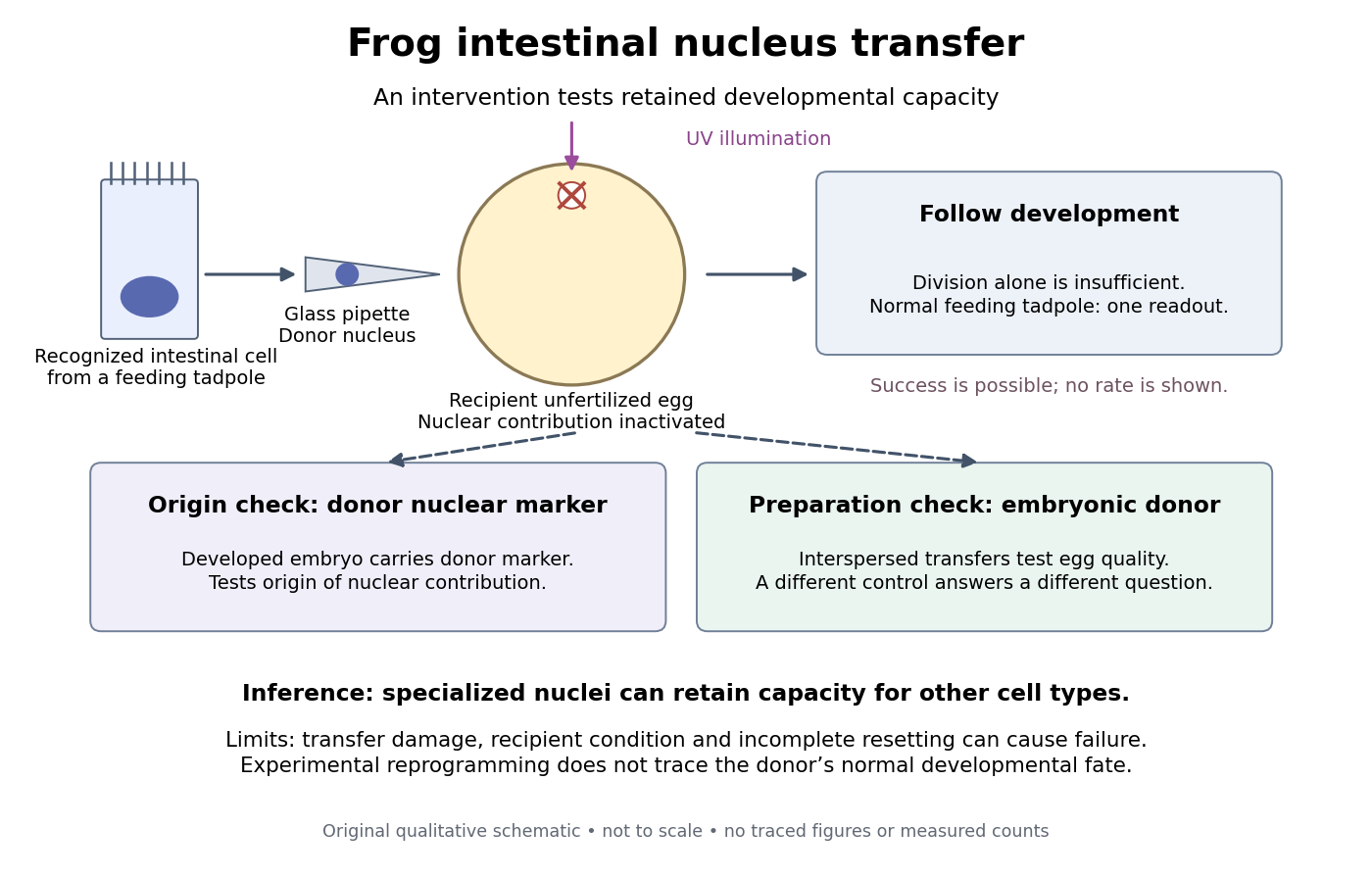
Somatic cell nuclear transfer: intervention, developmental readout and distinct controls
. Original apparatus-and-inference schematic, not a tracing of an experimental photograph. The ultraviolet beam indicates inactivation of recipient nuclear material; the injection pipette supplies a donor cell nucleus. Donor nuclear markers test origin; interspersed embryonic-donor transfers test recipient quality. Successful development is a possible outcome, not an asserted success rate. The figure omits exact dimensions, light dose and many technical steps. Details.
Controls ask different questions. Donor cell nuclei carried a marker absent from recipients; post-blastula embryos carried that marker. The marker distinguished diploid donors with one nucleolus per cell nucleus from the usual two-nucleolus recipient background, rather than mistaking one nucleolus for proof of a haploid state. [ref]
The Egg and the Nucleus: A Battle for Supremacy by J. B. Gurdon. Gurdon, Nobel lecture, The Technique of Nuclear Transfer in Xenopus, p. 233: one-nucleolus diploid marker and its use to establish donor nuclear origin
Interspersed transfers of blastula or later embryonic cell nuclei checked variable recipient quality. A positive embryonic-donor control thus tests the preparation, while the marker tests donor origin. Abnormal development remained common. Neither control establishes universal transfer competence. [ref]The Developmental Capacity of Nuclei taken from Intestinal Epithelium Cells of Feeding Tadpoles by J. B. Gurdon. Gurdon (1962), Material and Methods (nuclear marker), Results (interspersed embryonic controls), and Normal tadpoles (abnormal outcomes); primary text inspected through the indexed preview
Inference and limits. A successful marked donor demonstrates that specialization had not irreversibly removed all information required to build other cell types. Failure is less decisive: transfer damage, recipient condition and incomplete cellular reprogramming can also prevent development. The marker identifies nuclear origin; it is not a complete DNA sequence comparison. The experiment tests donor nuclear potential in an altered cytoplasm, rather than normal donor cell fate, a universal capacity of every donor, or development from a mature mammalian red blood cell. The Nobel account also describes serial transfers through embryonic intermediates; these must not be silently combined with direct transfers into one success rate. [ref]
Mature cells can be reprogrammed to become pluripotent by Nobel Assembly at Karolinska Institutet. Nobel Assembly, Scientific background, Gurdon's nuclear-transfer experiments and serial transplantation
What separates a hydration shell from the surrounding water experimentally? Electrical conductivity addresses a different question. The documented lamp demonstration immerses metal electrodes in a chemical solution, rinses them between samples, and records brightness; adding sodium chloride to distilled water makes it conductive. A water blank and dissolved sucrose comparison test whether dissolved material alone explains the signal. Fixed geometry, temperature, and stated concentrations are additional proposed controls. This reveals mobile electric charge, with limits from contamination, electrode interfaces and detection threshold; it supplies no shell positions. Conductivity experiment on salt solutions explains the apparatus and controls in detail.[ref]
Conductivity of Solutions by Harvard Natural Sciences Lecture Demonstrations. “Setting it Up” and “Comments”
In the authored study Influence of ions on the hydrogen-bond structure in liquid water by Anne Willem Omta and others, pump-probe spectroscopy uses tunable mid-infrared pulses traversing a sample. The probe's wave polarization is set at to the pump; after the sample, splitting and polarizers select parallel and perpendicular transmission. Measuring each transmission with and without the pump gives and , the respective logarithms of the transmission ratios. Their dimensionless anisotropy isIts decay probes reorientation rather than merely loss of vibrational excitation. Dilute semiheavy water in heavy water separates the O–H and O–D bands. Varying the semiheavy water concentration checked that transfer of excitation between nearby O–H groups did not determine the decay. These apparatus and control details are from the inspected author-uploaded article, not a new experiment.[ref]
The related thesis chapter documents two O–H absorption bands in a sodium perchlorate chemical solution: approximately for groups forming hydrogen bonds to water, and for groups forming hydrogen bonds to the anion. Selecting pump and probe bands, then a later delay window, separated their responses. The anion-associated anisotropy decayed more slowly; the water-bonded component showed no resolved change in decay time across the tested sodium perchlorate concentrations. The chapter also used O–D excitation to extend observation beyond the shorter O–H vibrational lifetime. These results support distinct local dynamics rather than a permanently fixed hydration shell. Spectral overlap, finite observation windows, and the selected salts limit the inference: this does not prove that every ion leaves all distant water properties unchanged.[ref]
Ion-dipole attraction 2026-10-14
An ion-dipole attraction couples an ion's electric field to a molecule's electric dipole moment. In the elementary point-electric dipole approximation, the interaction potential energy is . An orientation with the electric dipole moment along the electric field lowers this energy. For water, the oxygen end preferentially faces a cation, and the hydrogen end an anion. At nonzero temperature, fluctuations and competing hydrogen bonds prevent perfect alignment of every molecule.[ref]
11.2 Electrolytes. Chemistry 2e by Paul Flowers and others; “Ionic Electrolytes”, Figure 11.7 and its explanatory paragraph
Hydration shell 2026-10-14
A hydration shell is a solvation shell in water. The existing hydration of ions discussion describes preferential orientations around cations and anions.
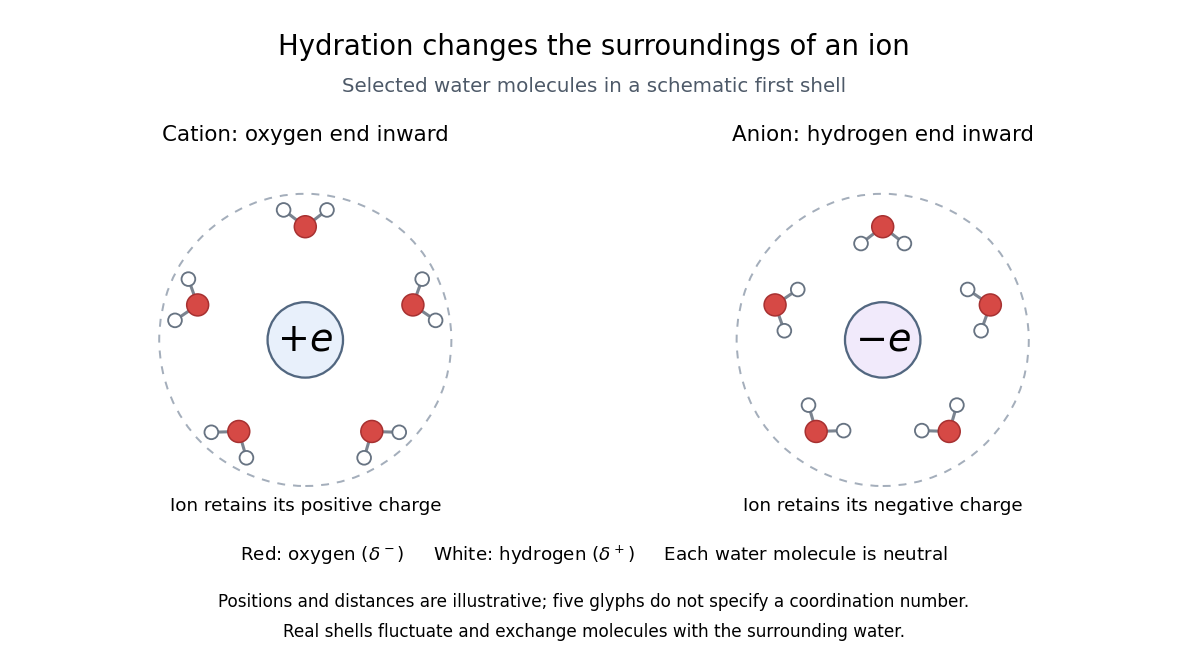
Qualitative hydration shells: opposite orientations of polar water molecules around a cation and an anion, with each ion's net electric charge retained
. Original schematic, not measured molecular positions. Atom spacings and the dashed shell boundary are illustrative. Five selected water glyphs in each panel do not assert a coordination number. Each water molecule is neutral despite its partial atomic charges. Details.
Solvent-specific stabilization 2026-10-14
Solvent-specific stabilization means that the same species need not have the same solvation free energy in different solvents. Chemical polarity, hydrogen bonds, and the cost of reorganizing each solvent all matter. Water can stabilize ions by ion-dipole attractions; a favorable isolated attraction alone still cannot decide the total dissolution balance.[ref]
With a common gaseous reference and compatible dissolved standard states, subtraction removes that reference:A negative result favors solvent B under those reference conventions. This comparison assumes the same species : if protonation, ionization, or formation of ion pairs changes its identity, include a chemical equilibrium for each corresponding chemical reaction.
For nonzero imposed thermal gradient and linear liquidus equilibrium, wherever a mixture of crystals and pore liquid persists. A sealed boundary requires zero solute flux, so a local-equilibrium mush trace there would require , not a zero-solid-fraction roof. In particular a pure-liquid trace with the equilibrium concentration gradient has nonzero diffusive flux. A sealed column must develop a nonequilibrium-in-the-liquid temperature/composition relation, a separate liquid cap, or an appropriate phase-fraction jump; simply transporting the initial zero-fraction level violates the boundary condition.
Instantaneous interface kinetics 2026-10-14
Instantaneous interface kinetics is the limit of negligible kinetic undercooling at a moving solidification interface. Its temperature is set by local liquidus equilibrium and curvature-induced melting-temperature depression, without a further velocity-dependent attachment term. It does not imply that diffusion or heat transport is instantaneous.
A compact orientable irreducible three-manifold with connected torus boundary which is compressible is a solid torus. Compressing along a compression disk gives an embedded sphere. The compressed component has one sphere boundary and irreducibility makes it a ball; undoing compression attaches one one-handle, giving .
Solar cycle 2026-10-14
The solar cycle is the recurrent variation of magnetic activity, with a characteristic sunspot-number period of about eleven years. The large-scale magnetic polarity reverses from one activity cycle to the next, giving an approximately twenty-two-year magnetic cycle. Activity cycles vary in length and amplitude. A satisfactory solar dynamo model must account for polarity reversal, equatorward activity-belt migration in the solar butterfly diagram, the phase relation between polar and active-region fields, and long-term modulation including solar grand minima.
Sunspot 2026-10-14
A sunspot is a relatively cool, dark photospheric region associated with concentrated magnetic flux. The strong magnetic field inhibits convective heat transport, reducing the emergent local intensity. Spots commonly emerge in bipolar active regions, whose polarity and systematic tilt follow Hale's polarity law and Joy's law. Their number and latitude distribution are visible tracers of the solar cycle.
Solar dynamo 2026-10-14
The solar dynamo is the induction and regeneration of the solar magnetic field by conducting flows powered ultimately by solar convection and rotation. In a mean-field dynamo, differential rotation supplies the Omega effect and helical correlations or the Babcock-Leighton mechanism regenerate a poloidal magnetic field. The mean induction equation iswhere is the mean-field electromotive force. A model must close this correlation and include feedback to predict a saturated magnetic cycle; prescribing a shear alone does not close the regeneration loop.
Solar magnetic network 2026-10-14
A spatially extended pattern of magnetic concentrations near boundaries of supergranulation. Surface transport and convergence redistribute magnetic elements into this network; flux emergence, cancellation and diffusion also continually modify it. It is distinct from the much smaller-scale field pattern in individual intergranular lanes and from the organized strong fields of sunspots.
Solar granulation 2026-10-14
The evolving cellular intensity pattern on the Sun's photosphere, produced by solar granules. Its radiative appearance and flow pattern are related but are not identical observables. Near-surface horizontal flow can redistribute weak magnetic field into the surrounding intergranular lanes.
Signed Cauchy boundary operators 2026-10-14
With , the upper and lower limiting Cauchy integrals are . They obey . The actual complementary idempotent projections are and ; confusing this signed convention with two positive projectors changes reconstruction signs. These boundary operators naturally enter the spectral reconstruction of an attenuated Radon transform.
There are unlisted articles, also show them or only show them.