
For a Laplace-type operator on a closed manifold, let be the constant coefficient of its full heat trace expansion. In the Mellin transform defining the spectral zeta function, the reduced trace has constant coefficient . Its contribution is , and proves the identity. For the scalar positive Laplace-Beltrami operator on a closed surface, and is the number of connected components. In particular, a connected sphere has value and a connected flat torus has value .
Complexified transport Cauchy kernel 2026-10-14
For and , the operator has the displayed decaying fundamental solution. A rotated real-linear coordinate turns it into a multiple of a Wirtinger derivative, reducing the kernel identity to . The kernel is analytic in separately inside and outside the unit circle, is at zero and at infinity, and develops a jump at the real directional-transport limit.
Let , , and be the directed attenuated Radon transform. With the signed Cauchy boundary operators, set . An integrating factor turns the attenuated equation into unattenuated directional transport; its spectral solution has jump on the unit circle. A normalized Cauchy integral formula and the coefficient at spectral infinity then prove the reconstruction formula. Known attenuation and full directed angular data determine the source; attenuation itself is not reconstructed by this pair.
Calibrated photometer model 2026-10-14
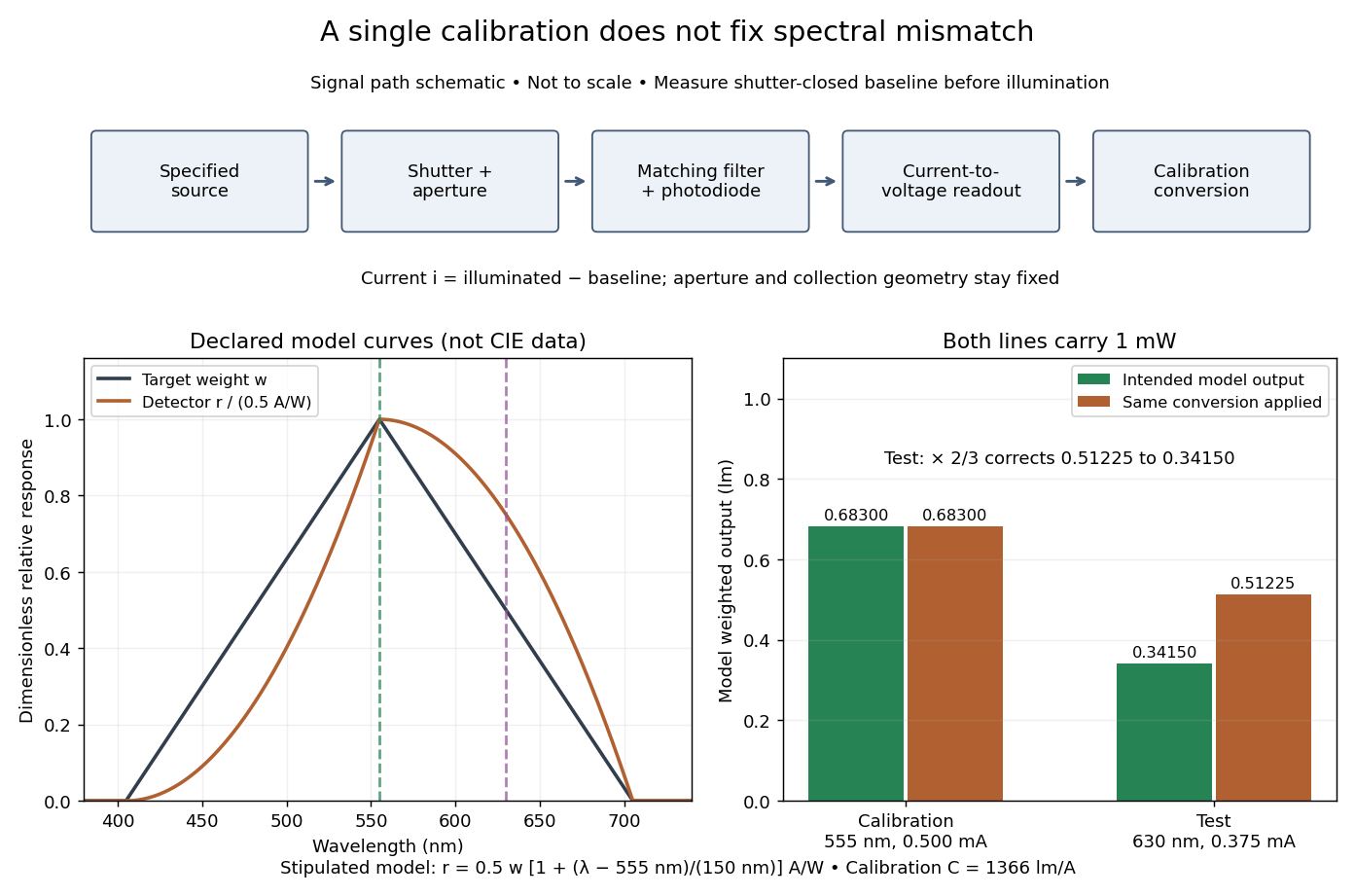
Use the triangular in equal radiant power under visual weighting and stipulate the detector's spectral responsivityThis model has nonnegative response: is zero outside –. For a ideal calibration line at , and , so . An equal-radiant flux test line at gives , and . The unchanged conversion indicates , whereas the model's intended weighted result is . The required spectral mismatch correction is : the uncorrected result is 50% too large. All these numbers are declared model outputs, not instrument measurements or standard photometry data.

The cumulative function of the finite positive spectral measure of a stationary time series is nondecreasing and right-continuous, with total mass equal to the variance. For an absolutely continuous measure, , where is the time-series spectral density. Under angular-frequency normalization, and, when the covariance series is absolutely summable, . Atoms describe persistent periodic components and cannot be represented by an ordinary density.
For uncorrelated zero-mean unit-variance amplitudes , the process has covariance and hence the displayed two-atom spectral measure of a stationary time series. Independence or Gaussian amplitudes are unnecessary for weak stationarity. A phase shift need not preserve the whole joint amplitude distribution, so strict stationarity cannot be inferred from these second moments alone.
For on with zero endpoints, the zero-parameter Green function is . Its eigenfunctions are with eigenvalues . At , the kernel is and its expansion contains precisely the odd reciprocal squares, giving the displayed identity.
Cross-spectrum of two stationary time series 2026-10-14
For zero-mean real weakly stationary processes whose cross-covariances are summable, the cross-spectrum is the Fourier series of their lagged covariance, with the displayed convention. Reality gives , but the cross-spectrum need not be real or even. Exchanging the two series gives . The entries form a Hermitian spectral density of a stationary process matrix.
Under angular-frequency normalization, the displayed time-series spectral density gives and for nonzero integer . This follows from the even integral . All nonzero even-lag covariances vanish while the odd-lag covariances are positive.
Volumetric heat capacity 2026-10-14
Volumetric heat capacity is heat capacity per unit volume, with units . For homogeneous material of mass density , it equals , using specific heat capacity for the same constraint. It measures the heat required per small temperature increase for a chosen occupied volume. In a material model using specific heat capacity at constant pressure, thermal diffusivity is , where is thermal conductivity.
Near the identity, the matrix logarithm of a unitary matrix is skew-Hermitian. Restrict the logarithm's operator norm below ; determinant one then forces its trace to be zero, since and no nonzero multiple of fits this bound. The matrix exponential gives the inverse chart on a ball in the displayed real Lie algebra, of dimension . Left translation supplies compatible charts on the whole special unitary group.
Project a based map to . Since , the resulting homotopy class vanishes. Lift a based null-homotopy by the special orthogonal sphere fibration. Its endpoint lies in the fiber . If the lift moves its base point, right-multiply at time by the inverse of its base-point value, which lies in the fiber. This keeps the projected homotopy unchanged and makes the lift based. Thus is based-homotopic to a map into , proving the asserted surjectivity.
The scalar center has order . For the quotient is simple except at . Its faithful primitive projective-point action, abelian fixed-center transvections, elementary-matrix generation and perfectness give the Iwasawa simplicity lemma proof.
SL2 over F2 as a permutation group 2026-10-14
A determinant-one matrix over permutes the three nonzero vectors of . This group action is faithful because fixing two basis vectors forces the matrix to be the identity. There are invertible matrices, all of determinant one since the only nonzero field element is one, so the action identifies the group with the symmetric group . Reduction of integer determinant-one matrices modulo two is onto: and induce two distinct transpositions, which generate . Its kernel consists of matrices congruent to the identity modulo two, the level-two principal congruence subgroup.
Unique involution in SL2 over an odd field 2026-10-14
Over a field of odd characteristic, an involutory matrix has minimal polynomial dividing , so it is diagonalizable with eigenvalues in . In dimension two, determinant one requires either both eigenvalues one or both minus one. Hence the only element of order two in is ; the identity has order one.
Modulational instability 2026-10-14
Modulational instability is growth of long-wavelength perturbations of a uniform or periodic wave due to coupling between its modulation and nonlinear dynamics. In the focusing nonlinear Schrodinger equation, the amplitude and phase perturbations can have imaginary modulation frequencies even though the unperturbed wave is an exact solution.
Matrix graph 2026-10-14
For a symmetric sparse matrix, its matrix graph has one vertex per unknown and an edge whenever the off-diagonal entry is structurally nonzero. Simultaneous row and column permutation relabels this graph. Nonsymmetric patterns are instead represented by directed or bipartite graphs when row and column roles must be distinguished.
Fill-in 2026-10-14
Fill-in consists of factor entries that become nonzero despite being zero in the original sparse matrix. In symmetric elimination these are the added edges of the elimination graph. Removing a high-degree vertex can create many fill entries, whereas a perfect elimination ordering creates none. Symbolic fill predicts possible nonzeros before floating-point arithmetic; special cancellation can reduce the numerical pattern.
Minimum degree algorithm 2026-10-14
At each step choose a remaining vertex of minimum degree in the current elimination graph. This heuristic reduces the size of the immediate Schur complement update and often reduces fill-in, but does not guarantee a globally optimal ordering. Its degrees must reflect earlier fill, rather than just the original graph.
Nested dissection 2026-10-14
A vertex separator divides the remaining unknowns into disconnected subdomains. Nested dissection recursively eliminates each subdomain before its separator, keeping interaction localized until late in the factorization. For a regular two-dimensional mesh with unknowns, separators have size ; the resulting direct factorization uses work and storage under the usual geometric separator assumptions.
There are unlisted articles, also show them or only show them.