
The assertion that every surjective function has a right inverse is equivalent to the axiom of choice. Choice selects one member of each nonempty fiber of a function, giving a right inverse. Conversely, for a family of nonempty sets, the projection from the disjoint union onto is surjective. A right inverse selects one element from each , giving a choice function.
Orientation-reversing Riemannian isometry 2026-10-14
An isometry between oriented Riemannian manifolds that reverses orientation. Its differential is orthogonal with determinant minus one in oriented orthonormal frames, so it reverses the oriented volume form while preserving the associated positive volume measure. Reflection in a geodesic of the hyperbolic plane is an example. An orientation-reversing isometry still identifies the scalar Laplace spectra, even though it does not preserve the chosen complex orientation of a Riemann surface.
In a relatively compact coordinate ball the Riemannian metric norm is bounded above and below by positive multiples of the Euclidean norm. A coordinate segment gives the upper distance bound. A path leaving the ball has a positive lower length bound before its first exit; paths staying in it have the Euclidean displacement lower bound. Consequently distinct points have positive Riemannian distance, and the resulting metric topology equals the manifold topology. Connectedness makes the distance finite because smooth manifolds are locally path connected.
Riemannian distance on a circular cylinder 2026-10-14
On the lateral surface of an infinite circular cylinder of radius , the induced metric is . Lifting a curve to the unrolled plane preserves its arc length. If the endpoints differ by angular coordinate and height , the possible lifted endpoint displacements are for integers . Each straight segment gives a geodesic, and the shortest of their lengths isChoose the representative of with smallest absolute value modulo ; if its absolute value is , the two angular directions tie. This minimum is attained because the candidate lengths tend to infinity as . The formula concerns travel on the lateral surface; it does not allow a shortcut through the cylinder's interior or across end caps.
For , take and in surrounding Euclidean space. The angular difference is and height difference is . The route has length . The route goes the other way around and has length . Both are among the geodesics on a circular cylinder, but only the first is a minimizing geodesic between these endpoints.
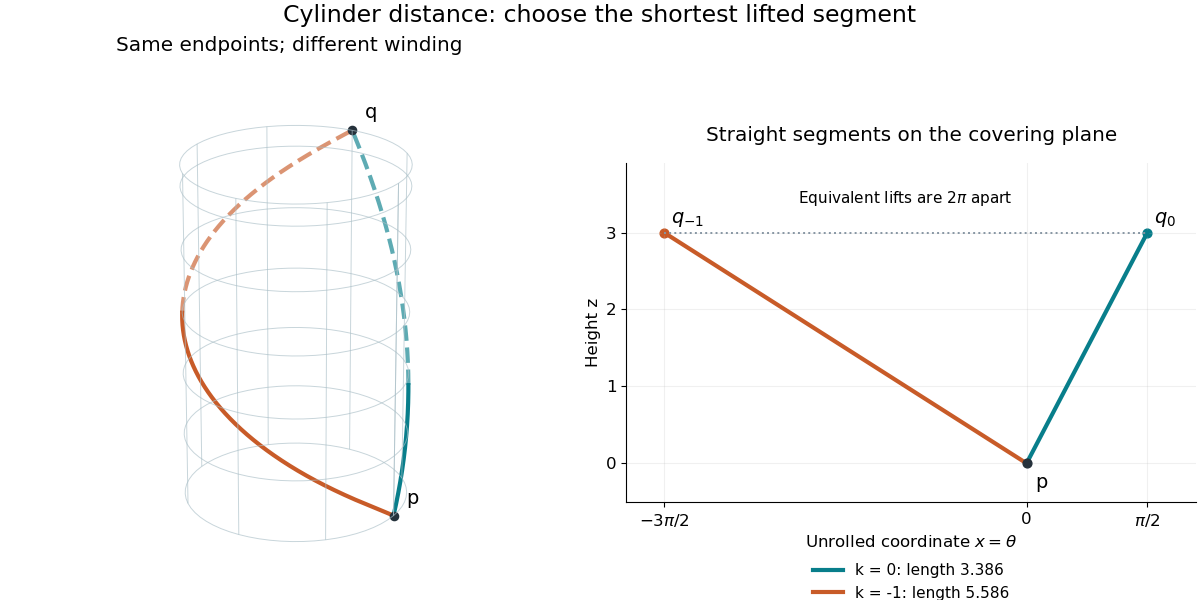

This is a global consequence of intrinsic flatness of a circular cylinder: locally everything is Euclidean, yet the periodic angular coordinate leaves several competing routes. A shortest-route problem on the curved surface becomes a family of ordinary planar distance calculations.
Order-one growth of the Riemann xi function 2026-10-14
The pole-subtracted theta integral for the completed zeta function bounds the Riemann xi function on by a polynomial in times . The Stirling formula gives logarithmic growth . On the positive real axis, the definition and give . Thus its order of an entire function is exactly one.
// Target: analytic-number-theory.bigb
Asymptotic inversion of the zeta zero count 2026-10-14
List positive ordinates of Nontrivial zeros of the Riemann zeta function in nondecreasing order, including multiplicity. The Riemann–von Mangoldt formula gives . For each fixed , evaluate this at to bracket the th ordinate. Letting decrease to zero proves the displayed asymptotic without assuming simple zeros or distinct ordinates.
List positive ordinates of Nontrivial zeros of the Riemann zeta function in nondecreasing order, including multiplicity. If all sufficiently late gaps were at most , summing would give , since with the sum starting at two. The Riemann–von Mangoldt formula would then give , a contradiction when . The same argument applies when only distinct ordinates are listed, because still holds.
Contact discontinuity 2026-10-14
A contact discontinuity in one-dimensional gas dynamics moves with the common fluid velocity and has continuous pressure, while mass density and specific entropy can jump. The mass jump condition is automatic with common ; momentum conservation then requires . The energy jump condition is also satisfied. Thus a contact is a material interface, not a compression shock. A smooth self-similar positive-density flow cannot spread this zero-speed-relative-to-the-fluid family into a fan: on an interval would require both and, from continuity, .
Two positive uniform ideal-gas states can be joined by one nontrivial rarefaction wave precisely when their specific entropy agrees, , and for one they satisfy with . These equations are the constant-entropy and Riemann invariant conditions of the self-similar ideal-gas rarefaction. They are sufficient because its affine profiles match the two states at and , and . The left family has , while the right family has . The inequality alone does not impose the two matching equalities.
For a univalent function with , suppose is omitted. Apply the disk automorphism so the resulting image omits zero, take a holomorphic square root, then apply the disk automorphism taking the value at to zero. If is a simply connected domain, the root exists. The resulting normalized univalent map has derivative magnitude multiplied by , since . Thus a map maximizing the derivative cannot omit an interior disk point.
A rational jump with no zeros or poles on the contour can be split into factors analytic and nonvanishing on the two sides. The exterior factor may carry a power of recording the winding number. For a circle enclosing , the jump has the canonical factors , . The exterior growth of imposes compatibility conditions when a Cauchy transform is required to vanish at infinity.
Assume a regular invertible normalized Riemann-Hilbert problem solution with jump tending to the identity and conjugated by . Residuals of its two differential equations have no jump and vanish at infinity, so Liouville theorem gives a Lax pair. Coefficient comparison gives the displayed reconstruction and ; compatibility yields . A jump matrix tending to zero instead is inconsistent with the normalization. Recovering the initial jump from a prescribed initial potential still requires direct scattering.
Suppose a scalar canonical factor has exterior growth with index , and the original exterior unknown must decay as . Dividing by the canonical factor gives an additive jump with exterior decay . The exterior Cauchy integral expands in moments . Its first coefficients must therefore vanish, yielding the displayed solvability conditions. Under this decay there is no nonzero entire polynomial addition. A nonlocal moment appearing in must additionally agree with the moment of the reconstructed original jump.
Half-line NLS Riemann-Hilbert reconstruction 2026-10-14
Combine columns of the three normalized Lax pair eigenfunctions in their common Volterra analyticity sectors for a half-line NLS Lax pair, dividing by the relevant determinants . The resulting matrix is normalized to the identity at infinity and has jumps on the real and imaginary axes. Connection matrices determine each jump explicitly. Zeros of those determinants require residue conditions or local contour deformations.
Use the bounded columns supplied by Volterra analyticity sectors for reverse-dispersion mKdV and divide the necessary columns by their determinants. This gives a normalized meromorphic matrix on the six-ray contour . The constant scattering data connection matrices generate its jumps by conjugation with . Zeros of column determinants require residue conditions; in a sufficiently small-data, zero-free regime only jumps are needed. The off-diagonal expansion coefficient reconstructs for this sign convention.
Flux Richardson number 2026-10-14
The ratio of stable buoyancy destruction to shear production of turbulent kinetic energy. With down-gradient transport and turbulent Prandtl number , it obeys , rather than automatically equaling the gradient Richardson number. Unstable buoyancy production gives a negative value in this convention.
Weighted matching Markov chain 2026-10-14
On the matchings in a graph, a lazy Markov chain proposes adding an edge, deleting an edge, or exchanging an edge for the unique matching edge incident with it. A proposal incident with two matching edges is rejected. Select the proposed edge uniformly and use the Metropolis–Hastings acceptance probability for the displayed weights. Symmetric proposals give detailed balance; deletions connect every state to the empty matching in a graph. The normalizing constant is the matching generating function.
A polynomial regression birth move can introduce a coefficient while shifting the intercept by , with the sample average of the new monomial. The fitted-value increment is , whose sample average vanishes. The Jacobian determinant of the coefficient transformation is one. A reversible-jump Markov chain Monte Carlo acceptance ratio must still include the normalized dimension-dependent prior distributions, the model-order prior distribution, the birth/death selection probabilities and the proposal density for .
For nested regression models, append one coefficient drawn from density while retaining the variance and existing coefficients . The dimension-matching map has absolute Jacobian one. With joint model/parameter target , birth-selection probability , and reverse death-selection probability , the displayed acceptance probability and its reciprocal death rule enforce detailed balance. Include normalized parameter-prior densities and a model-order prior in : constants that depend on model order cannot be dropped from a cross-model ratio.
To minimize over models with different parameter dimensions, sample from a target proportional to and cool . A dimension-matching proposal augments the smaller model by auxiliary variables, transforms them bijectively into the larger parameter vector, and includes the proposal probability density function and absolute Jacobian determinant in the Metropolis–Hastings acceptance probability. For a positive Poisson mean and normal parameters , one convenient transformation isIts absolute Jacobian determinant is one. If the forward and reverse model-jump selection probabilities are and , the Poisson-to-normal ratio isThe reverse ratio is its reciprocal at the inverse map. This enforces detailed balance. When the target is proper and the annealing chain explores it adequately, the low-temperature laws concentrate on the minimum Akaike information criterion, rather than the maximum marginal model evidence. Likelihoods compared across models must describe the same observed data with a compatible reference measure.
There are unlisted articles, also show them or only show them.