Without replenishment, the electron'smomentum decreases. The referencedipoles then bend it more tightly, producing a displaced orbit. In linear beam optics, x=Dxδ and y=Dyδ, where δ=Δp/p≃−U0/E≃−1.11×10−3 per uncompensated turn. In an ideal planar ring the horizontal dispersion is nonzero and the orbit shifts horizontally, inward where Dx>0. There is no corresponding vertical closed-orbit shift when Dy=0. Real coupling or vertical dispersion can change that idealization.
With current I=0.500A, the number of circulating particles is N=ITrev/e, so the radiated power is
The 2μs revolution time cancels when using beam current. Radio-frequency cavities restore the lost energy longitudinally, with synchronous gain eVRFsinφs=U0 in the sine-phase convention. Their RF power system must supply at least this beam power, in addition to its own losses. Radiation damping and quantum excitation determine beam emittances; they should not be confused with the dispersive closed-orbit shift from amomentum change.
The ratio is (γp/γe)3≃(me/mp)3, explaining the strong suppression for protons. The critical-energyformula is an ultrarelativistic approximation, excellent for the electron and only approximate for this moderately relativistic proton. If “5 GeV proton beam” instead denotes kinetic energy, then γp=1+5/0.9383 and the estimate is about 7.50×10⁻⁶ eV; the two beam-energy conventions should not be mixed.
Relativistic radiation is concentrated into an angle of order 1/γ around the instantaneous velocity. The emission direction sweeps past atangent observer over an orbital interval of order ρ/(γc). Since the charge moves toward the observer, arrival times are compressed by an additional factor of order 1/γ2, giving the spectral scale ω∼cγ3/ρ.
The conventional numerical factor follows from the radiation Fourier phase. Near the tangent direction, circular motion gives
The beaming argument supplies the physical scaling; the spectral integral fixes the conventional factor 3/2. Critical energy is a broad spectral scale, not a hard photon-energy cutoff.[ref]
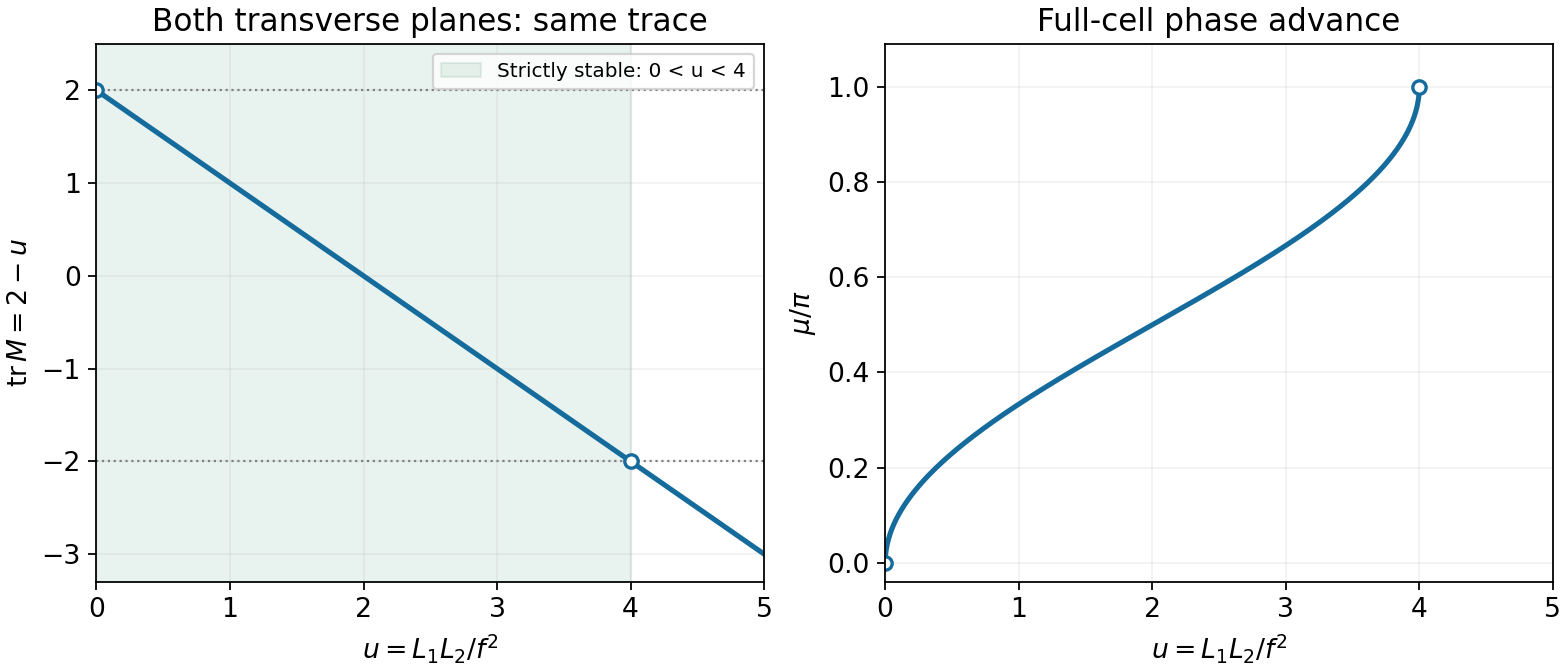
If the full ring contains Nc identical cells, its one-turn phase is Ncμmodulo 2π; nring turns use nNcμ. The displayed Mn is for n repetitions of the specified cell.
Evaluate the envelopes at their displayed arguments and set a=η∗ρ. The common phase e−iV0t cancels from every bilinear. Direct use of the Pauli matrices gives
The physical longitudinal current is Jz=∣η∣2−∣ρ∣2: the two density profiles move in opposite directions. Their separate transport identities give ∂t(∣η∣2+∣ρ∣2)+∂z(∣η∣2−∣ρ∣2)=0.
For a coherent superposition, the transverse currents Jx=2Re(η∗ρ) and Jy=2Im(η∗ρ) generally do not vanish. They are independent of x,y, so they contribute no divergence in this one-dimensional construction. Omitting them would give an incorrect local four-current. Pointwise, ∣J∣2=(∣η∣2+∣ρ∣2)2, so the pure two-component Weyl current is future null wherever the density is nonzero. If only one envelope is present, the current points entirely along its propagation direction; an incoherent average can remove the transverse interference terms.
Here η propagates toward +z and ρ toward −z, both at unit speed.
For a fixed unit vector n^, replace z by n^⋅x and choose orthonormal spinors satisfying (σ⋅n^)u±(n^)=±u±(n^). If n^=(sinϑcosφ,sinϑsinφ,cosϑ), one choice is
Consequently K is conserved for spatially constant V; a spatially uniform time-dependent scalar offset would also commute with it. For general nonuniform V it is not conserved. At nonzero momentum, (σ⋅p^)2=I, so the helicityeigenvalues are +1,−1. In the chosen constant-potential Weyl Hamiltonian, the positive E−V branch has helicity +1; the negative branch has −1. An expectation value in a superposition need not itself be an eigenvalue.
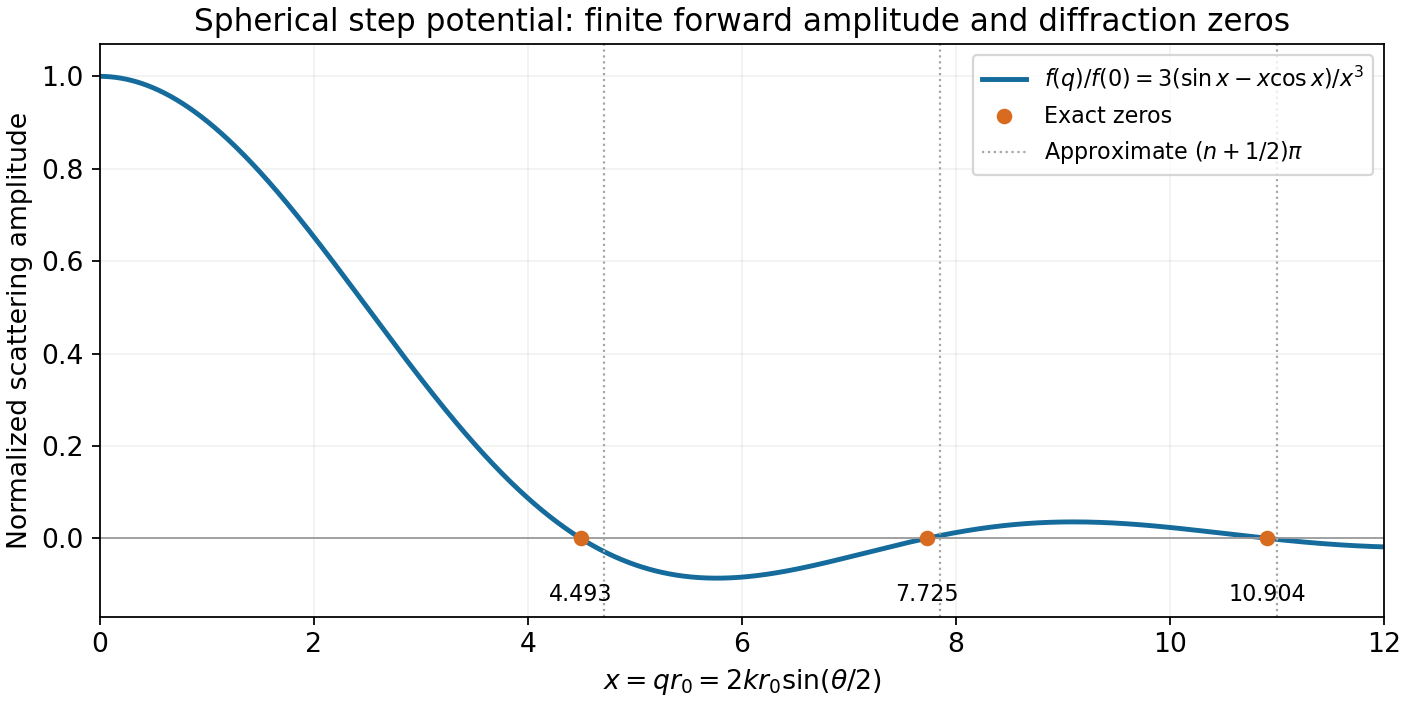
Apart from the finite forward limit, amplitude zeros obey sinx−xcosx=0, or tanx=x, where x=qr0. The firstpositive root is x1≃4.49341. Since the accessible range is 0≤x≤2kr0,
Thus there are no zeros for k<kc; the first enters at the largest momentum transfer, θ=π, when k=kc.
For larger roots, xn lies just below an=π(n+21), n=1,2,…. Expanding tan(an−ε)≃1/ε gives xn=an−1/an+O(an−3). Keeping its leading term yields the requested diffraction estimate
Exactly, replace the numerator π(n+21) by the corresponding root xn. The displayed approximation is a large-qr0rootapproximation: taking k large at fixed low order does not make x1 equal to 3π/2. For example, the exact firstangle at high k is approximately 4.49341/(kr0), not 4.71239/(kr0).
The spherical potential has a rotationally symmetric Fourier transform, so choose the polar axis of the integration along q. With q=∣kf−ki∣=2ksin(θ/2),
There is no azimuthal dependence. At q=0, the bracket is (qr0)3/3+O(q5), so fk(0)=−2mV0r03/(3ℏ2) is finite, not zero. The approximation assumes scattering weak enough for the incident plane wave to replace the distorted wave inside the interaction integral.
For the Schrödinger probability current, j=(ℏ/m)Im(ψ∗∇ψ), the incident flux is jin=ℏk/m. The outgoing scattered radial flux, separated from the incident beam, is jsc,r∼(ℏk/m)∣fk∣2/r2. Thus the outgoing rate through r2dΩ, divided by incident flux, gives
The gauge-covariant kinetic term contains p2/(2m), e(A⋅p+p⋅A)/(2m), and e2A2/(2m): free kinetic, orbital magnetic, and diamagnetic contributions. The spin term is −μ⋅B with μ=−eσ/(2m), givingspin gyromagnetic factor g=2 at this order. In uniform B and symmetric gauge, the orbital term is eB⋅L/(2m).
Squaring introduces extra formal solutions unless the original first-order equation is retained. In the usual positive-energyDiracbasis it relates the small lower component to the upper one by χ=(σ⋅π)φ/(2m+E)≃(σ⋅π)φ/(2m). Thus these are not two independent nonrelativistic particles. Restoring units places ℏ in the spin term, eℏσ⋅B/(2m).
Use Fμν=∂μAν−∂νAμ. The stated derivative convention gives [Dμ,Dν]=−ieFμν. Also [γμ,γν]=−2iσμν. Splitting products into symmetric and antisymmetric parts therefore yields
The gradient of the local phase is exactly cancelled by the potential transformation. Since U is scalar in spinorspace and commutes with the Dirac matrices,
Consequently a solution is mapped into a solution: the minimally coupled Dirac equation is covariant under the local U(1) gauge symmetry. The operator and wavefunction both transform; ordinary differentiation of the transformed wavefunction alone would leave an extra phase-gradient term.
The ordinary derivatives commute, so only the symmetric part of γμγν contributes. Requiring this operator to factor the Klein-Gordon equation, (∂μ∂μ+m2)ψ=0, for arbitrary free momenta gives