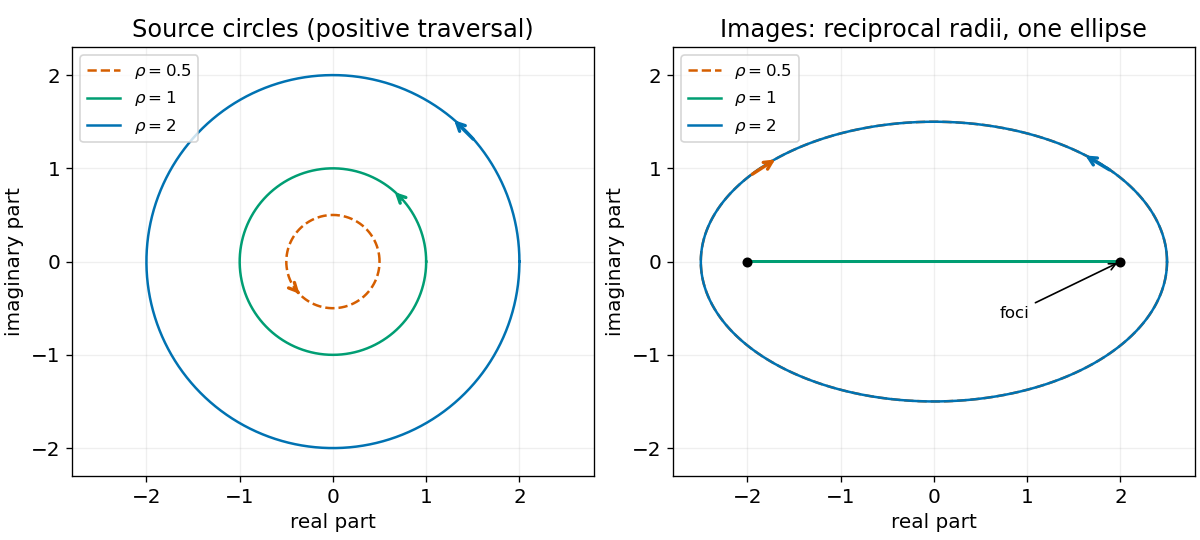
Its horizontal semiaxis is ρ+ρ−1, its vertical semiaxis is ∣ρ−ρ−1∣, and its foci are ±2 because the squared semiaxes differ by 4. Reciprocal radii give the same ellipse, traversed in opposite directions as θ increases.
An exactly circular orbit closes for every nonzero l. A nonzero infinitesimal radial oscillation closes at leading order precisely when 3sinθ is rational. This condition concerns the cone angle: changing s0 or l cannot change the leading-order ratio. Thus there are no special nonzero l values selecting closure for a fixed cone at this order.
At finite radial amplitude the system is equivalent, after unrolling the cone with planar angle χ=ϕsinθ, to a planar central force with potential proportional to s. Its angle advance per radial period changes continuously from 2π/3 near acircle towards π at very large radial energy. Hence the physical advance changes from 2π/(3sinθ) towards π/sinθ. This nonzero interval contains rational multiples of 2π, so tuning a larger initial ∣ps∣ can produce closed orbits even when the small-amplituderatio is irrational. Generic amplitudes still produce a precessing orbit; neither energy conservation nor increasing ∣ps∣ guarantees closure.
Qualification: the printed “any” pϕ excludes a regular interior equilibrium when pϕ=0. In that case Veff=mgscosθ has no stationary point for s>0. Its minimum is the nonsmooth apex, where these coordinates and the smooth-cone dynamics fail.
Hamilton's equations imply f˙=∑i(fqiHpi−fpiHqi)={H,f}paper. With the other common Poisson bracket convention the correct statement is instead f˙={f,H}standard. For example H=p2/(2m), f=q gives {H,q}standard=−p/m, contradicting the printed order unless its sign convention is adopted. Since Ht=0 and {H,H}=0, the Hamiltonian is conserved. Also p˙ϕ=−Hϕ=0: this canonical momentum is the axial angular momentum.
Thus the wind must blow towards a direction east of south by tan−1(mf/K) in the northern hemisphere, west of south in the southern hemisphere, and due south at the equator. This compensates the Coriolis force; at the optimum vx=0 and the ice moves due south. If the drag coefficients are per unit mass, replace K/m by the corresponding total drag rate. “Blows towards” avoids the opposite convention used when naming winds by their origin.
At latitudeℓ, the Earth's angular velocity in east–north–up coordinates is Ω=(0,Ωcosℓ,Ωsinℓ). Assume a small horizontal patch, constant Ω, negligible vertical velocity, and a vertical constraint balancing effective gravity. Absorb the steady centrifugal force into that effective gravity. With f=2Ωsinℓ and physical horizontal force per unit mass Fx′,Fy′, the Coriolis force gives
Its expansion contains the ordinary kinetic energy, mr˙′⋅(Ω′×r′), and m∣Ω′×r′∣2/2. These velocity and position terms generate the apparent forces in the rotating frame.
Both terms must be expressed in the same basis before adding them. If R(t)maps rotating components into inertial components, the precise component equation is d(RV′)/dt=R(V˙′+Ω′×V′). The printed expression suppresses this basis conversion.
Equivalently Vt=−ΩVφ implies d(E−ΩLz)/dt=0. This Jacobi integral assumes a rigidly rotating potential with constant Ω and negligible back-reaction from the test particle.
The appropriate invariance is invariance of the action element Ldt, including the change of the timemeasure. Under δt=λϕ and δqi=λψi, differentiation of qi′(t′) gives δq˙i=λ(Dtψi−q˙iDtϕ). Therefore