
The arc length factor is the norm of the tangent:Hence and . The scalar line integral is thereforeThis uses scalar arc length, rather than the oriented displacement used in the vector line integrals of part (a).
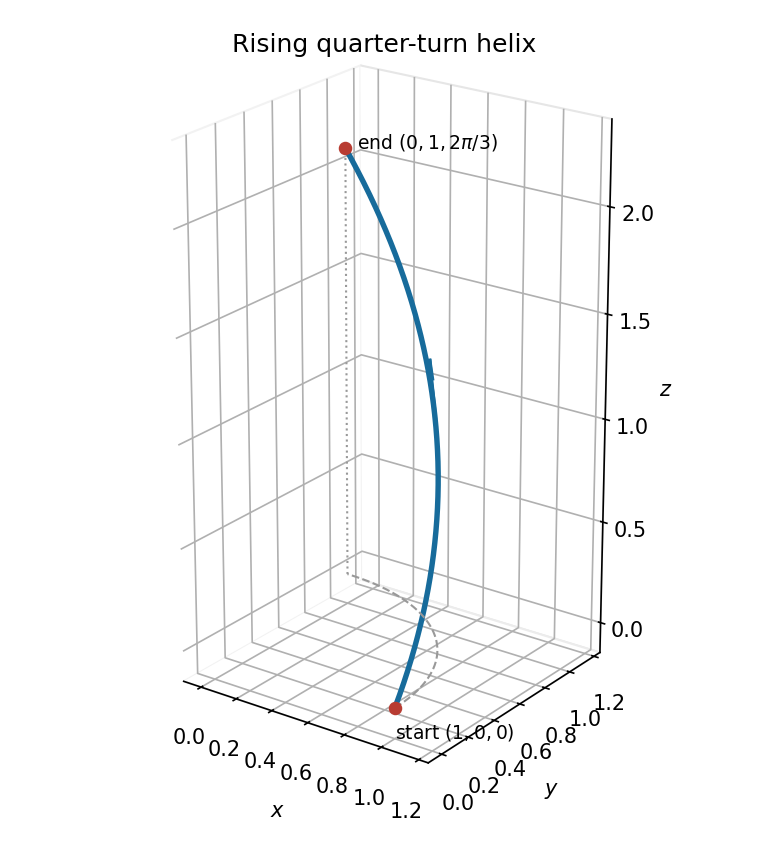
Starting at , traverse the right, top, left and bottom sides in that order. For , the differential expression is . The four line integral contributions are respectively , so the total is two.
For , the expression is . The right side contributes , and the top side contributes ; the other sides contribute zero. Therefore
At , the gradient is . The requested direction must be normalized to the unit vector . The directional derivative is thereforeUsing without normalization would instead measure change per unit of a differently scaled path parameter.
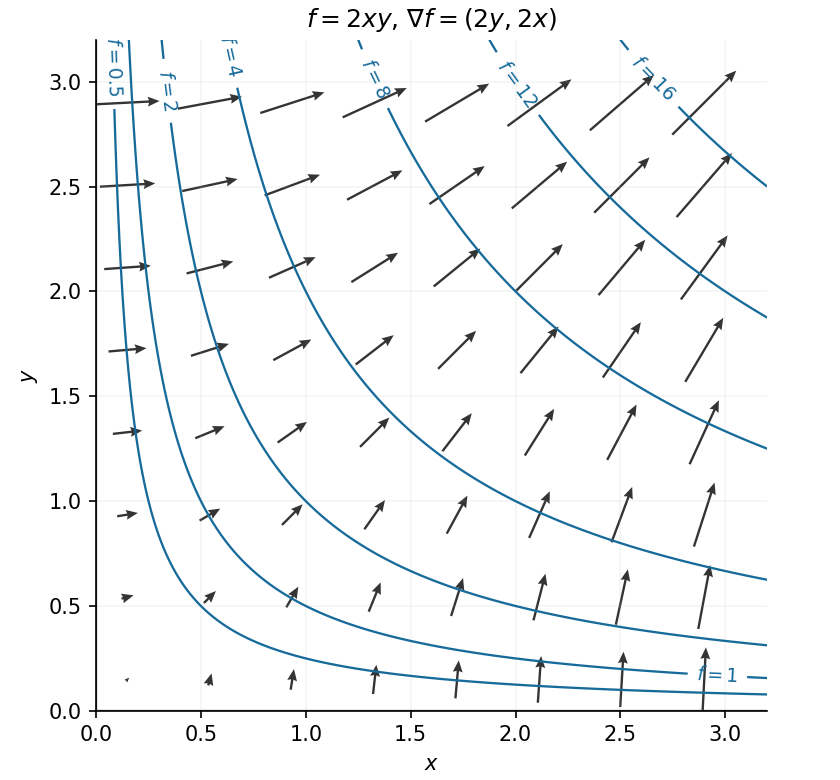
In the positive quadrant, both components of the gradient are positive. Along the arrows point along ; near the horizontal axis they point mainly upwards, and near the vertical axis mainly rightwards. The level sets are the hyperbolas , including the coordinate axes for level zero. The gradient is orthogonal to each regular level set and points towards increasing values of .
Rationalize the positive difference:Since the denominator is at least ,The upper bound is a constant multiple of the convergent p-series with exponent two. The comparison test therefore provesThe asymptotic equivalence of its summand to gives the same conclusion by limit comparison test.
For the positive terms , the ratio is . The ratio test therefore gives divergence. More directly, the terms increase by a factor at least two for all , so they fail the necessary term test for divergence condition . Hence
For , continuity fails. Take and . Both tend to zero, but the corresponding function values are and . Thus there is no limit, and the function is not differentiable either, since differentiability would imply continuity.
For , the bound and the squeeze theorem give continuity at zero. Its difference quotient is , however, which has no limit by the same two sequences. It is therefore not differentiable there.
For , the bound proves continuity. Its difference quotient is , whose absolute value is bounded by , so the derivative exists and equals zero. The complete classification is
For statement (1), continuity at the interior point meansExplicitly, for every there exists such that implies for points in the domain. This is the epsilon-delta definition of continuity.
For statement (2), differentiability means the two-sided difference quotient has a finite limit:The same finite value must be obtained from positive and negative . Differentiability implies continuity, whereas the converse need not hold.
The ellipsoid and the exponential factor are invariant under separate reflections of any coordinate. Split the integrand into its two polynomial terms. The term times that exponential is odd in , so its volume integral vanishes by reflecting . The other term times the exponential is odd in , so its volume integral vanishes by reflecting . Both integrands are continuous on a bounded region. Therefore odd-integrand cancellation by reflection gives
Scale the ellipsoid to a unit ball usingwith , and . This is spherical coordinates followed by a diagonal linear transformation, so the Jacobian determinant is . The required volume integral is
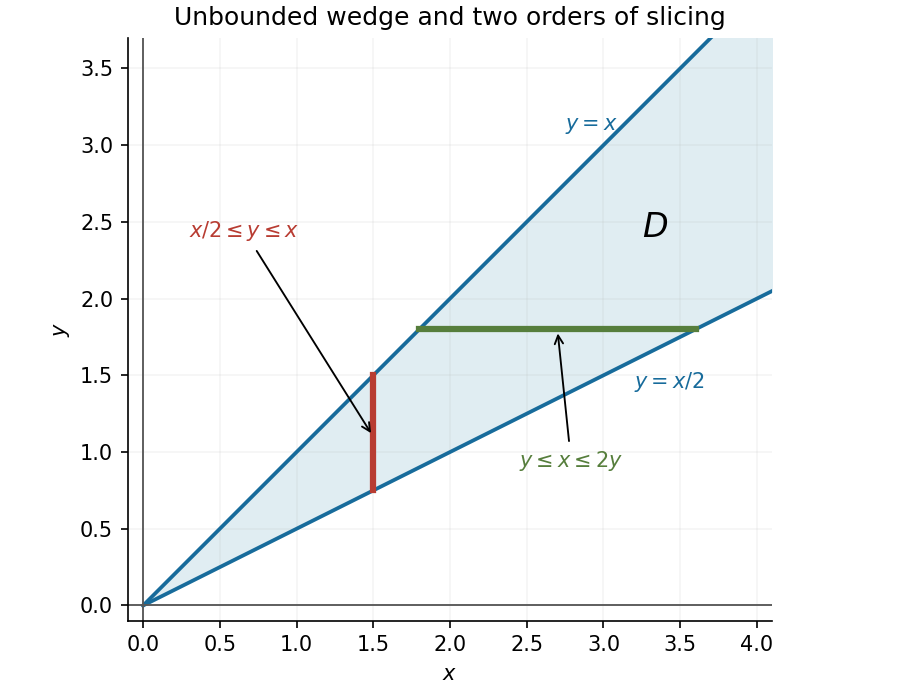
Reverse the order in the nonnegative double integral, using and . For , an antiderivative in is . ThusLet denote the requested improper integral. Its numerator is near zero, so its apparent singularity is removable; it also decays at infinity. We may therefore separate the preceding expression into the convergent integralsIt follows thatThe two terms divided separately by would each have a divergent integral at zero; the cancellation in their difference is essential.
For fixed , integrate first over :The integrand is nonnegative, so this order of the double integral is legitimate even before its finiteness is known. Applying the scaled Gaussian integral yields


This is a Bernoulli differential equation with exponent four. On the nonzero branch selected by , put . Multiplying the original equation by givesIts integrating factor is , so and . The initial condition sets . ThusThis is the maximal real solution interval containing zero: the solution diverges as . The real negative branch of the same algebraic formula for is disconnected from this initial-value solution. The original equation also admits , but it does not satisfy the prescribed initial condition.
For the solution through , work on the connected domain . While , separation of variables givesThe initial condition gives , soThe restriction matters: the unsquared equation requires . The solution reaches zero at . Continuing the squared formula beyond that point would give a positive derivative, contradicting the original negative square-root right-hand side.
The nonnegative forward continuation is insteadThe two pieces join with , and both satisfy the original equation. Because the right-hand side is nonpositive for , a nonnegative solution cannot leave zero in the forward direction. This is a finite-time extinction phenomenon for a separable differential equation.
The two independently computed answers agree:This verifies the divergence theorem. Its hypotheses hold because the field is smooth and the prism has a closed piecewise smooth boundary with consistently outward normals.
Use the prism bounds read from the PDF diagram and the divergence from part (ii):Set in the inner evaluation. Since , the inner integral is . Therefore
There are unlisted articles, also show them or only show them.