
Multiplication by the integrating factor and the product rule turn the left side into a single derivative:Using integration by substitution gives . Therefore the general solution isThere is one arbitrary constant of integration, as expected for a first-order ordinary differential equation.
For a first-order linear ordinary differential equation , an integrating factor is . Here , soThe sine is positive on the specified interval, so this integrating factor never vanishes there. Any nonzero constant multiple is equally suitable.
In spherical coordinates, the cone condition forces and becomes . The unit ball gives . HenceFor an independent calculation in cylindrical coordinates, the lower boundary is and the upper boundary is . They meet at , since . ThusThe equality uses . The positive cosine on the stated range removes any square-root sign ambiguity.
At height , the elliptic paraboloid has a circular cross-section , of area . The cylindrical coordinates volume element therefore reduces the volume integral toFor the specified , the derivative is . Thus is integrable at zero and decays exponentially at infinity. Apply integration by parts first on a truncated interval and then take the endpoint limits:Both boundary terms vanish because . With , integration by substitution gives the Gaussian integral:The integrand is singular at the apex but the resulting improper integral is convergent.
The cardioid has a nonnegative radial boundary, so each ray from the origin contributes . Integrating the polar coordinates area element yieldsThe three angular integrals are , zero and , respectively, using the double-angle formula for the last. Thus
Let be the positive Gaussian integral. Its improper integral converges because for . Multiplying two copies and using the polar coordinates area element givesNonnegativity justifies the product double integral and the change of integration order. Since ,
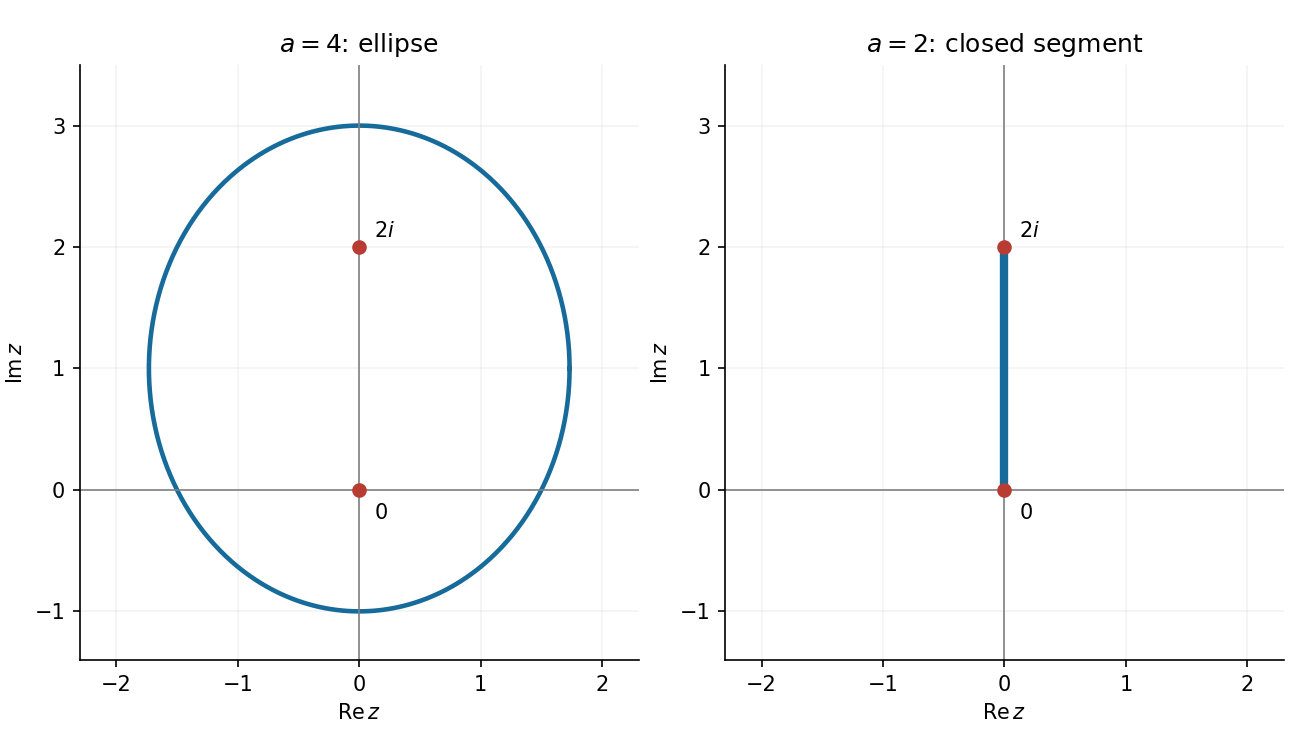
The triangle inequality bounds the distance sum below by the separation of the two foci, which is two. Equality holds exactly for points on the closed segment joining them. Hence the locus isBoth endpoints are included. It is the segment on the positive imaginary axis shown in the right-hand panel above.
Write . Then and , so the condition fixes the sum of distances from and . It is an ellipse with centre , vertical semimajor axis , and focal distance . Its horizontal semiminor axis obeys . Thus the locus isThe vertices are and ; the horizontal extremities are . The complex conjugation places the second focus above the origin.

The literal expression in the original PDF is undefined. Indeed, hyperbolic tangent satisfies , andAlready the summand contains , a pole. The shifted term has the same issue when . Thus this is not a finite sum of defined complex numbers, and it has no literal real or imaginary part. Cancelling two undefined terms is not ordinary arithmetic.
There is nevertheless a natural interpretation by meromorphic telescoping cancellation. Insert the same small positive real shift into every hyperbolic tangent argument. Each term is then finite, and the telescoping sum isSince hyperbolic tangent has period , its first argument can be reduced to . Taking the limit givesThis is a common-shift continuation of the sum, plausibly the intended telescoping answer. It requires that additional convention; it is not the value of the expression as printed.
The exponential definitions of hyperbolic sine and hyperbolic cosine, together with Euler's formula, give and . The argument of the complex logarithm therefore reduces to .
Using the principal logarithm, , soIf no branch of the complex logarithm is selected, its complete set of values is , . The real part remains zero, while the imaginary part is . The original paper does not explicitly state a branch convention.
Powers of the imaginary unit repeat in blocks , each with sum zero. The first terms comprise eleven complete blocks; the last is . Applying Euler's formula to the resulting complex exponential gives . HenceThe angles here are in radians.
Multiply numerator and denominator by the complex conjugate :Thus the real part and imaginary part are
With the same separation of variables ansatz, givesOn , integration yields and . The choice , gives a polynomial that extends smoothly to all real :It is nonconstant and real everywhere, and , including on the axes.
Use separation of variables with on a region where the factors do not vanish. The equation becomes , soThe separated equations are and , giving . Choosing gives the nonconstant real solutionAlthough the division used , the resulting solution extends smoothly across and directly satisfies everywhere.
Successive substitution in the matrix recurrence relation gives . In the matrix power of , every adjacent cancels, so . ConsequentlyHere for , and . The formula also gives correctly at .
The eigenvector equations combine column by column into . Since , multiplication by the inverse matrix gives the diagonalizationThe nonzero determinant of ensures that its columns form an eigenbasis.
Let and . The specified entries mean . Multiplication of determinants therefore givesThis is also the direct row- and column-scaling rule, and it includes zero scaling factors.
Multiplying an matrix by scales every row, giving a factor in its determinant. Also , since . HenceOnly needs to be invertible; the result remains valid when .
The determinant is multiplicative under matrix multiplication:This also holds when is singular, in which case both sides vanish.
The first initial condition gives . The original first equation gives , whereas the general solution gives . Thus andThe corresponding has , checking the other initial condition.
There are unlisted articles, also show them or only show them.