
Every row sums to six, so is an eigenvector with eigenvalue six. Since is a real symmetric matrix, its other two eigenvalues, say , are real. The trace givesAlso, for a real symmetric matrix, is the sum of the squares of all its entries. HereThus . Together with their zero sum, this implies
A square matrix is a diagonalizable matrix over a specified field if some invertible matrix makes diagonal. Equivalently, the underlying vector space has a basis of eigenvectors of .
For example,The first is already diagonal. The second has only the eigenvalue one, of algebraic multiplicity two, but its eigenspace consists of and has dimension one. It cannot supply a two-vector eigenbasis.
The finite-dimensional spectral theorem gives a spectral decomposition of the Hermitian matrix:The matrix exponential respects similarity, soThe diagonal entries are real, so the conjugate transpose of this expression equals itself. Its eigenvalues are , provingIn particular, for any nonzero , . Thus the exponential of a Hermitian matrix is a Hermitian positive-definite matrix, even when itself has negative eigenvalues.
If , then is a Hermitian matrix, because . By the finite-dimensional spectral theorem, there is a unitary matrix withThus . Since the matrix exponential respects similarity,Each diagonal entry has modulus one, so . Using ,Hence the exponential of a skew-Hermitian matrix is unitary.
Induction shows for every nonnegative integer : in a product, adjacent factors cancel. At , this is . Hence each partial sum of the matrix exponential satisfiesThe series is absolutely convergent, since a submultiplicative matrix norm bounds it by . Passing to the limit therefore proves that the matrix exponential respects similarity:No diagonalizability assumption is required.
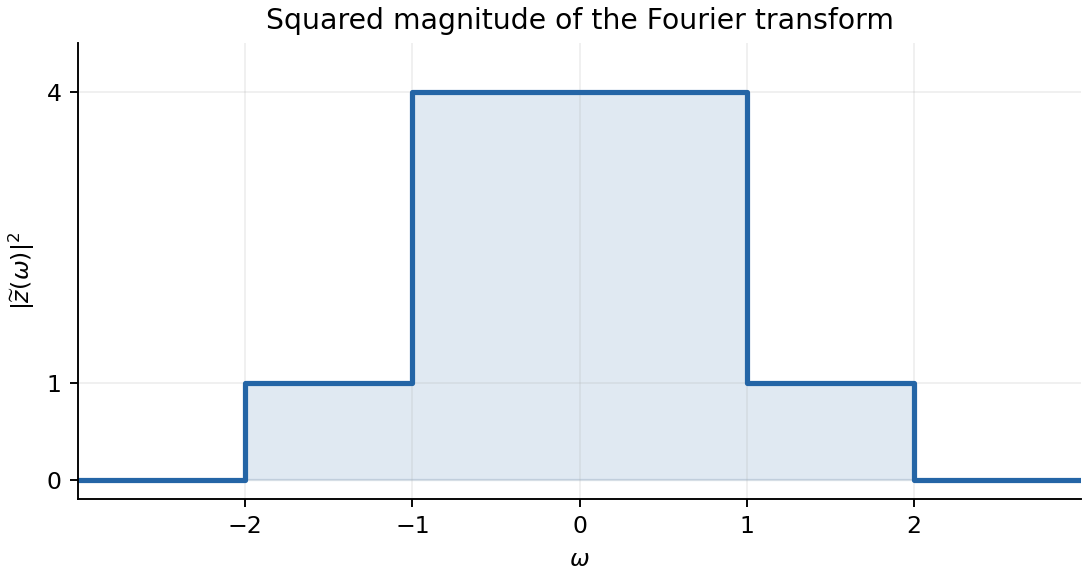
By Fourier inversion, the sinc function has Fourier transform equal to one for and zero for . Thus the two bandwidths add to giveThe requested squared-magnitude spectrum therefore has heights four and one:Values at the jump points depend on the chosen Fourier convergence convention and do not affect any integral. The graph is shown below.

For the difference of Heaviside step functions is an interval indicator, and on and zero elsewhere. Its Fourier transform isThe apparent singularity at is removable. The formula remains valid for real negative , because the original step-function difference and the oriented integral both reverse sign; for both vanish. This is the Fourier transform of an interval indicator and produces a scaled sinc function.
For , the even exponential is except for an irrelevant single value at zero. Linearity and the scaling property of the Fourier transform at giveIn particular, for positive real the transform is real and even, as expected from the symmetry of .
The Heaviside step function restricts the integral defining the Fourier transform to , soThe convergence condition is essential. For real it means , which is the decay assumption used in the subsequent parts. At a distributional Fourier transform is needed; for negative real the defining improper integral diverges.
For a real nonzero , put in the Fourier transform. Reversing the integration limits when produces the absolute value:This is the scaling property of the Fourier transform. If and exists, the transformed function is constant in time; its transform is in the sense of tempered distributions, rather than an ordinary convergent Fourier integral.
Using Fourier inversion with the stated convention,Hence applying the transform twice gives the duality property of the Fourier transform:The formula holds directly for rapidly decreasing smooth functions, and extends through the usual L2 space or tempered distribution formulations when absolute convergence is unavailable.
For , the homogeneous solutions are . The left boundary condition selects , while boundedness at infinity selects on the right. Thus write for and for .
A unit Dirac delta distribution in the second derivative requires continuity of and a derivative jump of one:The second equation and the first give , so the Dirichlet half-line Green function for d2 minus 1 isThe second expression is also a method of images construction. Applying the Green's function to the forcing givesFor bounded forcing this is bounded, vanishes at zero and solves the equation; a bounded homogeneous solution vanishing at zero is zero, proving uniqueness. More general forcing is allowed when the integrals converge and the resulting function has the required growth. Arbitrary unbounded forcing need not admit a bounded solution; this distinction is relevant in part (b).
Here and . LetTwo applications of integration by parts giveSolving these equations,Consequently the required amplitudes areThe stated initial velocity is nonzero at the fixed endpoints, whereas a classical solution differentiable there would require zero endpoint velocity. Thus it is understood on the open interval, or as an L2 space initial datum in the usual finite-energy solution. Its Fourier sine series takes value zero at the endpoints; this changes no initial energy or interior initial data.
For each sine normal mode, the temporal characteristic equation is , with roots . Since , the first modes are overdamped and all higher modes are underdamped. No integer gives critical damping.
The zero initial displacement excludes the hyperbolic cosine and cosine terms. HencewhereTo impose the initial velocity, let be its Fourier sine series coefficients. Differentiating the expansion at gives for the overdamped modes and for the underdamped modes. These determine all coefficients. Despite the hyperbolic sine, the first modes decay: , so both temporal exponential rates are negative.
For the linearly damped string, substitute and divide by :Thus separation of variables givesThe fixed-end Dirichlet boundary conditions require . Nonzero solutions are , with , . Neither nor a negative spatial eigenvalue produces a nonzero function obeying both endpoint conditions.
There are unlisted articles, also show them or only show them.