
For a nonzero admissible radial profile define the radial diffusion Rayleigh quotientMinimizing the numerator subject to introduces a multiplier . The Euler-Lagrange equation for isThe allowed variations vanish at , and the natural condition at the centre is zero radial flux. Thus the minimum, when attained, is the smallest decay eigenvalue . Equivalently, expansion in weighted-orthogonal eigenfunctions makes a weighted average of their decay eigenvalues. The Rayleigh-Ritz variational principle therefore givesAdmissible trial functions must obey the outer boundary condition, be nonzero and have finite weighted norm and energy; they need not solve the differential equation. If the diffusion operator has no lowest eigenfunction, the same variational argument bounds the infimum of its spectrum. Existence of a fundamental diffusion mode is an additional assumption for strongly vanishing diffusivity, not a consequence of the identity alone.
Multiply the separated Sturm-Liouville problem by real and apply integration by parts:The outer endpoint term vanishes because . At zero, regularity gives vanishing radial flux. This can be obtained from the equation without assuming a bounded derivative: let . Since and is bounded, has a finite limit at zero. If that limit were nonzero, positive bounded thermal diffusivity would make have fixed sign and magnitude at least a constant times sufficiently near zero, contradicting bounded . Hence , and in fact . This also forces for bounded .
Substitute into the axisymmetric heat equation and cancel the exponential:Thus the radial ordinary differential equation and its Sturm-Liouville form areThe weight in this Sturm-Liouville problem is therefore . The outer Dirichlet boundary condition is , and the physical solution is regular at the centre. The factor in the weighted inner product is also the radial part of the polar area element.
First compute the curl directly:Reflection symmetry in makes the last component integrate to zero. The middle component gives the hemisphere's volume, soFor an independent surface integral, the closed boundary consists of the curved hemisphere and its flat base. The right-hand side in part (b) is .
On the curved part use spherical coordinates with and . There,The last component has zero angular integral. The first two components giveOn the base, and the outward normal vector is . Thus . In polar coordinates its integral isThe first components cancel, and therefore both required sides equal
Take any constant vector . Its curl is zero, so part (a) and the divergence theorem givewhere is the outward unit normal vector. The scalar triple product identity rewrites the last integrand as . Since is arbitrary, equality of these scalar products implies the vector identity
Apply the product rule in Einstein notation, using the Levi-Civita symbol to express the cross product:The third line uses a cyclic permutation of indices in the first term and an interchange of two indices in the second. Rearranging proves the divergence of a cross product identity:
Squaring with the product law givesEquality to the identity matrix requires in . Since 2 has a multiplicative inverse modulo 5, this forces . The middle condition then gives , hence . ThereforeThis agrees with Lagrange's theorem: a group of odd order has no element of order two.
The subset specified by is not a subgroup. It omits the identity element. It also fails closure: both and lie in it, but their product is , whose coordinate is zero.
A member of is . The multiplication law from part (a) becomesIt stays in and is unchanged when the two factors are exchanged, since . The identity lies in , and also lies in . Thus is an Abelian subgroup, namely the Abelian plane subgroup of a finite Heisenberg group in this coordinate convention.
There are five choices each for , soThis verifies Lagrange's theorem: the subgroup order divides the group order, and the number of distinct left cosets is five.
Explicitly, the map is a surjective group homomorphism to the additive group of , by the product formula. Its kernel of a group homomorphism is . Thus is even a normal subgroup; the five left cosets are the level sets for , with representatives . Each contains 25 elements, providing a direct count as well.
Write with in entry , in entry and in entry , and perform all arithmetic in the finite field . Direct multiplication givesThus the set is closed. Associativity comes from matrix multiplication. The identity element is , and solving the product formula for it givesBoth orders of multiplication with this inverse give the identity. Hence these matrices form a finite group, an instance of the Heisenberg group over a prime field. Each coordinate has five independent possibilities, with distinct triples giving distinct matrices, soThe explicit coordinate convention matters because the central coordinate is here; other descriptions of the Heisenberg group over a prime field may place the central coordinate last.
Let be the set of torsion elements of the given Abelian group. It contains the identity element, which has order one. If have orders , set . Commutativity permits powers of the product to split:Hence has finite order, dividing , and lies in . The nonempty set therefore satisfies the subgroup test and is a subgroup:This is the torsion subgroup. The proof uses commutativity exactly when rearranging the factors in ; one cannot use that step in an arbitrary noncommutative group. The subgroup need not itself be a finite set.
Observe that , and . Thus , while , and . The multiplication table, with the left factor labeling the row, isIt proves closure of the set. Associativity is inherited from matrix multiplication, is the identity element, and every element is its own inverse element. Therefore this set is a group. The table is symmetric, so it is an Abelian group; its three nonidentity elements have order two, identifying it as the Klein four-group .
Direct matrix multiplication gives and hence . It follows thatand . These six matrices are distinct; consequently no smaller positive power is the identity element. ThusProducts add exponents modulo six and . This verifies the cyclic group structure explicitly.
Continue with . Decompose the initial displacement into the normal modes:There is no translational component. Because all initial velocities vanish, the oscillatory coordinates contain only cosines and the zero-frequency velocity is zero. ThereforeAt these give the prescribed displacements and zero velocities. Each term separately satisfies . Also for all , so the centre of mass remains at its original equilibrium position, consistent with the absence of external forces.
Substitution of into the normal modes of three masses connected by two equal springs givesThe corresponding shapes are , , . For example, , verifying the third eigenvalue directly.
Their relevant orthogonality uses the kinetic matrix :This is mass-matrix orthogonality of normal modes. It also follows by subtracting from its transpose and using the symmetry of . Ordinary Euclidean inner products need not vanish: in fact .
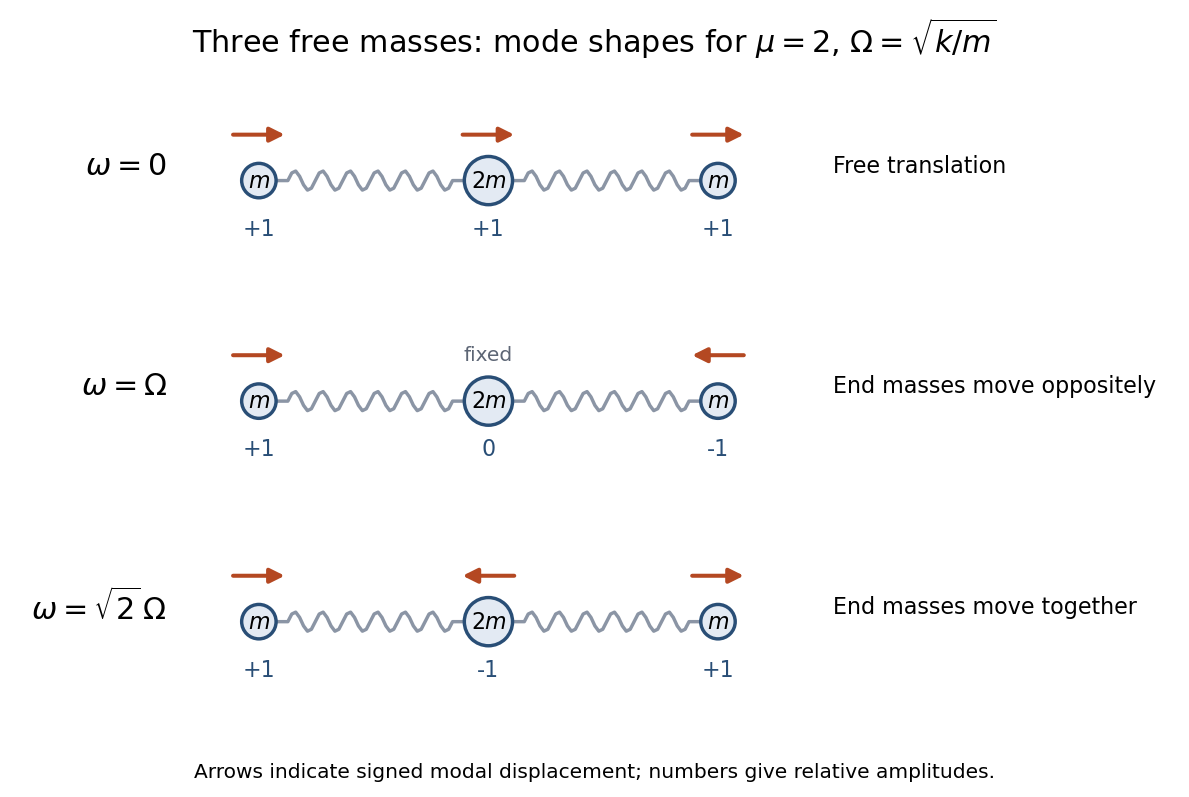
The three normal modes for a free spring chain with middle mass ; amplitudes are relative and the zero mode is translation
. Details. 
Past exam of the mathematics course of the year 2 of the natural sciences course of the University of Cambridge 2017 Paper 2 7 a Solution Created 2026-10-18 Updated 2026-11-05
Use displacements from an equilibrium, so the two spring extensions are and . The kinetic energy and elastic potential energy areThus and , with the small-oscillation mass and stiffness matricesIf instead denote absolute positions, the appropriate natural spring lengths must first be subtracted from the differences in . They do not affect the equations for displacements.
Euler-Lagrange equations give , so a normal mode obeys the generalized eigenvalue problem for small oscillations . Reflection symmetry separates antisymmetric shapes from symmetric shapes . In the antisymmetric sector the end equation is , giving . In the symmetric sector the two independent equations areTwice the first plus the second gives . If , then . Otherwise , and substitution into the first equation gives . Thus the three independent shapes are:For both springs retain their lengths, so this is uniform translation. For the end masses move oppositely and their forces on the middle mass cancel. For the end masses move together, while the middle mass moves oppositely so the centre of mass remains fixed. Direct substitution verifies all three eigenpairs; for positive the three eigenvalues are distinct and exhaust the three degrees of freedom. These are the normal modes of three masses connected by two equal springs.
A useful normalization is the weighted inner product induced by . Since the squared mass norms are , and , respectively, takeIf ordinary Euclidean unit eigenvectors are intended instead, divide by , respectively. The frequencies and physical motions are independent of this normalization choice. The zero-frequency coordinate has general motion rather than an oscillation.
Use the vector triple product expression from part (a). Put and . Since ,Expanding and canceling the zeroth-order terms givesThe first bracket is odd in and integrates to zero over the centred ball. With , the Cartesian moments of a three-dimensional ball giveThereforeThe resulting vector is parallel to , as the rotational symmetry of the centred domain requires.
Take the centre of the ball as the origin. An orthogonal change of variables leaves both this domain and its volume measure invariant. Consequently its Cartesian moment integrals are isotropic tensors. Equivalently, inversion immediately makes every odd moment zero.
There is no nonzero invariant rank-one vector, soAn isotropic tensor of rank two is a scalar multiple of the Kronecker delta, giving . Contract the indices and use spherical coordinates:Thus the Cartesian moments of a three-dimensional ball giveFor the last identity, one may also use the general rotation-invariant rank-three tensor : the moment is fully symmetric in its indices, whereas the Levi-Civita symbol is antisymmetric, forcing .
In orthonormal Cartesian coordinates, a rank- tensor has components transforming under a change of axes asRepeated indices are summed. This is the tensor component transformation law; for rank one it is precisely the transformation law of a vector.
Use the vector triple product to write the double cross product asBoth dot products are invariant under an orthogonal change of axes, while and . ThereforeHence is a vector. This argument also avoids the sign issue for an individual cross product under an orientation-reversing orthogonal transformation: the double product has two such factors, whose signs cancel.
Let . Transform the three terms of the order-zero Bessel differential equation using part (a):Adding and dividing by givesOn , separation of variables gives , hence . To obtain the usual solution regular at , choose the compactly supported extensionThis is a genuine distributional weak solution: the differential equation can be written , and vanishes continuously at both endpoints. Thus differentiation produces no endpoint Dirac delta terms.
Fourier inversion now givesThis integral is smooth at the origin and solves the original equation. Its value there is . Normalizing fixes , and identifies the Bessel function of the first kind of order zero:The last equality uses . Without normalization, the regular solution is an arbitrary constant times this integral; this is the Fourier transform of the Bessel function J0 pair.
Regularity qualification. The source specifies the differential equation but no condition at its singular point . The transformed equation separately has solutions on the two exterior intervals. Thus it does not, by itself, determine the support or a single global multiplicative constant. The compactly supported choice above constructs the regular Bessel branch. The other independent branch, the Bessel function of the second kind, is singular at the origin. Also is not absolutely integrable on the real line, so its transform is properly taken as a tempered distribution, rather than relying on the stronger classical integrability assumptions of part (a).
For the Gaussian function, direct differentiation gives . Applying the Fourier transform identities from part (a),Solving this first-order ordinary differential equation givesIn fact, the normalization can also be fixed: the Gaussian integral gives , so with the convention used here. The transform has the same Gaussian shape.
There are unlisted articles, also show them or only show them.