
Work by Chien-Shiung Wu 2026-10-18
IceCube Neutrino Observatory 2026-10-18
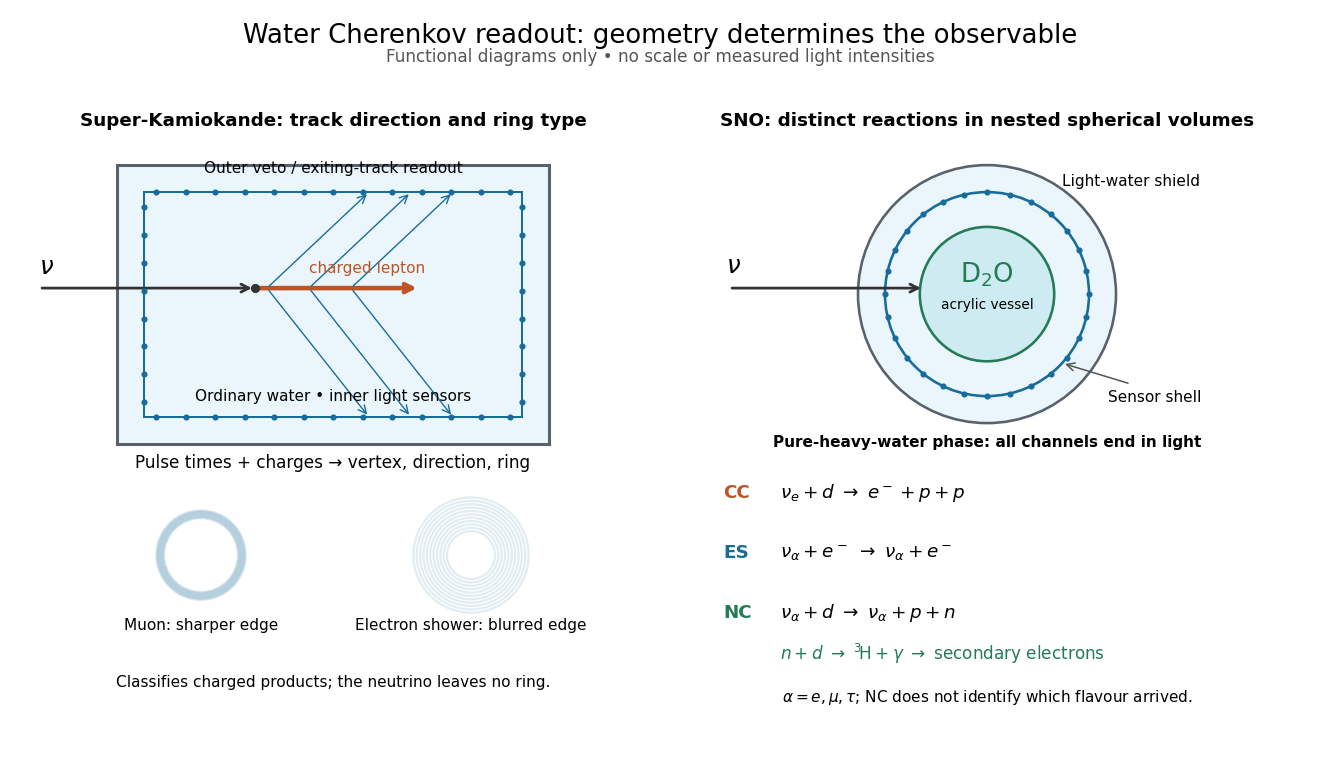
IceCube turns Antarctic ice into a Cherenkov detector: digital optical modules on strings span depths of –. Hot-water drilling allowed deployment before refreezing. Neutrino interactions produce charged particles; their Cherenkov radiation, rather than the incoming neutrino, supplies the optical readout.[ref]
Neutrino astronomy asks where the incoming neutrino originated. A Cherenkov detector asks how its reaction products make measurable light. Connecting these questions requires track reconstruction, detection efficiency and background tests. An astronomical messenger and the light carrying information inside the apparatus are different stages of one inference.
How can a detector establish that an unseen particle changes identity? The Super-Kamiokande atmospheric-neutrino experiment compares different travel paths; the Sudbury Neutrino Observatory compares different interaction channels. Both infer neutrino flavor from reaction products and calibrated responses. Their complementarity connects particle detection to neutrino oscillation, neutrino mass and neutrino astronomy.
Takaaki Kajita and Arthur B. McDonald shared the 2015 physics Nobel Prize. These were collaboration achievements: Yoichiro Suzuki's Super-Kamiokande work included the solar neutrino analysis, and George Ewan helped establish and lead the Sudbury Neutrino Observatory.[ref]
ICRR’s Takaaki Kajita to share Breakthrough Prize in Fundamental Physics by Institute for Cosmic Ray Research, University of Tokyo. Research contributions of Kajita and Suzuki; shared 2015 prize
[ref]https://www.queensu.ca/gazette/stories/queen-s-remembers-professor-emeritus-george-ewan/. 17 December 2020: founding and joint leadership of SNO
The older Kamiokande account explains water Cherenkov neutrino reconstruction; Raymond Davis Jr.'s Homestake experiment explains why a deficit in an electron neutrino channel alone leaves a source-versus-propagation ambiguity. Complementary channels can break that ambiguity.

Work by Chen Ning Yang Created 2026-10-18 Updated 2026-10-25
Work by Charles Thomson Rees Wilson Created 2026-10-18 Updated 2026-10-24
Work by Charles Louis Critchfield 2026-10-18
Work by Charles L. Bennett 2026-10-18
Work by Charles Kuen Kao Created 2026-10-18 Updated 2026-10-24
Work by Charles Hard Townes Created 2026-10-18 Updated 2026-10-24
Work by Charles Glover Barkla Created 2026-10-18 Updated 2026-10-24
Work by Charles-Édouard Guillaume 2026-10-18
Work by Charles Daniel Gelatt Jr. 2026-10-18
Work by Changhuei Yang 2026-10-18
Work by Chandrasekhara Venkata Raman Created 2026-10-18 Updated 2026-10-24
Work by Cesare Mansueto Giulio Lattes Created 2026-10-18 Updated 2026-10-24
Fetal bovine serum Created 2026-10-18 Updated 2026-11-05
Fetal bovine serum is the liquid fraction obtained after blood from bovine fetuses clots, used as a complex supplement for some cell cultures. It supplies a mixture of proteins, carrier molecules and growth-supporting components. Because it is a biological mixture, composition and growth effects can vary between lots. A result obtained in serum-containing medium therefore depends on a less chemically defined environment than one using individually specified components. [ref]
Animal Cell Culture Guide by ATCC. Media and supplements: sera and serum variability
Trypan blue exclusion test 2026-10-18
The trypan blue exclusion test reads cell membrane integrity through trypan blue exclusion. Prolonged dye exposure can itself increase staining.[ref]
An unstained biological cell is dye-excluding at the time of this assay. That observation alone does not demonstrate future division, sustained metabolism or long-term renewal of a cell line. Conversely, a smaller unstained count can reflect both staining and loss of biological cells from the recovered preparation. Report the denominator and recovery procedure alongside the fraction.
Hemocytometer 2026-10-18
An original constructed hemocytometer count uses four such squares after mixing the biological cell preparation with the same volume of stain. The dye-excluding counts are ; the dye-stained counts are . The dilution factor is . With the sampled volume per square and the arithmetic mean count per square,Hence the undiluted preparation has dye-excluding number density and total number density . Its dye-excluding fraction is . If the well-mixed preparation contains , it contains an estimated dye-excluding biological cells. The chamber sample itself contains only counted dye-excluding biological cells.
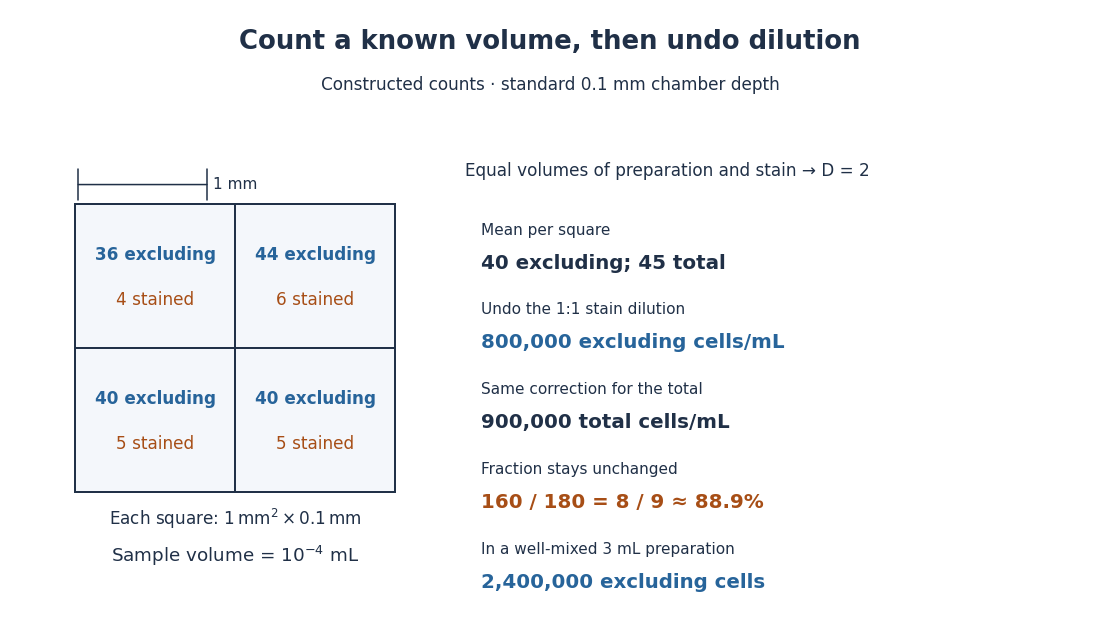

The relation follows from counting material in a known volume, then undoing dilution. It assumes a representative mixed sample and correctly identified single biological cells. Clumps, inconsistent decisions at grid edges, wrong chamber depth and nonrepresentative sampling introduce measurement error. A fixed convention such as including top and left edges while excluding bottom and right edges assigns shared-edge centers to just one square. Adding ten times as much suspension to a correctly filled chamber does not make each square's calibrated volume ten times larger.
Stellar orbit Created 2026-10-18 Updated 2026-11-05
A stellar orbit is a star's trajectory in the gravitational field of its surroundings. A close binary star can often be approximated by a Kepler orbit, while a star moving through a galaxy responds to an extended distribution of stars, gas and dark matter. Its path need not close into an ellipse.
Observed positions, proper motion and line-of-sight velocity constrain different components of the motion. Reconstructing an orbit also requires a distance and a model of the gravitational potential. Comparing many stellar orbits can therefore constrain an unseen mass distribution, but one projected track need not uniquely determine the full three-dimensional trajectory or potential.
Orbital energy Created 2026-10-18 Updated 2026-11-05
Orbital energy is the mechanical energy associated with relative motion and mutual attraction. In the isolated Newtonian two-body problem, let be the reduced mass, the separation and the relative speed. ThenDividing by gives specific orbital energy. With zero potential energy at infinity, negative gives a bound Kepler orbit, zero gives the parabolic limit and positive gives an unbound encounter.
For an elliptic orbit, with semi-major axis . Energy loss can therefore shrink a bound orbit, whereas a sufficiently large gain can unbind it. External forces or interactions with additional bodies invalidate conservation of the isolated pair's orbital energy.
There are unlisted articles, also show them or only show them.