
Binary system 2026-10-18
Two objects orbiting their common center of mass under their mutual gravity.
Orbital speed Created 2026-10-18 Updated 2026-10-24
Orbital speed is the magnitude of the velocity of an orbiting body in a specified reference frame. For a Newtonian circular orbit around a point source of mass , equating to gives . In a curved spacetime, a speed inferred from coordinate radius and coordinate time generally differs from a speed measured by a local observer. For a circular orbit in the Schwarzschild metric, a static local observer measures ; uses the clock normalization at infinity instead.
Work by Cecil Frank Powell 2026-10-18
Orthogonality of regular real and imaginary level curves Created 2026-10-18 Updated 2026-10-24
For a holomorphic function , the Cauchy-Riemann equations give the displayed gradient identities. Where , both level sets are regular curves; their nonzero normal vectors are perpendicular, so their tangents are perpendicular as well. The qualification is necessary. At a critical point both gradients vanish and the zero level sets may have several tangent branches. For at zero, consists of two diagonals while consists of the two coordinate axes; there is no general orthogonality assertion at that point.
Momentum balance for a material fluid element Created 2026-10-18 Updated 2026-11-05
For an inviscid material volume element, neglecting body forces, Newton's second law gives . Since mass conservation keeps constant, the result is . Cancelling before differentiating would incorrectly omit its changing volume. A fixed control volume instead requires the advected momentum flux, yielding .
Passing-base fraction for the Fermat test 2026-10-18
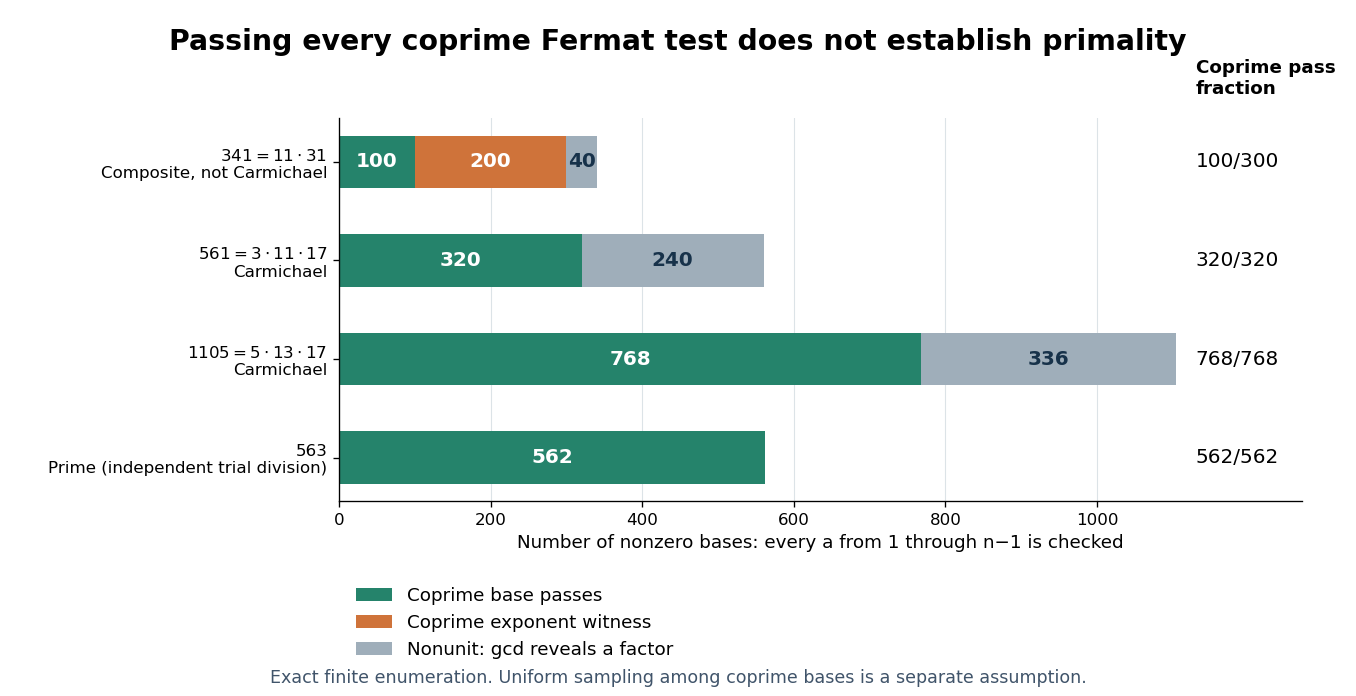
Among the units modulo , the passing residue classes form the kernel of a group homomorphism . If each trial samples independently and uniformly from those units, with replacement, the probability that trials all pass is . This statement assumes that sampling rule; it does not describe arbitrary or dependent choices of bases.
For , the Chinese remainder theorem identifies the unit group with cyclic groups of orders and . The number of solutions of is , among units. Thus . The Carmichael numbers and have passing fractions and , so their conditional false-pass probability remains one regardless of the number of independent trials.

Work by Carlo Rubbia 2026-10-18
Work by Carl Wieman 2026-10-18
Work by Carl Friedrich von Weizsäcker 2026-10-18
Work by Carl David Anderson 2026-10-18
Malic acid Created 2026-10-18 Updated 2026-11-05
Malic acid is a four-carbon dicarboxylic acid with one hydroxyl group. Its deprotonated form, malate, is an intermediate of the citric acid cycle.
Oxidation of malate to oxaloacetate couples a change in the carbon skeleton's functional groups to reduction of NAD+. The reaction illustrates why protonation state and oxidation state are separate aspects of a metabolite's identity.[ref]
The citric acid cycle by Hans Adolf Krebs. Table 1, malic and oxaloacetic acids
Carboxylate 2026-10-18
Trichloroacetic acid 2026-10-18
Trichloroacetic acid is a chlorinated carboxylic acid, used for protein precipitation in the Nirenberg and Matthaei experiment.
Lactic acid Created 2026-10-18 Updated 2026-11-05
Lactic acid is 2-hydroxypropanoic acid, . Its central carbon is a stereogenic centre, and its conjugate base is lactate.
In lactic acid fermentation, reduction of pyruvate to lactate regenerates NAD+ from NADH. That regeneration allows glycolysis to continue when the pathway cannot rely on sufficiently rapid respiratory oxidation of NADH.
Phosphoenolpyruvic acid Created 2026-10-18 Updated 2026-11-05
Phosphoenolpyruvic acid is the acid form of phosphoenolpyruvate, a phosphorylated enol derivative of pyruvic acid. Its phosphate group is attached through oxygen to the enol system.
In glycolysis, transfer of that phosphate group to ADP forms ATP and pyruvate. Conversion of the initial enol product into the more stable keto form helps favour the overall reaction, connecting molecular rearrangement with energy transfer.
Oxalic acid Created 2026-10-18 Updated 2026-11-05
Oxalic acid is the simplest dicarboxylic acid, with structure . Stepwise loss of two protons gives hydrogen oxalate and then oxalate.
Oxalic acid combines acid-base chemistry with metal-ion binding. Some oxalate salts have low solubility, so the behaviour of an oxalate-containing system depends on both pH and the available metal ions.
Graphene Created 2026-10-18 Updated 2026-10-20
Graphene is a single layer of carbon chemical atoms arranged in a honeycomb lattice. A nearby gate can select predominantly electron or electron hole conduction, as demonstrated by the graphene exfoliation and field-effect experiments.[ref]
Electric Field Effect in Atomically Thin Carbon Films by Konstantin Novoselov and others. pp.1–2, mechanically cleaved films, gate and Hall response
A useful question is how geometry changes motion. The nearest-neighbour model of graphene starts with three equivalent bonds from each site and two sites per primitive cell. Interference between those three hopping paths makes two energy bands meet; near their meeting, energy grows linearly with distance in wave vector. The resulting Dirac cones explain why an atomic sheet can imitate one aspect of a relativistic particle while remaining an ordinary material with contacts, defects and boundaries.
Diamond Created 2026-10-18 Updated 2026-11-05
Diamond is an allotrope of carbon with a three-dimensional tetrahedral covalent network. The connected structure gives high hardness and distinguishes it from layered graphite.
Diamond can transport heat well while remaining an electrical insulator in a sufficiently pure form, because heat transport and charge transport have different microscopic carriers. Defects and impurities can introduce optical or electronic features without changing the host material's basic identity.
Carbon-14 Created 2026-10-18 Updated 2026-10-31
Carbon-14 has six protons and eight neutrons. Atmospheric production is dominated by using secondary cosmic ray neutrons. It undergoes beta-minus decay to nitrogen-14, with a physical half-life of approximately years.
MOS capacitor Created 2026-10-18 Updated 2026-10-20
A gate, insulating oxide and semiconductor form a capacitor. Applied electric potential difference changes the near-surface distribution of charge carriers.
There are unlisted articles, also show them or only show them.