
Past exam of the mathematics course of the University of Cambridge 2010 iii Paper 2 4 Solution 2026-10-14
The finite representation type of a quiver condition means there are only finitely many isomorphism classes of indecomposable finite-dimensional -modules. Equivalently, every finite-dimensional module is a direct sum of members of a finite list of indecomposables.
For the case, we give the reflection argument underlying the Gabriel theorem, rather than using its conclusion as the proof. Since the underlying graph is a tree, every orientation is acyclic. At a sink , writefor the sum of the incoming arrow maps. If an indecomposable is not the simple , then is surjective: a nonzero complementary subspace to its image at the sink would be a direct summand supported only at . The Bernstein–Gelfand–Ponomarev reflection functor reverses the arrows and replaces by , with reversed maps the component projections. The source reflection replaces that kernel by the cokernel of its inclusion into , recovering . The inclusion is injective, so the reflected representation has no direct summand at the new source. If it decomposed, applying the inverse would decompose . Thus reflection preserves indecomposability except that it annihilates .
On a dimension vector of a quiver representation, it acts by the integral simple reflectionLet . These reflections preserve the positive-definite quadratic form . Positivity can be checked without a classification theorem: label the graph by the chain and attach vertex to . The leading principal minors are , all positive.
Choose a topological ordering so arrows point from smaller to larger indices. Reflect successively at sinks . This restores the orientation after one full cycle. The transformation of dimension vectors is the Coxeter element . If has diagonal entries one and entry above the diagonal at an arrow, direct multiplication of the reflection matrices givesThus has no fixed vector. It is an integral isometry of a positive definite form, so it has finite order : the image of each lattice basis vector lies in a finite set of vectors of the same norm, giving only finitely many possible isometries. Since and is invertible,If an indecomposable survived all reflection cycles, its dimension vectors would all be nonzero and componentwise nonnegative, contradicting their zero sum. Therefore it reaches a simple at one of the finitely many reflection steps and is then annihilated. Applying the inverse reflections uniquely reconstructs it from that simple. There are at most such stopping positions, provingThis supplies the requested finite-type proof sketch.
Past exam of the mathematics course of the University of Cambridge 2010 iii Paper 19 5 Solution 2026-10-14
Sunada's theorem states that if a finite group acts isometrically on a closed Riemannian manifold , and two Gassmann equivalent subgroups act freely, then and are isospectral for the function Laplace-Beltrami operator. Gassmann equivalence means for every conjugacy class of . For each Laplace-Beltrami operator eigenspace , its invariant subspace has dimensionThe character of a representation is a class function, so the two multiplicities agree. A necessary condition for nonisometry is that the subgroups are not conjugate in : conjugation by an ambient deck transformation would induce an isometry. This is not sufficient when the common covering has additional geometric symmetries.
Use the oriented hyperbolic triangle groupand the epimorphism given by , . Its base orbifold is the doubled hyperbolic triangle with angles , having signature . Let and .
The groups are torsion free. Indeed, torsion elements in an oriented triangle group are conjugate to nontrivial powers of its three vertex rotations. Such powers map either to elements of order three, which cannot lie in a subgroup of order , or to the order-two cube . The latter is central and absent from both , so it is absent from every conjugate as well. Thus the degree-twelve orbifold coversare smooth, closed, connected orientable surfaces. The common cover is smooth too; act freely on it. Orbifold Euler characteristic givesFor example, this formula follows by triangulating the base and weighting a vertex of order by before multiplying by the cover degree. Equivalently, each doubled triangle has hyperbolic area , so has area and Gauss-Bonnet theorem gives the same genus.
There is one extra issue in obtaining the same hyperbolic limit on a single marked surface: the two limiting hyperbolic covers must themselves be isometric. Nonconjugacy and the displayed element orders alone do not prove this. An explicit realization of the supplied example resolves the issue. The group seed is recorded in the original genus-two construction; the following coset actions and reflection identities give a direct verification. Label the twelve sheets so that the two right-coset actions of areThese are concrete permutation data for an order- realization with the required two subgroups. The permutationsatisfies, by direct substitution,Reflection of the doubled triangle reverses both vertex rotations. Apply this reflection on every fundamental domain and relabel sheets by . The two identities ensure that identified edges go to identified edges, so this descends to a hyperbolic isometry . Fix , let be its hyperbolic metric, and use to mark by the same smooth surface. Thus both pulled-back limiting Riemannian metrics are exactly . The explicit reversed-action check is what makes the common limit justified, rather than treating it as a consequence of Sunada's theorem.
Choose smooth orbifold Riemannian metrics on the base converging to its hyperbolic metric , with no nonidentity local isometry on the regular part. The density assertion in Sunada's local isometry lemma applies in orbifold charts as well: use equivariant perturbations at the finitely many cone points and ordinary local perturbations elsewhere. Smoothness here is orbifold smoothness, so the lifted Riemannian metrics on and the two smooth covers are ordinary smooth Riemannian metrics. Such choices can be made in successively smaller smooth neighbourhoods of ; cone orders and the topological coverings stay fixed.
For area separation of convergent Sunada families, adjust each by a constant positive factor so thatExplicitly, multiply the initially chosen Riemannian metric by the ratio of the desired area to its actual area. In dimension two this ratio is exactly the area multiplier. The ratios tend to one, so smooth convergence persists, and constant scaling preserves the absence of local isometries. Lift these adjusted Riemannian metrics to and pull them back by the fixed markings to obtain , for . The three required properties follow below.
Past exam of the mathematics course of the University of Cambridge 2010 iii Paper 16 2 Solution 2026-10-14
A proper morphism of schemes is a separated morphism of finite type which is a universally closed morphism: after every base change, the resulting map of underlying topological spaces takes closed subsets to closed subsets.
The valuative criterion for properness, in the Noetherian setting used here, says that a finite type morphism is a proper morphism if and only if the following existence and uniqueness condition holds. For every valuation ring , its fraction field , and compatible morphisms of schemes and with , there is exactly one morphism of schemes such that and . All valuation rings are allowed; no discreteness assumption is needed in this formulation. The following arguments also use that each of the three defining conditions for a proper morphism is preserved by base change.
Past exam of the mathematics course of the University of Cambridge 2010 iii Paper 15 2 Solution 2026-10-14
A smooth rank- vector bundle over a smooth manifold consists of a smooth total space , a smooth projection , and an -dimensional real vector space structure on each fibre . Each point has a neighborhood with a vector bundle trivializationthat is a diffeomorphism, commutes with projection to , and is a linear isomorphism on every fibre. The overlap maps have the form with smooth. For a complex vector bundle, replace by and require complex-linear fibre maps.
A connection on a vector bundle is an -linear mapwhere is the module of smooth sections, consists of vector-bundle-valued differential forms of degree one, and is a smooth function. Equivalently, evaluating on a vector field gives operators with and . A connection on a vector bundle is local: its value at a point depends on the germ of the section of a vector bundle, so the same definition applies to local sections.
Past exam of the mathematics course of the University of Cambridge 2010 ii Paper 4 37A Solution 2026-10-14
For axisymmetric incompressible flow without swirl, the Stokes streamfunction satisfiesSubstitution into the divergence in spherical coordinates makes incompressibility an identity. Its only vorticity component isTaking the curl of the Stokes equation eliminates pressure and gives . For an axisymmetric azimuthal vector, its scalar component obeys . Direct differentiation verifiesApply this to to obtain
Past exam of the mathematics course of the University of Cambridge 2010 ii Paper 3 17F Solution 2026-10-14
Take a uniformly random ordering of the vertices and select each vertex that precedes every neighbor. The selected set is independent: if two adjacent vertices were both selected, each would have to precede the other. Among the vertices consisting of and its neighbors, each is equally likely to come first, so the selection probability is . Linearity of expectation gives expected size . At least one ordering attains at least this average; its integer size is therefore at least the ceiling. This proves the Caro-Wei bound
Past exam of the mathematics course of the University of Cambridge 2010 ii Paper 3 11G Solution 2026-10-14
The Miller-Rabin primality test first handles as prime and or even as composite. For odd , write with odd and choose a base . A nontrivial proves compositeness. Otherwise compute : the round passes if or . If neither holds, square successively, at most times, and pass if a value occurs; otherwise declare composite. An occurrence of before exhibits a nontrivial square root of one and is also a failure. For prime , Fermat's theorem and the fact that a field has only the square roots force a pass. The standard strong-liar bound says that an odd composite passes for at most one quarter of the bases; independent random rounds therefore have error probability at most after rounds. Passing is a probable-prime verdict, not a proof of primality. A Fermat pseudoprime is composite and passes ; a strong pseudoprime is composite and passes the stronger round above.
Past exam of the mathematics course of the University of Cambridge 2010 ii Paper 2 1G Solution 2026-10-14
For an odd prime number and an integer not divisible by , the Legendre symbol is if is a quadratic residue modulo , and otherwise. One may extend it by when .
Past exam of the mathematics course of the University of Cambridge 2010 ii Paper 2 19F Solution 2026-10-14
If a group representation of has character , its restriction of a representation to has character . For an -representation with character , the induced representation is , with acting on the first factor. Decomposing into coset copies of shows that its character isIndeed only cosets fixed by contribute to the trace, and each coset has representatives.
The Frobenius reciprocity says . Directly, with the usual character inner product,The first equality substitutes in the finite sum, and the second uses conjugacy invariance. This proves the theorem.
Past exam of the mathematics course of the University of Cambridge 2010 ii Paper 2 17F Solution 2026-10-14
A matching in a graph from to chooses one distinct neighbour in for each vertex of . For a finite bipartite graph, the Hall marriage theorem states that such a matching exists if and only if for every . Necessity follows because the matched neighbours of are distinct members of .
For sufficiency use induction on , with the empty and one-vertex cases immediate. If some nonempty proper satisfies , the induced graph on satisfies Hall's condition. The remaining graph on does too: for ,Inductively match both pieces and combine them. If no nonempty proper subset is tight, choose an edge and remove its endpoints. Every nonempty subset of the remaining is proper in the original , so ; removing preserves Hall's condition. Match the remainder inductively and add . This proves the theorem without a flow or disjoint-path theorem.
Past exam of the mathematics course of the University of Cambridge 2010 ii Paper 1 37A Solution 2026-10-14
For a constant-density incompressible fluid, the Navier-Stokes equation and incompressibility constraint areScale length by , velocity by , time by and pressure by . In dimensionless variables they becomeA rectilinear flow has velocity , parallel everywhere to one fixed direction and independent of that direction. Its convective acceleration is identically zero. A steady such flow therefore satisfies the linear equation , with no inertial term and no Reynolds-dependent change of equation or spatial shape for fixed scaled boundary/forcing data. Relative changes in imposed pressure forcing can of course change the profile; Reynolds independence is not independence of the boundary data.
Past exam of the mathematics course of the University of Cambridge 2010 ia Paper 4 10B Solution 2026-10-14
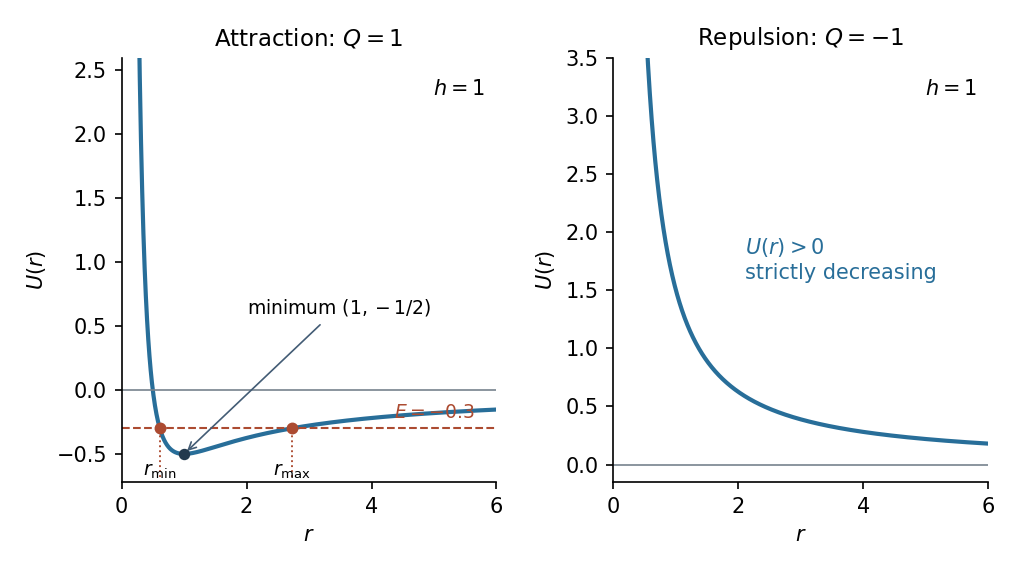
For the inverse-square potential , the central force is . The transverse component of acceleration in polar coordinates is therefore zero:Thus ; for unit mass it is the signed angular momentum perpendicular to the orbital plane. The radial component givesConsequentlyThis is the mechanical energy, since the full kinetic energy is and .
For and , the effective potential goes to as and to zero from below as . Its derivative is , so it decreases up to and then increases. Its zero and minimum areFor , is positive and strictly decreasing, with limits at zero and at infinity. It has no minimum at a finite positive radius.

There are unlisted articles, also show them or only show them.