
Semisimple linear operator Created 2026-10-14 Updated 2026-11-05
A linear operator is semisimple if it becomes diagonalizable over an algebraic closure; equivalently, its minimal polynomial has no repeated root over that closure. If an invertible operator has finite order prime to the characteristic of a field, its minimal polynomial divides . The derivative is coprime to this polynomial, so is semisimple. Its invariant irreducible summands over a finite field become multiplication by scalars in suitable finite field extensions.
Maxwell cantilever creep 2026-10-14
For a quasistatic beam made of a two-element series Maxwell material, . A force step therefore produces an instantaneous elastic deflection followed by unbounded linear creep, as displayed. It cannot have the finite long-time plateau of a Kelvin-Voigt cantilever creep response; a solid with finite relaxed modulus requires an additional elastic element.
Maxwell start-up shear layer Created 2026-10-14 Updated 2026-11-05
For a half-space initially at rest and a wall given a step velocity , momentum conservation and the Maxwell fluid stress law give . The displayed decaying Laplace transform solution obeys the wall condition. Inverting on a right-half-plane Bromwich contour yields a shear signal of speed . The limit at fixed gives viscous error-function penetration; at fixed gives a sharp elastic front.
Oscillatory channel flux of a linear Maxwell fluid Created 2026-10-14 Updated 2026-11-05
For a no-slip channel with half-width , a harmonic pressure gradient and complex viscosity , put . Solving gives ; integration gives the displayed flux per unit width. At low frequency it approaches . At fixed positive , the high-frequency leading flux is , although shear waves can persist in the local profile. If instead while , the negligible-inertia elastic limit is . The last two limits impose different scale orderings.
For dust, curvature and a constant cosmological constant, write . Then and , which imply . Thus is a solution of the pressureless linear matter perturbation growth equation. In an Einstein-de Sitter universe, is the decaying mode and the independent growing mode is . Additional dynamical components need not preserve this identity.
Use a monotone linear growth factor as time, , and with and . The cosmological Poisson equation becomes ; the continuity equation becomes . The material derivative is . Substitution into the pressureless cosmological Euler equation, followed by the growth equation and , proves the displayed motion equation, with . The density derivative in the conservative continuity equation is Eulerian, not material.
Filter gain 2026-10-14
For an absolutely summable linear filter of a stationary time series, the filter gain is the modulus of its frequency response . It multiplies a sinusoidal amplitude, while its square multiplies the spectral density of a stationary process. A zero removes the corresponding frequency; the filter gain of a composition is the product of the two filter gains.
Two absolutely summable linear filters of a stationary time series compose by convolution: and . Absolute convergence in the space of square-integrable random variables justifies exchanging the sums. The frequency responses multiply, giving the spectral density transformation under a linear filter twice.
Filter generating function 2026-10-14
For absolutely summable linear-filter coefficients, the generating function is the displayed Laurent series, absolutely convergent on the unit circle. If the filter is one-sided, it is a power series analytic inside the unit disk. A two-sided filter need not have a nonempty larger annulus of convergence. Substituting the backshift operator gives the formal notation .
Linear relation 2026-10-14
A linear relation among vectors is a coefficient tuple satisfying . It is nontrivial if at least one coefficient is nonzero. For the matrix with these vectors as columns, the space of relations is its kernel. The vectors are linearly independent exactly when this kernel is zero. An invertible change of coordinates preserves every relation, since if and only if .
Consider the vectors in the complex numbers, where is the imaginary unit. With scalar field , a linear relation has . Taking its real part and imaginary part gives , so the pair is linearly independent. Every complex number also has coefficients in the real numbers, so form a basis and the dimension of a vector space is two.
With scalar field , the same pair is linearly dependent, sinceuses the nonzero coefficients from the complex numbers. The single vector is now a basis, because for every complex number , giving dimension of a vector space one. For example : the second representation uses a coefficient unavailable over the real numbers. Specifying the field is part of the definition of linear independence.
On with a homogeneous wall condition, positive diffusion and growth , remove constant drift by . The scale reduces the eigenvalue problem to the Airy ordinary differential equation. Decay selects , where enforces the wall. The least negative zero sets the global instability threshold . A locally absolutely unstable pocket can therefore exist without an unstable global mode.
Trivial character 2026-10-14
The trivial character takes the value on every group element and is afforded by the one-dimensional trivial representation.
With instantaneous photon decoupling and tight-coupling initial brightness, integrate the synchronous photon brightness equation along the unperturbed ray . The direction here is photon propagation, opposite to the observer-to-source sky direction. Emission terms are evaluated at the emitter, not the observer. The synchronous metric integral combines endpoint gravitational redshifts and evolving-potential effects when expressed in Newtonian gauge; it is not solely the Integrated Sachs-Wolfe effect.
// Target: cosmology.bigb
Matter-era photon endpoint solution Created 2026-10-14 Updated 2026-10-20
In the negative-spatial-perturbation convention, a matter-era scalar solution gives the displayed exact photon brightness perturbation. Integration gives emission bracket times the propagation phase, plus observer monopole and dipole . Under ordinary adiabatic growing-mode initial conditions and , the emission gravitational term dominates higher angular multipoles. Arbitrary freely specified initial brightness need not obey this dominance.
Lyapunov condition Created 2026-10-14 Updated 2026-11-05
For independent centered random variables with total variance , the Lyapunov condition requires the displayed expression to tend to zero for some . The inequality implies the Lindeberg condition after normalization. The Lindeberg-Feller central limit theorem then makes the normalized sum converge to the standard normal distribution.
Conditional lognormal layer recovery 2026-10-14
For a lognormal distribution, let for . The truncated lognormal moment formula gives the recovery numeratorDivide by to condition on . This handles both the partially penetrating claims and the capped payments beyond the upper attachment.
Sparse peaks can determine a limit superior 2026-10-14
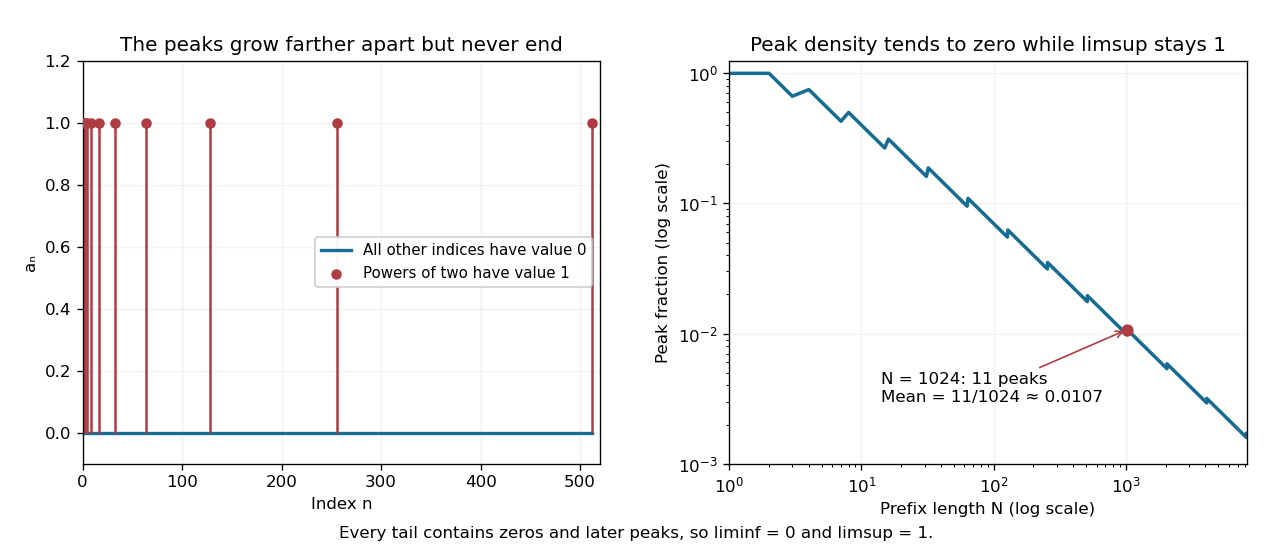
Define a sequence by when is a power of two, including , and otherwise. Every tail of a sequence contains both a later power of two and a later nonpower. Therefore and , and the sequence does not converge. Its peak indices become increasingly sparse, yet never stop appearing.
Through index , the number of peaks is , so their fraction isThe set of powers of two has natural density zero. The same fraction is the Cesàro mean of the first terms, which tends to zero even though the limit superior stays one. At , eleven peaks give mean . An average and a long-run upper edge answer different questions about the same sequence.

A full and faithful functor reflects every existing shape of categorical limit. If the image of a cone is limiting, apply its universal property to the image of any competing cone. Fullness lifts the unique mediating morphism; faithfulness proves the cone equations and uniqueness of the lift. No essential-surjectivity hypothesis is needed.
If has finite categorical limits, every functor preserving pullbacks in a category also preserves equalizers, even when it does not preserve a terminal object. Factor it through the slice category by sending to . This lifted functor preserves pullbacks because the slice forgetful functor reflects them; it also preserves the terminal object, so it preserves finite limits. The slice forgetful functor preserves equalizers, completing the proof.
There are unlisted articles, also show them or only show them.