
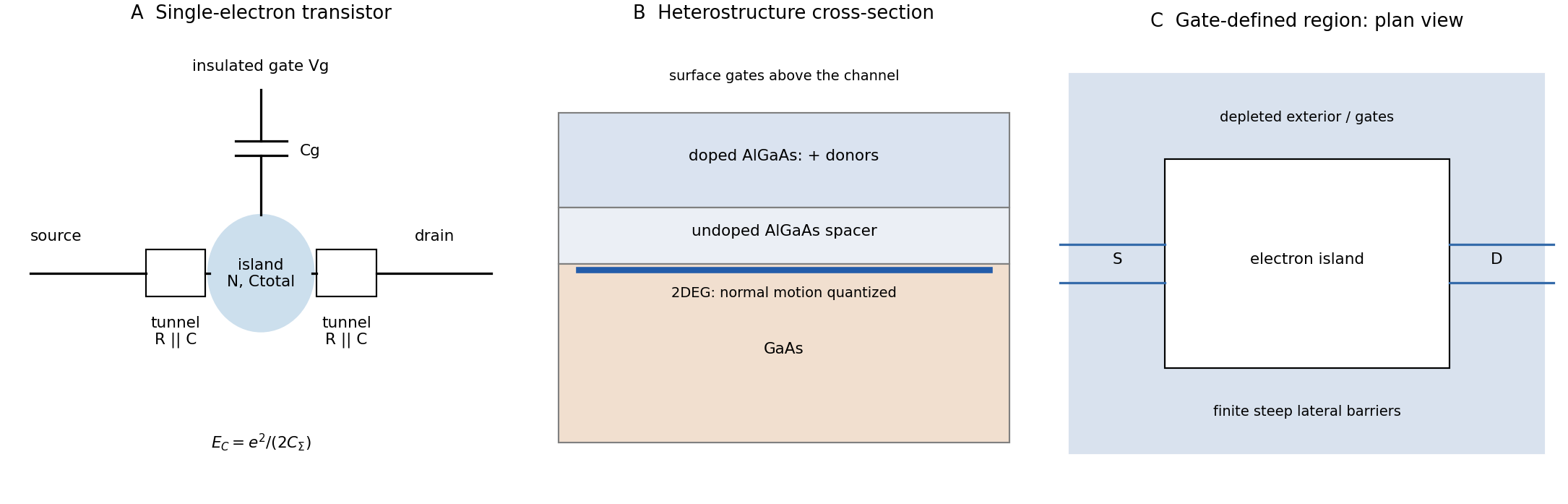
A gallium arsenide/aluminium gallium arsenide semiconductor heterostructure combines lower-gap GaAs with a higher-gap AlGaAs barrier. In a modulation-doped design, AlGaAs donors supply electrons to lower conduction-band states on the GaAs side. An undoped spacer separates the channel from ionized donors and reduces impurity scattering. The interface barrier and band bending quantize motion normal to the interface while allowing in-plane motion: a two-dimensional electron gas.
The normal confining potential is commonly triangular and finite rather than an infinite square well. At suitable density and low temperature, only the lowest normal subband is occupied. modulation doping reduces an important scattering source; it does not eliminate all disorder.
Use negatively biased surface gates to deplete the surrounding electron gas and leave a rectangular central region. Gate voltage controls lateral dimensions and barrier heights. Two constrictions can weakly couple the region to reservoirs, with a plunger gate controlling population. Etched boundaries are possible but may introduce edge disorder. A flat interior and steep edges approximate a box, givingFringing fields, finite barriers and penetration change the ideal result. A 2DEG confines only the normal direction; gates supply the extra lateral confinement. Gate-dependent spectroscopy can test level spacings, while charging measurements separate orbital confinement from Coulomb blockade.
An isolated nanometre-sized island has small total capacitance , so discrete charge carries appreciable charging energy. A simple constant interaction model isAway from charge degeneracy, adding or removing an electron costs more energy than a sufficiently small thermal/bias window supplies. Coulomb blockade suppresses sequential tunnelling between resolved charge states.
A single-electron transistor has source and drain reservoirs connected to an island through two tunnel junctions, plus an insulated capacitive gate. Each junction has resistance and capacitance; the gate shifts electrostatic energies without carrying the transport current. The original device schematic labels all components.
Require , a source–drain window below the relevant transition, and junction resistances well above to suppress strong quantum charge fluctuations. Electromagnetic noise and lifetime broadening must also be small. Gate-induced charge degeneracy permits conduction even at small bias; there is no gate-independent blockade threshold. Resolving orbital levels additionally requires temperature and broadening below their spacing between energy levels.
The infinite exterior potential enforces outside . Within the well,The boundary conditions give and , with . Since , normalization givesThese functions vanish outside the well. The ground state has energy and one density maximum at . The first excited state has energy , a central node, and maxima at . The second excited state has energy , nodes at , and maxima at .
There is no normalized state: that choice gives the zero function. The original wells figure shows all three wavefunctions and probability densities. An arbitrary overall wavefunction sign does not affect the probability distribution.
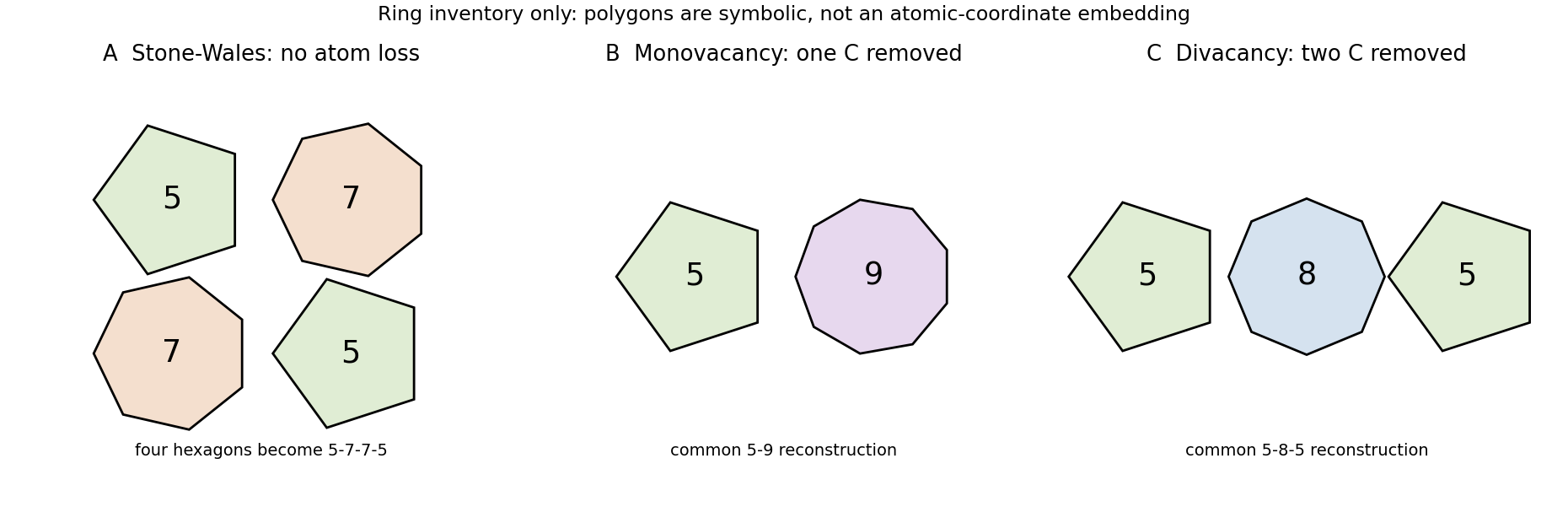
Three point-defect structures are a Stone-Wales defect, a reconstructed graphene monovacancy and a reconstructed graphene divacancy. The original sketch gives ring inventories rather than fitted atomic coordinates.
A Stone-Wales defect rotates one C–C bond, converting four hexagons into a 5–7–7–5 group without changing the number of atoms. A graphene monovacancy removes one carbon; a common reconstruction gives a 5–9 group with residual under-coordination. A graphene divacancy removes two adjacent carbons; a 5–8–5 reconstruction can eliminate dangling bonds. Other divacancy reconstructions exist, so atom loss does not uniquely select one topology.
Irradiation, energetic processing, etching and incomplete growth can create vacancies; thermally or beam-activated bond rearrangement can change their structures. Electron microscopy itself can create defects, so compare exposures before attributing a time sequence to unperturbed material.
Pentagons favor positive curvature and heptagons negative curvature. Such defects can bend tubes, help form caps or junctions, or change a local wrapping relationship. They scatter carriers and alter the local density of states; vacancies can add localized states and chemical reactivity. Whether a clean band gap appears depends on defect identity, concentration and arrangement, not merely on the presence of a defect.


A zero-dimensional example is buckminsterfullerene, : a closed cage with 60 vertices, 90 edges, 12 pentagons and 20 hexagons. Euler's relation is . Each carbon has three neighbors in a curved, approximately -bonded network; bonds are not all equivalent. Its cage diameter is of order .
Confinement in all directions gives discrete molecular orbitals, unlike the extended dispersion of graphene. It is an electron acceptor with characteristic electronic and vibrational spectra. Its pentagons supply the positive curvature needed to close the carbon network. A molecular solid of cages is held together predominantly by intermolecular forces, so its mechanical and electrical properties differ from those of an individual strongly bonded cage. Undoped fullerene is not a high-conductivity graphene sheet; doping, packing and charge transfer can strongly change transport.
With ,Hydrophobicity requires , henceEquality is the boundary. A smooth-solid angle between about and can therefore become apparently hydrophobic if the suspended state persists.
For general , the criterion is . For , the threshold is , reaching at . For , all satisfy it, with marginal. For , the ideal equation predicts hydrophobicity for every original angle; formally as .
These conclusions require retention of gas beneath the liquid. On intrinsically wettable textures the Cassie–Baxter state can be metastable. Pressure, condensation or defects may trigger invasion; penetration tests and contact-angle hysteresis distinguish that failure from the ideal suspended state. Roughness alone does not guarantee stable water repellency.
Advance the projected contact line by per unit transverse length without wetting the gaps. A fraction converts solid–vapor interface into solid–liquid interface, contributing . The remaining fraction creates liquid–vapor interface above trapped gas, costing . The outer droplet surface contributes . ThusSubstituting Young's equation givesThis is the ideal Cassie–Baxter state relation. Its is projected solid-contact fraction, not the roughness factor of Wenzel wetting. A suspended interface over the gaps is essential; invasion of the texture changes the area bookkeeping.
At a straight contact line, take forces per unit transverse length and measure the contact angle through the liquid. Solid–vapor surface tension pulls outward along the solid, solid–liquid surface tension pulls inward, and the liquid–vapor force has horizontal component . Tangential equilibrium givesThis is Young's equation. The substrate supplies the normal reaction balancing the vertical capillary component. The original force sketch labels directions at a right-hand contact line. The result assumes smooth, chemically uniform, rigid surfaces in partial-wetting equilibrium, with negligible pinning and line tension.
There are unlisted articles, also show them or only show them.