
An alkaline zinc-air battery combines a porous Zn negative electrode, aqueous KOH, an ion-permeable separator and a gas-diffusion positive electrode. At discharge, oxygen is reduced at the air electrode:Zinc oxidation can be written , followed by ZnO precipitation and hydroxide regeneration. The net reaction is .
High energy requires high accessible Zn loading and low inactive mass; high power requires short ion paths, good electronic conduction and a large catalytically active gas/electrolyte/electron interface. A porous hydrophobic gas-diffusion layer admits oxygen while controlling electrolyte flooding and drying. Zn morphology and electrolyte composition must avoid premature passivation, excessive corrosion and hydrogen evolution; atmospheric CO2 can carbonate the alkaline electrolyte. A very high loading can impair transport, so energy and power must be optimized together.
Electrical recharge is possible, but is not guaranteed by a primary Zn-air design. It requires reversible Zn deposition with controlled morphology and an oxygen electrode that can evolve oxygen efficiently without rapid catalyst or support corrosion. Dendrites, shape change, ZnO redistribution, gas evolution and large oxygen-reaction overpotentials limit cycling. Bifunctional oxygen catalysts, or separate oxygen-reduction and oxygen-evolution electrodes, help. Mechanical replacement of spent Zn is a different form of refuelling.[ref]
Phase-transition tailored nanoporous zinc metal electrodes by Liangyu Li and others. Demonstration of rechargeable alkaline Zn-air electrodes and transport/passivation limitations
A lead-acid battery is suitable. Its positive electrode reduces PbO2 to PbSO4 and its negative electrode oxidizes Pb to PbSO4. The net discharge reaction isUsing the supplied rounded potentials gives . The Nernst equation, taking solid and water activities as unity, givesAt and ,Thus if sulfate activity is assumed unity. The pH alone does not specify sulfate activity, particularly where bisulfate formation and nonideal concentrated acid matter; without that assumption the numerical voltage is underdetermined.
For recharge, reverse both electrode reactions without irreversible loss of active material. Use porous, electronically connected Pb and PbO2 on acid-compatible conducting grids, with enough pore volume for PbSO4 formation and electrolyte transport. Fine, reversible sulfate deposits are desirable; coarse persistent crystals cause sulfation. The separator must remain acid-resistant, electronically insulating and permeable to electrolyte ions while preventing shorts; selective ion exchange is not intrinsically required. A compatible lead-alloy grid is preferable to assuming any metallic substrate survives the positive electrode's oxidizing acidic environment. Control current and charging voltage to limit hydrogen evolution, oxygen evolution, water loss, corrosion, heating and active-material shedding. Nickel hydroxide-based alkaline electrodes are poor choices in this acidic electrolyte because their phase stability and reaction conditions differ from those of their tabulated alkaline half-reactions.
For a spherical liquid droplet, the Kelvin equation isHere , soThe formal answer is about . At molecular dimensions, bulk surface tension, incompressible-liquid and continuum curvature assumptions are only approximate. There is one liquid-vapour interface here, unlike a soap bubble's two interfaces.
Tune doping to the optimum carrier concentration; a rise in conductivity is useful only if it outweighs the accompanying loss of thermopower and extra electronic heat conduction. Band convergence, favourable density of states and energy-dependent transport can improve the power factor , provided mobility is retained.
Reduce lattice thermal conductivity through alloy disorder, heavy or complex unit cells, grain boundaries and nanoscale inclusions that scatter phonons. Aim to scatter heat-carrying phonons much more strongly than charge carriers; indiscriminate disorder can reduce both thermal and electrical conductivity. Nanostructuring and interfaces can therefore help, but an improvement must be demonstrated in total at the operating temperature, not inferred from lower alone.[ref]
Complex thermoelectric materials by G. Jeffrey Snyder and Eric S. Toberer. Strategies for improving electronic transport and reducing lattice heat conduction
At low carrier concentration, can be large but electrical conductivity is too small. Increasing the carrier concentration usually increases , while decreases. Electronic thermal conductivity rises approximately as by the Wiedemann-Franz law; lattice conduction supplies an additional background. Thus neither an insulator nor an ordinary metal usually maximizes .
Heavily doped semiconductors and semimetals often give the useful compromise, near a maximum of as doping is varied. The optimum is material- and temperature-dependent; there is no universal optimal concentration.
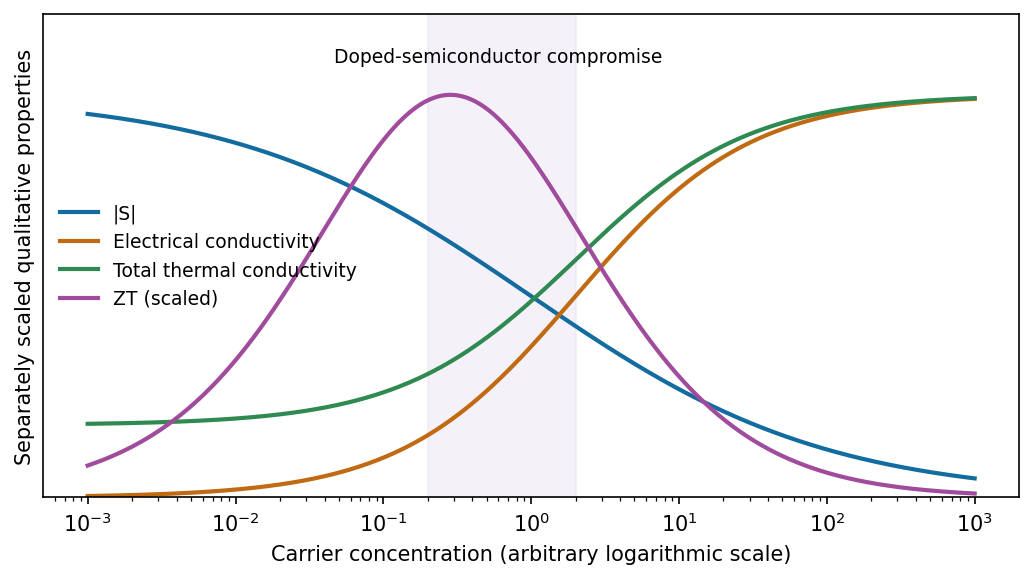

[ref]
Complex thermoelectric materials by G. Jeffrey Snyder and Eric S. Toberer. Carrier-concentration trade-off and thermoelectric optimization
The Seebeck effect produces an open-circuit voltage when a material has a temperature gradient: for the stated sign convention. A circuit containing dissimilar thermoelectric legs converts this into useful voltage and current. The intrinsic thermoelectric figure of merit isHere is electrical conductivity and total thermal conductivity. has units ; is dimensionless. A large Seebeck coefficient and electrical conductivity, together with low thermal conductivity, favour efficient conversion.
There are unlisted articles, also show them or only show them.