
Enthalpy of activation 2026-10-14
The standard molar enthalpy difference between the transition state and the starting reactants, at the same temperature and pressure, in transition state theory.[ref]
GHZ contradiction for N congruent to 3 modulo 4 Created 2026-10-14 Updated 2026-10-25
For , let have one Pauli X gate at site and Pauli Y gates elsewhere, and let . The relations , show that is proportional to exactly when is odd. In that case its eigenvalue is , while always has eigenvalue .
Under the EPR criterion of reality and locality, each site's and outcomes have predetermined values . Multiplying the certain equations gives when is odd, since every appears an even number of times. This contradicts the certain quantum value precisely when . Thus the displayed GHZ state gives an infinite family of perfect-correlation contradictions with local hidden-variable theory, without an inequality.
Thurston geometry Created 2026-10-14 Updated 2026-11-05
The eight Thurston geometries are the simply connected, three-dimensional homogeneous model spacesThe first three have constant positive, zero and negative sectional curvature. The product models and the three remaining Lie-group models allow additional locally homogeneous metrics. A complete geometric structure is a quotient of the entire model by a discrete freely acting group of isometries.
Compatible model charts define a local geometric structure; to recover a quotient of the entire model one also needs completeness. An open unit ball with its usual Euclidean metric has compatible Euclidean charts but is incomplete, since a radial geodesic reaches its missing boundary in finite length. This distinguishes local coordinate geometry from a complete geometric piece in the geometrization theorem.
Geometrization conjecture 2026-10-14
Every closed orientable three-manifold admits a prime and torus decomposition into pieces modeled on the eight Thurston geometries. In particular, a closed irreducible orientable three-manifold with fundamental group carries a flat metric. The Bieberbach theorem then identifies it with the three-torus because an abelian crystallographic group has trivial linear holonomy. Simply connected closed three-manifolds are three-spheres by the Poincaré conjecture.
Choose a torus-invariant functional nonzero on a fixed vector, and map the representation to right-torus-invariant matrix coefficients on . These functions lie in a finite filtration by polynomials of bidegree in the two matrix columns. For , all binomial coefficients are nonzero in characteristic , so the invariant tensor given by the determinant to power induces an invertible map from the symmetric power's dual to itself. The filtration piece becomes its endomorphism space, with the constant function corresponding to the identity. The endomorphism determinant is an invariant degree- polynomial equal to one there; composing it with the original representation map proves geometric reductivity.
Propositional geometric theory 2026-10-14
A geometric theory with only nullary relation symbols has formulas built from primitive propositions by finite conjunctions and set-indexed disjunctions. Its sequents present a frame; its locale carries a canonical model in its sheaf topos, where a proposition is interpreted as the corresponding open subterminal sheaf.
Common ratio 2026-10-14
The common ratio of a geometric progression is the multiplier in . Whenever , it can be recovered as . For and , the first step gives zero and all subsequent terms remain zero, so those later quotients are undefined even though the recurrence remains valid. For the all-zero sequence, every multiplier gives the same progression, so it does not determine a unique common ratio.
For a functor , restriction of presheaves is faithful exactly when every is a retract in a category of some . Sufficiency follows by recovering a natural-transformation component at from its component at using the retraction. For necessity, the subpresheaf of consisting of arrows factoring through some becomes the whole representable after restriction. Faithfulness of a geometric inverse image reflects such a monomorphism being an isomorphism. The identity of must therefore factor through a , giving the retraction.
The geometric morphism induced by is a geometric embedding exactly when is full and faithful. Its right adjoint has . The counit at is precomposition with . It is invertible for all precisely when that comparison presheaf is an isomorphism, by the Yoneda lemma, which is precisely full faithfulness of .
Linearization of a line bundle Created 2026-10-14 Updated 2026-11-05
A linearization of a line bundle is a group action on its total space lifting the action on the base, linear on each fibre and obeying the group law. It induces actions on global sections of its tensor powers. For the projective space of lines in a linear representation , the induced action on the dual of the tautological line bundle gives the natural linearization of . Geometric invariant theory uses its invariant sections to define the semistable locus.
For the natural linearization of a line bundle of the action on lines in , a point is semistable when some positive-degree homogeneous invariant on is nonzero on a representative. This condition is independent of the representative. The nonsemistable vectors form the affine null cone.
Affine null cone 2026-10-14
The affine null cone is the set of vectors whose orbit closure contains the origin. For a reductive algebraic group it is also the common zero locus of all positive-degree homogeneous invariants. A nonzero vector in this set represents an unstable projective point. The Hilbert-Mumford criterion for the affine null cone detects membership by a algebraic one-parameter subgroup with only positive active weights.
A point is stable when a positive-degree homogeneous invariant is nonzero there and its orbit is closed in that invariant's nonvanishing affine open set, with finite stabilizer. This is stronger than merely having a closed orbit or a nonzero invariant. For binary forms of degree four, the stable points have four distinct projective roots.
Hilbert-Mumford criterion for projective stability Created 2026-10-14 Updated 2026-11-05
For a complex reductive algebraic group acting linearly on , decompose a nonzero vector into weights for each algebraic one-parameter subgroup. With the displayed sign convention, semistability is equivalent to for every such subgroup, and stability is equivalent to strict positivity for every nontrivial subgroup. One must test conjugates of the subgroups as well as those diagonal in a single fixed coordinate system.
Geometric count under Bernoulli thinning Created 2026-10-14 Updated 2026-11-05
Independently retain each event of a zero-based geometric distribution count with probability . Conditional on the original count, the retained count is binomial, so its probability generating function is . This is again a zero-based geometric distribution, with success parameter and mean . In excess of loss reinsurance, is the probability that a claim exceeds the retention.
Geometric return count before absorption Created 2026-10-14 Updated 2026-11-05
Let be a state outside an absorbing set of a Markov chain. Write for its first hitting time of and . Assume each excursion ends: , and put . Then the number of visits to before absorption, including the initial visit, has the positive-support geometric distributionAfter a return, the Strong Markov property restarts the same experiment. Thus and .
The excursion-ending assumption matters: on an infinite state space, an excursion may escape forever without either absorption or return. In that case the geometric parameter for the number of visits is , which need not equal the absorption-before-return probability.
For a continuous-time Markov chain, use the embedded jump chain and assume independent holding times at with exponential distribution of rate , independent of the jump destinations. The total occupation time before absorption is a geometric sum of exponential variables, with exponential distribution of rate and expected value .
Memorylessness of the geometric distribution Created 2026-10-14 Updated 2026-10-20
For the positive-integer geometric distribution with success probability , the displayed identity holds for nonnegative integers whenever the conditioning event has positive probability. The first attempts have failed; future independent attempts use the same success probability. Equivalently, divide the tail by . For a zero-based failures count , use . Constant success probability and independence are essential: accumulated wear or learning would require a different model.
The full remaining-count law is unchanged, not only one tail probability. With , after failures set on the event . For , its probability mass function under this conditional probability isHere independence makes the future trials unaffected by the observed failures, and the unchanged success probability makes their law identical to the original one. Consequently , while . For the constructed mechanism, five failures leave a mean of more attempts, making the conditional mean total ; the five already spent are still counted.
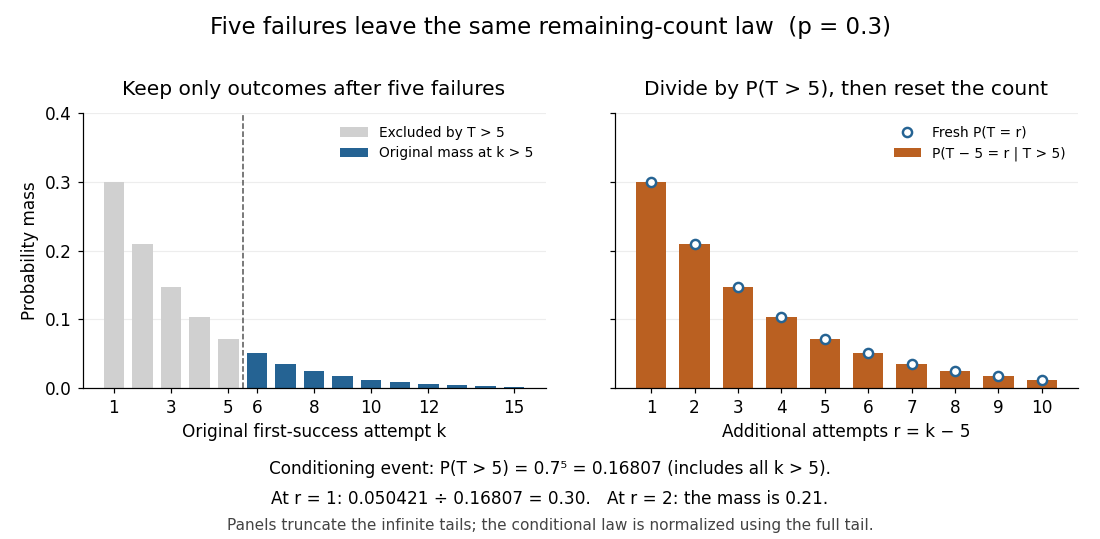
Conditioning on five failures, renormalizing, and resetting the count gives the original geometric law
. Details. 
The same mechanism has constant discrete hazard:Thus each reached attempt has the same chance of success. This differs from the decreasing unconditional probability : later success requires surviving earlier attempts. At , only conditioning on an event of positive probability is allowed: permits only , and only .
Among proper laws on the positive integers, memorylessness of the geometric distribution also characterizes the geometric distribution. Write . The identity gives ; if , both sides vanish anyway. Since , induction yields . Properness excludes , so setting recovers the geometric distribution, including .[ref]
The Geometric Distribution. Random: Probability, Mathematical Statistics, Stochastic Processes by Kyle Siegrist; Basic Theory, Distribution Functions and the Memoryless Property: conditional remaining-count identity and its converse
The retry example stipulates independent Bernoulli trials with a known constant ; it is not evidence that a real retry system behaves this way. Shared changing conditions or adapting attempts can alter the next success probability. Even constant individual success probabilities alone do not imply independence.
For an original contrasting model, uniformly shuffle one success card and three failure cards, then draw by sampling without replacement. Its success position has the discrete uniform distribution on . Initially the success probability is ; after one failure it is . In particular,This shows concretely why sampling without replacement need not be independent and why the remaining wait can change. Every draw still has unconditional success probability when all four positions are considered; the relevant discrete hazard changes after failures.
If the oriented coordinate tangent vectors meet at a constant angle with cosine , the first fundamental form has . The geodesic coordinate grid identities reduce to and . Since positive definiteness gives , both derivatives vanish. Thus and locally. Changing coordinates to and gives the constant metric . It is locally Euclidean after a linear change of coordinates, hence has zero Gaussian curvature.
// Target: geometry-and-topology.bigb
Generators of a finite cyclic group 2026-10-14
An element of the additive finite cyclic group is a generator of a group precisely when . The order of an element of a finite cyclic group proves this immediately: its cyclic subgroup has size , and this equals exactly when the greatest common divisor is one. There are therefore choices, where is the Euler totient function.
For , the two choices are and , so . For , they are . Starting from zero and repeatedly adding modulo eight gives , visiting every element once before returning. By contrast, adding gives and misses the odd integers represented in the other coset.
If the cyclic group is written multiplicatively as with of order , the same statement says that is a generator of a group exactly when and are coprime. This changes notation without changing the calculation.
Assume , , and . A maximum-cardinality left-compressed set family of -sets that is t-intersecting has a generating family for a uniform set family supported on under the displayed strict inequality. Reflection gives a right-end supporting interval for a right-compressed optimum. The strict threshold is important: at a tie between consecutive candidate families, use the next larger support bound. This auxiliary generating result, combined with the compatibility bound for complementary generating families, supplies the upper bound in the Ahlswede-Khachatrian theorem.
There are unlisted articles, also show them or only show them.