
Unreduced rational representation 2026-10-14
Consider an original abstract data type whose values are rational numbers. Store an ordered pair of integers, interpreted as a numerator and a denominator. Use exact, unbounded integer arithmetic in this model. The storage space, representation invariant and abstraction function areThe representation invariant does not require a positive denominator or a reduced fraction. Consequently , and are three different concrete states with the same abstract rational number . Similarly, and both represent zero. The abstraction function is a surjection: every rational number has an integer numerator and a nonzero integer denominator, so every abstract value has a representation.
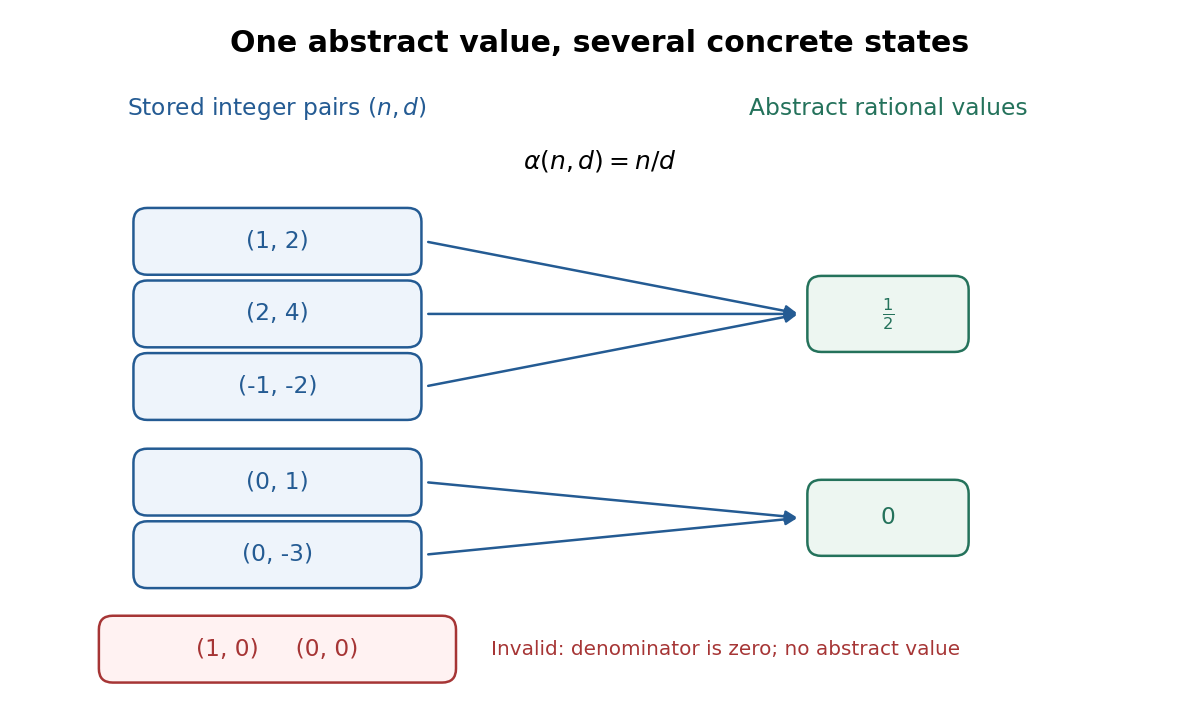

Both and violate the representation invariant; neither has a value under this abstraction function. By contrast, is completely valid. Simplifying it to the reduced fraction may be a useful implementation choice, but is not a requirement of this representation. Strengthening the representation invariant to require a positive denominator and a greatest common divisor of one would choose a unique stored representative for each rational number; every constructor and operation would then need to establish that stronger condition.
Equality of abstract values is therefore different from equality of stored ordered pairs. For valid and ,This defines an equivalence relation on : each equivalence class contains all representations of one rational number. An API equality operation can compare these cross-products using exact integer arithmetic. Comparing the two fields individually would incorrectly declare and unequal as rational numbers. The general reason is that an abstraction function may map several concrete values to one abstract value.[ref]
8.3 Module Documentation. Section 8.3.1, Abstraction Functions: several concrete values mapping to one abstract value; Section 8.3.4, Representation Invariants: valid domain of AF
Work by Z. S. Spakovszky 2026-10-14
Work by Will Fithian 2026-10-14
Peak-to-peak amplitude Created 2026-10-14 Updated 2026-11-05
The peak-to-peak amplitude is the difference between a signal's largest and smallest values over a stated interval. For , it equals and is independent of the offset . It is thus distinct from the maximum value measured relative to zero.
An oscilloscope trace that runs from to has peak-to-peak amplitude . If the trace is sinusoidal, its offset is , its peak amplitude about that offset is , and its alternating component has root mean square . For a nonsinusoidal or noisy signal these conversion factors need not hold. Reporting the observation interval matters because a rare noise spike can change the extrema without much change in the root mean square.
Work by Victor Ivrii 2026-10-14
Work by Vernier 2026-10-14
Molar mass measurement model Created 2026-10-14 Updated 2026-10-31
For a synthetic illustration, choose , , and . Using molar gas constant gives and under the ideal gas law. These are chosen model inputs, not observations of a particular chemical substance.
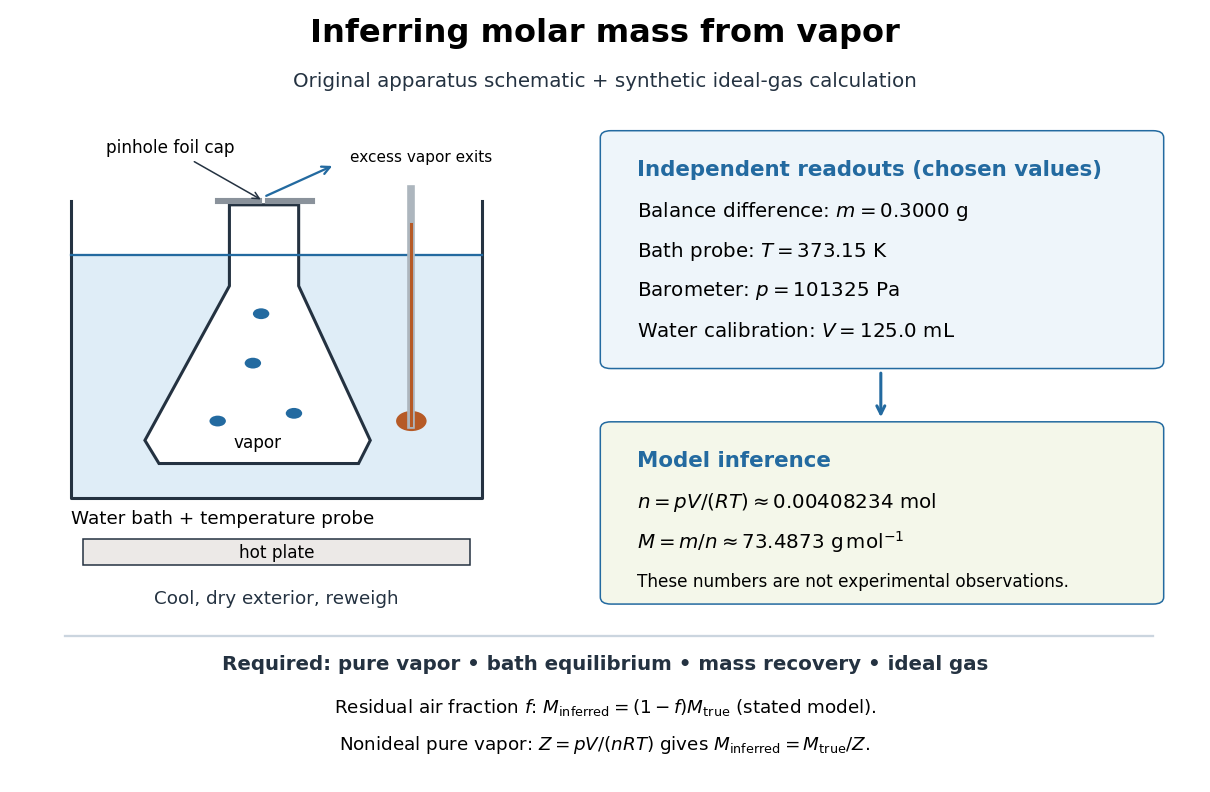
Vapor molar mass inference: apparatus, independent readouts, and the assumptions behind a synthetic ideal gas law calculation
. Details. 
An error's direction follows the model. Extra exterior water raises the apparent and hence . If a fraction of the hot gas particles is residual air, and only the unknown vapor contributes to recovered , an otherwise ideal gas calculation gives . For a pure nonideal vapor, define ; then , so the direction depends on . The dye endpoint alone cannot establish gas purity, thermal equilibrium, or ideality. These conditional checks explain why the same apparatus cannot provide a universal molar mass measurement for arbitrary mixtures or substances that decompose on heating.
University Physics Volume 2 by Samuel J. Ling and others 8.5 Molecular Model of a Dielectric 2026-10-14
Online text: openstax.org/books/university-physics-volume-2/pages/8-5-molecular-model-of-a-dielectric
Cited passages: §8.5, Figures 8.19–8.20 and the thermal-fluctuation qualification following Figure 8.20; §8.5, dielectric breakdown paragraph immediately before the definition of dielectric strength; §8.5, paragraph following Table 8.1: high dielectric constant does not ensure a good insulator; mobile ions permit conduction; §8.5: dielectric strength definition and voltage limit for a specified plate separation.
University Physics Volume 2 by Samuel J. Ling and others 2.1 Molecular Model of an Ideal Gas 2026-10-14
Online text: openstax.org/books/university-physics-volume-2/pages/2-1-molecular-model-of-an-ideal-gas
A section of University Physics Volume 2, published 6 October 2016, by Samuel J. Ling, William Moebs and Jeff Sanny. These are verified whole-book authors; no distinct chapter author is inferred.
Cited passages: OpenStax University Physics Volume 2, section 2.1: departures from ideal-gas behavior; OpenStax University Physics Volume 2, section 2.1: molecular model and ideal gas law; OpenStax University Physics Volume 2, section 2.1: particle-count and molar forms; OpenStax, University Physics Volume 2, section 2.1: the ideal gas law; §2.1, The Gas Laws, Figure 2.4, and equations 2.1–2.2: fixed temperature and particle number, absolute pressure, and the dilute-gas limit.
Online text: openstax.org/books/university-physics-volume-1/pages/2-2-coordinate-systems-and-components-of-a-vector
Section of the authored University Physics Volume 1. The year 2016 comes from the existing whole-book record; no section revision date is asserted.
Section of the authored University Physics Volume 1. The year 2016 comes from the existing whole-book record; no section revision date is asserted.
University Physics Volume 1 by William Moebs and others 6.2 Friction Created 2026-10-14 Updated 2026-10-18
Cited passages: Ling, Sanny and Moebs, OpenStax University Physics 1, §6.2: responsive static friction.
Cited passages: §6.2, Static and Kinetic Friction, equations 6.1–6.2; empirical-law limitations before Example 6.10; Friction and the Inclined Plane, Example 6.11 strategy and Figure 6.14 description: normal-force balance.
Official course notes for the 2012 offering. Marco Gualtieri is the course instructor, rather than an inferred author of these notes.
Official course notes for the 2012 offering. Marco Gualtieri is identified as the course instructor; no author byline for these notes is established. University of Toronto hosts the course.
Thermodynamics and Statistical Mechanics by Richard Fitzpatrick Joule-Thompson Throttling 2026-10-14
The HTML footer is dated 25 January 2016. This is the inspected page version, not an independently established print publication date.
Cited passages: Fitzpatrick, Joule-Thompson Throttling, equations 6.167–6.174: inlet/outlet pressure work and enthalpy conservation; Fitzpatrick, Joule-Thompson Throttling, equations 6.175–6.182: ideal-gas limit and coefficient; Fitzpatrick, Joule-Thompson Throttling, equations 6.188–6.190 and following paragraph: inversion locus, maximum temperature and limits of the van der Waals prediction; Fitzpatrick, Joule-Thompson Throttling: steady-flow enthalpy balance.
There are unlisted articles, also show them or only show them.