
Work by Charles Fabry 2026-10-14
Kinetochore Created 2026-10-14 Updated 2026-10-20
A kinetochore is a protein assembly at a centromere that attaches a chromosome to microtubules of the spindle apparatus. Each replicated chromosome has sister kinetochores; their attachment and subsequent separation help distribute the copied material. A kinetochore is therefore the attachment machinery, while the centromere is its chromosome site.[ref]
The Process of Meiosis. Biology 2e by Mary Ann Clark and others; §11.1, Prometaphase I and Prometaphase II
The kinetochore ablation experiment tests this mechanical role directly. Counting kinetochores as independent chromosomes before sister separation would confuse duplicated attachment machinery with ploidy.
Double thymidine block Created 2026-10-14 Updated 2026-11-05
A double thymidine block is a synchronization strategy in which two thymidine-induced interruptions of DNA synthesis, separated by release, enrich a cultured-cell biological population near the transition into S phase. Excess thymidine perturbs nucleotide balance rather than acting as a physical barrier. Cells resume progression after release with a distribution of timings, so synchronization is enrichment rather than perfect identity of cell states. The perturbation can itself affect replication and stress responses; measurements after release must account for this changed starting condition. [ref]
Cell Synchronization by Double Thymidine Block. Cell Synchronization by Double Thymidine Block, abstract and Introduction
Work by Carl Theodor Anger 2026-10-14
Work by Carl Runge 2026-10-14
Work by Carl Gustav Jacob Jacobi 2026-10-14
Tartaric acid 2026-10-14
Tartaric acid has two hydroxy groups and two carboxylic acid groups. Its meso compound form illustrates why two stereocenters need not make a chiral molecule.
Pyruvic acid Created 2026-10-14 Updated 2026-11-05
Pyruvic acid is a three-carbon α-keto acid, . At ordinary cellular pH, its conjugate base, pyruvate, predominates.
The pyruvate carbon skeleton is a branch point connecting glycolysis with acetyl-CoA formation, lactic acid formation, and alanine metabolism. The different names distinguish protonation states without implying unrelated carbon pathways.
Carbon nanotube Created 2026-10-14 Updated 2026-11-05
A carbon nanotube is a cylindrical carbon nanostructure with a graphitic bonding framework. Single-walled tubes can be described by the way a graphene-like sheet wraps around the cylinder; multiwalled tubes contain nested shells.
Graphite Created 2026-10-14 Updated 2026-10-18
Work by C. T. Kelley 2026-10-14
Bond dipole Created 2026-10-14 Updated 2026-10-20
A bond dipole represents the separation of positive and negative electric charge associated with a chemical bond. In a neutral two-point charge model put at and at , with . Its physical electric dipole moment isIf is the negative end, the physical electric dipole moment points from to . The customary crossed-tail chemical arrow points towards the negative, more electronegative end, from to . It therefore has the opposite direction. State the convention before doing vector addition; use physical electric dipole moments in the interaction potential energy , where is the electric field.[ref]
For a fixed neutral molecule, its complete electric dipole moment follows from all atomic nuclei and the electron density, not just point charges assigned to sites. If is the expected number of electrons per unit volume, the corresponding charge density is ; the nuclear terms contribute separately. Partitioning that distribution into bond dipoles is a model. Lone pairs and electric polarization within a chemical atom can contribute as well. A measured molecular electric dipole moment cannot uniquely recover every individual bond dipole or partial atomic charge.
Collision probability of two independent categorical draws Created 2026-10-14 Updated 2026-11-05
Suppose two independent random variables have the same categorical distribution, with label probabilities . The disjoint equal-label events giveFor the original chosen probabilities , this is , rather than the uniform four-label value . The Cauchy-Schwarz inequality gives , so uniform probabilities minimize this two-draw collision probability. This pair formula alone does not supply the entire group collision probability for a nonuniform model.
Birthday square-root scale 2026-10-14
The union bound gives . Using on the distinct-label product givesThe lower bound reaches at least one half when . The simple approximation predicts a group size near 23 for . It is the quadratic number of pairs that makes the square root appear.
For a precise limiting statement, let and . Expanding the logarithm of the complement yieldsOn this scale the remainder tends to zero. Thus a fixed substantial collision probability appears after order draws. For uniform output labels, the corresponding scale is order ; matching one specified birthday instead involves a number of draws of order .
Birthday collision count 2026-10-14
The birthday collision count counts equal-label unordered pairs. Write it as a sum of indicator random variables:This uses linearity of expectation; mutual independence of the pair indicators is unnecessary. For 23 uniform calendar labels, , whereas . A configuration with three equal labels contributes three pairs, so counting pairs and recording whether any pair exists are different random variables.
Treating every pair event as mutually independent would give the wrong exact formula. For three draws, and force . The probability that all three equalities hold is , while the product of their individual probabilities is for . This distinguishes independence of the original label draws from mutual independence of events built from overlapping draws.
Matching one specified birthday 2026-10-14
In a group of total size , designate one member and ask whether any of the other labels equals that member's label. Conditional on the designated label, all the other draws avoid it with probability . Independence givesFor , this is approximately , while the probability of some matching pair is approximately . The designated-member question examines pairs; the any-pair question examines all . A repeated label elsewhere in the group does not require a match with its designated member.
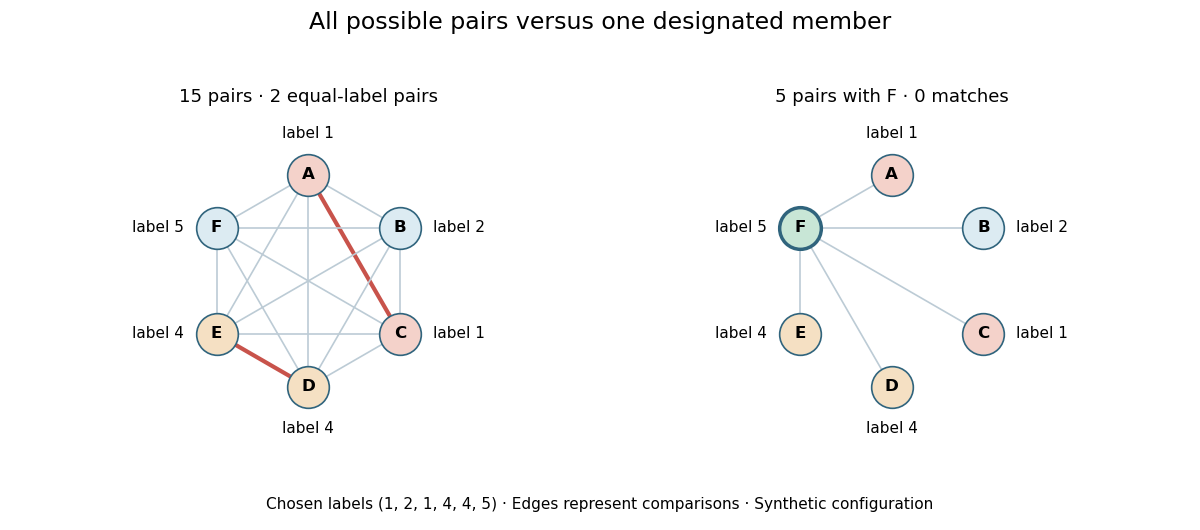
Fifteen possible pairs versus five comparisons with one designated member
. Original illustrative labels for six members: . The complete graph includes every possible pair and marks the two equal-label pairs in red. The right panel uses only pairs containing member F, whose label 5 is unique. This chosen configuration illustrates the two different events; it is not a random sample of measured birthdays. Details.
Null child slot count 2026-10-14
Every nonempty finite binary tree with vertices has exactly empty binary tree child slots. There are slots altogether, and precisely occupied slots, one for each edge of its underlying tree. ThereforeThis counts missing child references, not vertices or leaves. In the mixed four-vertex example, has no empty binary tree child slots, has one, and each have two: . The four-vertex chain also has five: one at each of its first three vertices and two at the last. For , there are no vertices and hence no child fields; the empty binary tree instead has a single empty root position if it is represented by a root reference.
A second proof uses the recursive decomposition. Count every empty subtree occurrence, including the root position for the empty binary tree: let . For a nonempty binary tree, . If the two subtrees have vertices, structural induction gives . Distinct empty positions may share the same
null value; these are occurrences, not separately allocated objects. This count is useful when analysing the base cases reached by a structural recursion that calls both subtrees of every vertex. Work by Bi-Heng Liu Created 2026-10-14 Updated 2026-10-31
Work by Beth Parks 2026-10-14
Atom interferometer Created 2026-10-14 Updated 2026-11-05
An atom interferometer supplies atomic preparation, coherent splitting and recombination, and a readout of the output populations. In a light-pulse apparatus, a cooled atomic cloud interacts with controlled laser pulses during flight, and state-selective detection measures the populations after the final pulse.
For ideal equal interfering amplitudes, one output has probability , where is the relative wave phase and the interferometric visibility. Scanning a laser phase produces fringes. Vibrations, phase noise, unequal path populations and information distinguishing the paths can reduce their visibility; simply detecting two atomic groups does not establish wave interference.
There are unlisted articles, also show them or only show them.