
Square grid Created 2026-10-14 Updated 2026-10-18
Two equally spaced families of perpendicular lines partitioning the Euclidean plane into congruent squares. A general affine map can turn this grid into parallelograms, or collapse directions if its linear part of an affine map is not injective.
Work by Euclid 2026-10-14
Zeitgeber 2026-10-14
Work by Enrique Galvez 2026-10-14
Racemate 2026-10-14
A racemate contains the same amount of substance of each member of an enantiomer pair. Their equal and opposite contributions cancel in ordinary solution polarimetry under identical conditions. Zero net optical rotation therefore does not establish achirality of the individual molecules.[ref]
5.8 Racemic Mixtures and the Resolution of Enantiomers. McMurry, Organic Chemistry, §5.8: equal enantiomer populations and cancelling optical rotations
Work by Emre Yolcu 2026-10-14
Electron microscope Created 2026-10-14 Updated 2026-10-20
An electron microscope forms a spatially enlarged representation of a specimen using electrons, electron lenses, and a detector. Its appeal is access to structure too fine for an ordinary optical microscope, but a short de Broglie wavelength alone does not guarantee fine electron microscope resolution. Increasing magnification can enlarge an existing blur without revealing any additional structure.
In transmission electron microscopy, an electron gun illuminates a thin specimen; magnetic electron lenses form and enlarge its transmitted image on a fluorescent screen or detector. A vacuum reduces collisions with gas. Lens electric currents control focusing and magnification.[ref]
Transmission Electron Microscope (TEM) by JEOL. JEOL, The difference between Electron Beam and Light: gun, vacuum, magnetic lenses and screen
In his 1888 reflection experiments, Heinrich Hertz excited a straight conductor with a central spark gap driven by an induction coil. The receiver was a wire circle of radius with an adjustable small spark gap; tiny sparks were observed in darkness. There was no connecting transmission wire. [ref]
Electric Waves: Being Researches on the Propagation of Electric Action with Finite Velocity through Space by Heinrich Hertz. Hertz, Electric Waves (1893 translation), VII, pp. 108–109; VIII, pp. 125–127
He removed hanging metal fixtures, installed a by zinc reflecting sheet, and moved and rotated the receiver. Spark strength alternated with position and gap orientation, supporting specular reflection and wave interference. He checked observations from farther away because the observer's body perturbed the response. Changing oscillator dimensions changed the spatial pattern. [ref]
Electric Waves: Being Researches on the Propagation of Electric Action with Finite Velocity through Space by Heinrich Hertz. Hertz, Electric Waves, VIII, pp. 125–127 and 135–136: preparations and controls
These tests supported propagating electromagnetic waves, rather than mere detection of nearby induction. They did not establish unlimited reception distance. His wire-versus-air wave interference experiment addressed finite velocity; he later judged its quantitative velocity comparison doubtful because of room effects. [ref]
Electric Waves: Being Researches on the Propagation of Electric Action with Finite Velocity through Space by Heinrich Hertz. Hertz, Electric Waves, VII, pp. 107–108; Introduction, pp. 9–12: retrospective limitations
The physical inference combines transmission with a spatially structured response to a reflected disturbance. In an ideal monochromatic incident-and-reflected model, standing wave nodes are separated by ; combining a reliable wavelength with independently known frequency gives phase velocity . A spark is a threshold event, however: its presence or length is not a calibrated wave intensity or a direct arrival-time measurement. The actual loop also responds to its orientation and finite size, so the simple standing-wave model is an explanation of the test's logic, rather than a reconstruction of Hertz's measured points. Poynting theorem explains how source energy can reach and drive the receiver's discharge.
Outgoing radiation pulse 2026-10-14
An outgoing radiation pulse carries a finite amount of electromagnetic energy through successively larger enclosing spheres. In vacuum, far from a localized source and without absorption or additional reflections, let be the emitted power. The retarded time at radius is . Define as the angular average of the radial Poynting vector over the sphere, not a cycle average:Here is the angularly averaged energy density in the leading radiation zone approximation. Multiplying by shell area removes geometric dilution: the energy per unit radial thickness translates outward without losing its shape. These angular averages do not assume that an actual electric dipole emits equally in all directions. Nor do they specify an exact spherically symmetric transverse solution of the Maxwell equations.
For an explicitly stipulated model, emitAfter emission ends, , the pulse lies between and , provided this shell is in the radiation zone. Its radial thickness remains . Substituting in the shell integral gives at every such time. The same substitution in the time integral of at any enclosing sphere gives that same total crossing energy. This is conservation of energy in two different views.
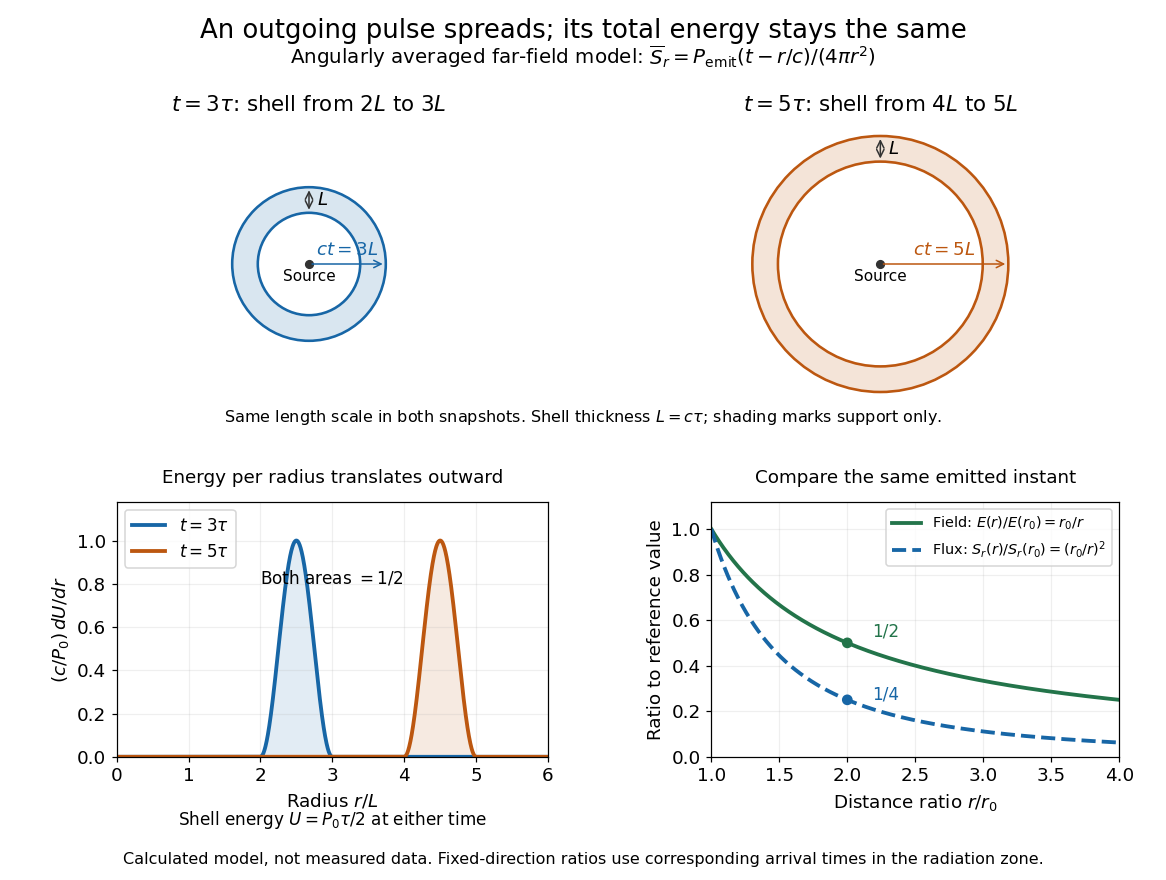

Along any fixed direction with nonzero outgoing power, compare the same part of the pulse at two radii, hence at different arrival times. The leading electric field amplitude falls as , while its squared wave intensity falls as . At the field is one half and the energy flux one quarter; the signal arrives later. A small fixed area receiver therefore intercepts less energy at greater distance even though every enclosing sphere receives the same total pulse energy. The inverse-square law expresses spreading over area, rather than destruction of energy. Close to the source, the neglected near and far field terms prevent extrapolating these formulas down to .
Vacuum frequency-wavelength relation 2026-10-14
A monochromatic wave in vacuum has frequency and wavelength related by , where is the speed of light. During one oscillation period , a constant-wave phase surface travels one wavelength, so . Equivalently, the plane electromagnetic wave relation with angular frequency and wavenumber gives the same result.
As a calculated example, a vacuum radio wave with has using . Doubling frequency halves wavelength, independently of wave amplitude and wave intensity. The frequency spectrum of a pulse contains multiple frequencies; the relation applies to each vacuum component, rather than assigning one exact wavelength to the whole pulse. In a homogeneous medium replace by the appropriate phase velocity; the vacuum equation does not assert that all media have the same wavelength at a given frequency.
Radio wave Created 2026-10-14 Updated 2026-10-18
A radio wave is electromagnetic radiation in the radio portion of the frequency spectrum. In vacuum its frequency and wavelength obey the vacuum frequency-wavelength relation.
Electromagnetic field momentum Created 2026-10-14 Updated 2026-11-05
An electromagnetic field carries momentum as well as energy. In vacuum, its SI momentum density iswhere is the Poynting vector. Thus the field momentum in a region is . [ref]
The Feynman Lectures on Physics, Volume II by Richard Feynman and others. Section 27–6, equations 27.21–27.22, momentum density and energy flux
For a directed vacuum plane wave, , so a pulse with total energy carries momentum . Complete absorption transfers that momentum to matter. Reversing the pulse at a stationary perfect mirror transfers twice as much normal momentum, explaining radiation pressure.
Conservation joins field momentum to the mechanical momentum of matter and momentum crossing the chosen boundary. Changing a field can therefore accelerate matter even when no material particle carries the momentum across the intervening space. Static configurations can also contain nonzero field momentum; the vacuum formula does not require radiation. [ref]
The Feynman Lectures on Physics, Volume II by Richard Feynman and others. Section 27–6, charge-magnet example and return of stored angular momentum
Induction coil 2026-10-14
An induction coil uses a changing electric current and Faraday's law of induction to produce a high output electric potential difference.
Spark gap 2026-10-14
A spark gap separates two electrodes; sufficient electric potential difference can cause an electrical discharge through the intervening gas.
Electronic amplifier Created 2026-10-14 Updated 2026-11-05
An electronic amplifier uses an electrical power supply to increase a signal's amplitude or available output power. The input controls the transfer of supply energy to the load; it does not supply all the amplified output energy itself.
A voltage amplifier, a transimpedance amplifier and a charge amplifier relate different input and output quantities. To characterize one, vary the input around its operating point and measure gain, frequency response, noise and the range before saturation. A large gain does not by itself improve signal-to-noise ratio, since input noise and amplifier noise can both be amplified.
Diode Created 2026-10-14 Updated 2026-10-18
A diode is a two-terminal component with an asymmetric current-voltage characteristic: reversing its terminal electric potential difference need not reverse its electric current with the same magnitude. Name the terminals diode anode and diode cathode . Define using their electric potentials, and take positive electric current from to . The bar in the diode symbol marks . Positive is the forward direction; negative is the reverse direction.[ref]
The asymmetry makes a rectifier possible: a sinusoid can drive electric current through a resistor on one half of each cycle. An ordinary resistor obeying Ohm's law instead reverses its electric current when the applied electric potential difference reverses. The useful idea is directional selection; the ideal diode model captures it, while the Shockley diode equation describes a smooth exponential function rather than an abrupt switch.
Work by Eben H. Toole 2026-10-14
Deoxynucleoside triphosphate Created 2026-10-14 Updated 2026-11-05
A deoxynucleoside triphosphate is a nucleotide containing deoxyribose and three phosphate groups. DNA polymerases use these substrates to extend DNA; the four standard substrate types carry adenine, cytosine, guanine or thymine.
Serial dilution 2026-10-14
Serial dilution repeatedly transfers a measured portion of one well-mixed chemical solution and dilutes that portion to a new final volume. With transferred volume and final volume at step , conserved solute givesThis product follows by repeated substitution. Each step conserves the solute in the portion transferred into its receiving flask, not the entire inventory in the preceding flask. Uniform mixing makes the selected fraction representative.
Continue the original solution mass and volume bookkeeping example. A portion of the stock contains of analytical sodium chloride, corresponding to before rounding. After dilution to , its analytical concentration is . A new portion of that mixed chemical solution contains ; dilution to gives . The two factors and multiply to .
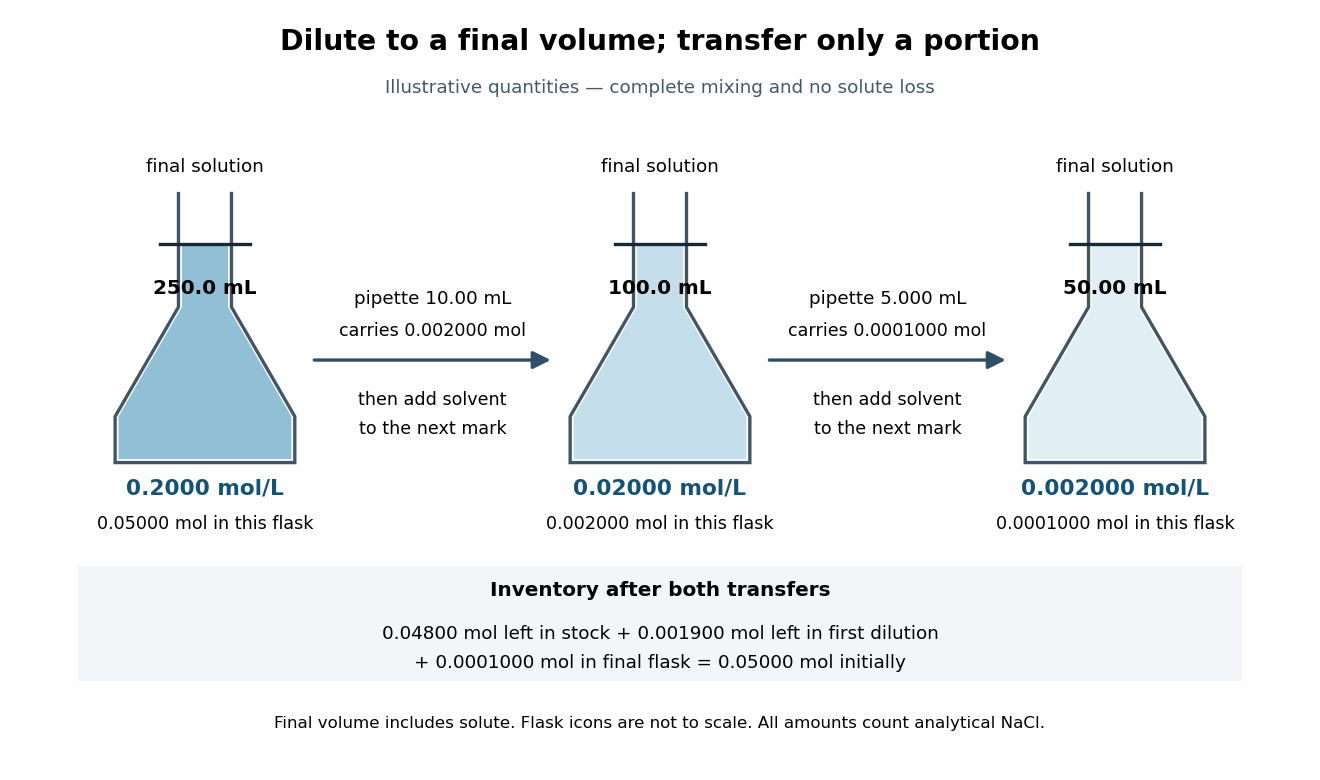

The remaining stock holds ; the remaining first dilution holds . Including the final flask restores the starting inventory:This is a direct check that making a dilute final sample does not destroy the solute. Most of it remains in earlier vessels.
Serial dilution makes a small final concentration accessible using measurable portions instead of a single extremely small transfer. Its limitation is that systematic errors propagate: if each transferred volume is below its intended value while final volumes are correct, two steps give times the intended concentration, a deficit. Repeated readings alone do not remove that bias. The gain in manageable volume therefore depends on calibrated transfer and representative mixing.
Homonuclear diatomic molecule Created 2026-10-14 Updated 2026-10-20
There are unlisted articles, also show them or only show them.