
HCl and DCl harmonic stretch comparison 2026-10-14
Keep the same bond force constant and approximate the nuclear masses of , , and by , , and , respectively. Here is the unified atomic mass unit, and denotes deuterium. These are chosen mass number approximations, not measured atomic masses or natural-abundance averages. With the same chlorine isotope in both molecules,This is the isotope scaling of diatomic vibration prediction. Doubling the light partner's mass nearly doubles the reduced mass, lowering the frequency by about . The factor differs from because the chlorine partner also moves.
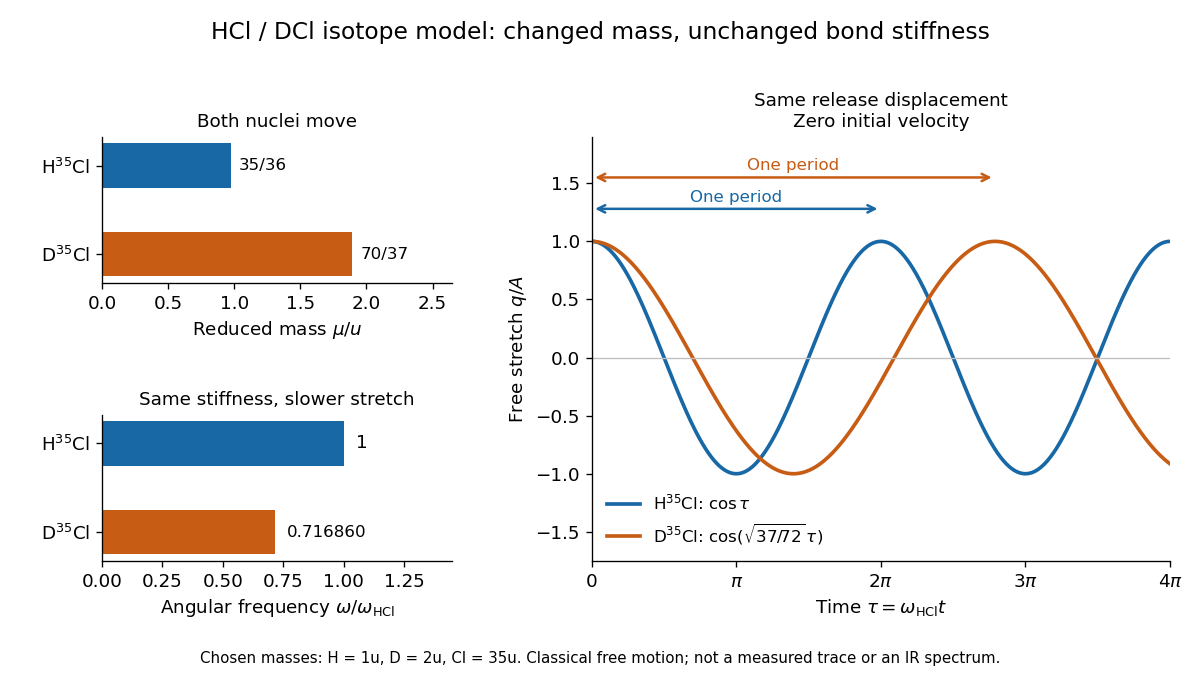

For the same small initial stretch and zero velocity, both models start with the same internal mechanical energy , but the DCl oscillation period is longer by . In the centre of mass frame, and for HCl; and for DCl. These ratios explain which partner moves and are separate from the change in frequency.
The common- assumption belongs to the leading Born-Oppenheimer approximation: fixed nuclear positions and electric charges determine the electronic potential energy, while nuclear masses govern motion on that curve. Quantitative comparison requires actual atomic masses, departures from that approximation, and separation of anharmonicity and molecular rotation from the measured band. Even with common , the quantum harmonic oscillator predicts a different zero-point energy for each isotope.[ref]
Harmonic vibrational energy levels 2026-10-14
Quantizing the stretching coordinate gives a quantum harmonic oscillator with reduced mass :Here is the vibrational quantum number and the reduced Planck constant. Consecutive energy eigenvalues have gap ; the ground state has zero-point energy above the well minimum. The offset cancels from every transition energy.
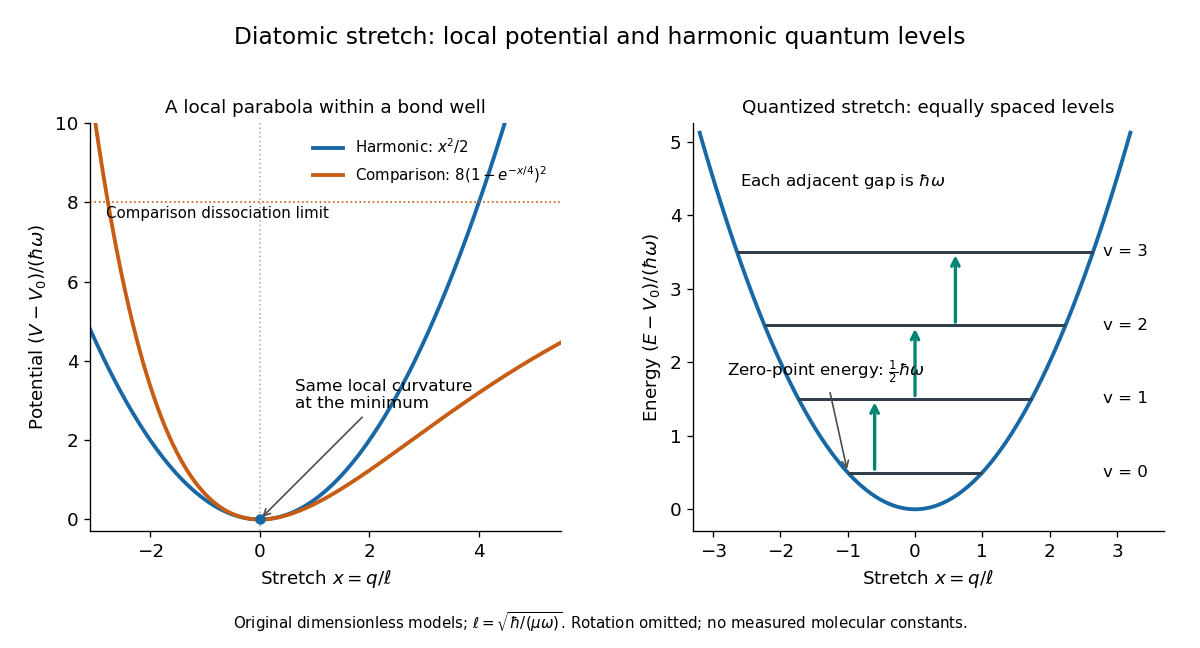
Local harmonic approximation near a potential minimum and equally spaced vibrational energy eigenvalues
. Original dimensionless model with and . The blue parabola is ; levels are . The orange comparison is the stipulated Morse potential , with the same curvature at ; it is not a fit to hydrogen chloride. Arrows show adjacent vibrational gaps, with molecular rotation omitted. Details.
A short proof uses creation and annihilation operators: with , write . The Quantum Hamiltonian becomes . Nonnegativity of gives the lowest level; repeated application of raises its energy by each time. This also gives andThe ground state therefore has a nonzero spread of bond lengths, even though its mean stretching displacement vanishes. A stationary energy eigenstate has a time-independent position probability density; the classical oscillation curve is not a trajectory of an atomic nucleus in that state.
The parabolic model formally extends to the whole real line, whereas an actual bond length satisfies . It is useful for low levels concentrated near , with typical stretching displacements much smaller than . It fails near breakup of the chemical bond and when neglected anharmonicity becomes substantial.
Bond force constant 2026-10-14
The bond force constant is the curvature of the effective potential energy at the equilibrium bond length. For a diatomic bond stretch, it plays the role of a spring constant. Its definition is local: two wells with the same curvature can have different bond-dissociation energies.
Work by Delmar S. Larsen 2026-10-14
De Morgan dual of a Boolean function 2026-10-14
For a Boolean function of input bits, define its De Morgan dual by complementing every input, applying , and complementing the output:
De Morgan's laws say that the De Morgan dual of logical conjunction is logical disjunction, and conversely. The constant zero Boolean function becomes constant one. This is different from merely negating the output: for AND, output logical negation gives one at , whereas the De Morgan dual gives zero there.
Taking the De Morgan dual twice restores the original Boolean function:Here each input is complemented twice as well. For a Boolean formula built from AND, OR, NOT and constants, its De Morgan dual can therefore be obtained by exchanging AND with OR and zero with one throughout, leaving input names and NOT in place. A structural induction proves the rule: it holds for an input and each constant, De Morgan's laws handle the two binary logical connectives, and double logical negation handles NOT. This symmetry lets one translate a complex test systematically instead of guessing where its failures occur.
Work by David E. Joyce 2026-10-14
Work by Daniel Evan Jones 2026-10-14
Work by Daniel Dadush 2026-10-14
Work by Conly L. Rieder 2026-10-14
Molar concentration 2026-10-14
Molar concentration is amount of substance of a named chemical species per final chemical solution volume: . State whether the count describes dissolved species or a conserved analytical concentration.
Phase convention for complex amplitudes 2026-10-14
Reference wave phases label complex amplitudes without changing measured powers. If , choose diagonal matrices whose entries have modulus one, and set , . Then and each component has unchanged squared modulus. For a beam splitter scattering matrix, transforming without transforming input complex amplitudes changes the stated physical input.
Just-in-time compilation 2026-10-14
Compilation performed during execution, often producing machine code for subsequent execution.
Compilation arithmetic example Created 2026-10-14 Updated 2026-11-05
Consider the program expression
x*(2+3)-4 in a deliberately small programming language. Its only program identifier is x, supplied as an integer input. Its literal values are nonnegative decimal numerals, interpreted as integers. Whitespace is ignored between lexical tokens. Its context-free grammar is:expression ::= term (("+" | "-") term)*
term ::= factor ("*" factor)*
factor ::= numeral | "x" | "(" expression ")"
numeral ::= digit digit*
digit ::= "0" | "1" | "2" | "3" | "4"
| "5" | "6" | "7" | "8" | "9"Here
* outside quotation marks means zero or more repetitions. Repeated operators are grouped to the left, specifying operator associativity; term gives multiplication higher operator precedence than addition and subtraction. Parentheses override that grouping. There is no unary minus, variable assignment, function call, or side effect in this language. Evaluation obtains each left operand before its right operand and uses exact integer arithmetic, with no fixed-width overflow.Lexical analysis recognizes
x, *, (, 2, +, 3, ), -, 4. Parsing constructs the concrete abstract syntax tree Sub(Mul(Name(x), Add(Int(2), Int(3))), Int(4)). Parentheses have done their work by making Add a child of Mul; they need not survive as nodes. Constant folding changes this to Sub(Mul(Name(x), Int(5)), Int(4)). It cannot replace Name(x) by a literal value because the input is supplied at execution. The resulting function of the input is .A compiler for our stack machine emits
LOAD x; PUSH 5; MUL; PUSH 4; SUB. LOAD x pushes the current input; PUSH n pushes the integer literal value n. Each binary instruction removes the top item as its right operand, then the next item as its left operand, and pushes the result. The instruction sequence is an intermediate representation that an interpreter can execute; no machine code has been emitted. A compact binary encoding could make it bytecode, but these printed instruction names are only a readable notation.Why does this compilation preserve the result? A structural induction supplies a short proof outline. Translating a literal value or
x appends its value to any initial stack. For a binary abstract syntax tree node, first translating the left child and then the right child appends the two operand values; the matching instruction replaces them by exactly the original operation's result. Previously present stack items remain intact. Constant folding also preserves the result because in the specified integer arithmetic. Together these facts explain agreement for every integer input, rather than merely agreement for one trial. Independence system 2026-10-14
An independence system consists of a finite set and a nonempty family of subsets such that and imply . This is the hereditary condition: deleting chosen elements keeps a selection admissible. In particular, the empty set belongs to . An independence system becomes a matroid when it also satisfies the matroid independence axioms for exchange. The hereditary nonmatroid greedy obstruction shows why deletion alone does not justify a greedy algorithm.
Work by Claude Berge 2026-10-14
Work by Clare McGowan 2026-10-14
Work by Chuan-Feng Li Created 2026-10-14 Updated 2026-10-31
Work by Cheryl Smith 2026-10-14
Work by Charles M. Grinstead 2026-10-14
Work by Charles H. Holbrow 2026-10-14
There are unlisted articles, also show them or only show them.