
Institution-issued Physics 110x laboratory instructions from Southern Methodist University. No personal byline or document date verified; a course term embedded in the hosting URL is not publication metadata.
Cited passages: Experiments 1–2, Equipment You Will Be Using, and final construction and dielectric-study instructions.
Single-molecule absorption in a molecular crystal Created 2026-10-14 Updated 2026-10-20
In 1989, William E. Moerner and Lothar Kador reported individual pentacene absorbers in para-terphenyl in Optical detection and spectroscopy of single molecules in a solid by W. E. Moerner and L. Kador (pp. 2535–2538). Different local environments spread photon absorption frequencies; tuning into the sparse wings selected few resonant molecules despite many molecules in the illuminated volume.
Their tunable dye laser focused through a numerical aperture lens onto a – crystal immersed in superfluid helium at . Frequency modulation accompanied either a electric field between coated sapphire disks, detected at , or a quartz shear transducer. An avalanche photodiode measured transmitted-light photon absorption, not fluorescence. Double modulation suppressed residual laser amplitude background.[ref]
Optical detection and spectroscopy of single molecules in a solid by W. E. Moerner and L. Kador. pp. 2535–2537: sample, lens, dye laser, FM/Stark and FM/ultrasound apparatus and detection
Repeated scans gave the predicted modulated line shape. Blank crystals and off-resonance scans gave background; changing modulation frequency expanded and contracted the feature as predicted. Agreement between both perturbation methods supported the individual-absorber inference. The authors acknowledged out-of-focus molecules and the unlikely alternative of multiple absorbers with exactly coincident frequencies.[ref]
Optical detection and spectroscopy of single molecules in a solid by W. E. Moerner and L. Kador. Fig. 1(d–g), Fig. 2(b–g), and pp. 2537–2538: blanks, modulation-frequency changes, background and coincident-absorber qualification
This is evidence for a selected absorber in a prepared, known chemical substance and host. It does not establish arbitrary unknown molecule identity from one spectral feature, provide an atom-resolved photograph, or count every molecule in the crystal. A measurement sensitive to only a narrow excitation range cannot detect a molecule whose transition lies outside that range. This distinction separates the total particle inventory from the number responding to a particular probe.
Gametophyte Created 2026-10-14 Updated 2026-10-18
The plant life-cycle generation that produces gametes. In an angiosperm, male gametophytes are pollen grains and the female gametophyte is the embryo sac.
Photogate 2026-10-14
Dounce homogenizer Created 2026-10-14 Updated 2026-11-05
A Dounce homogenizer mechanically disrupts cells with a fitted glass pestle moving inside a glass vessel. Relative motion drives fluid through the narrow clearance, generating deformation and shear stress in the sample. The device is commonly operated manually. [ref]
Tissue Grinders by DWK Life Sciences. DWK Life Sciences, Tissue Grinders: Dounce tube and fitted pestles
Different pestle clearances produce different flow and disruption. The resulting preparation depends on sample mechanics and the applied motion, so homogenization is a controlled physical treatment rather than simple mixing. Microscopy can test whether the desired cellular material was released and which structures remained intact.
Work by Santa Monica College 2026-10-14
By Shalabh.
The inspected chapter masthead identifies Sampling Theory, Chapter 2, Simple Random Sampling, and credits Shalabh of IIT Kanpur. Credit applies to the inspected chapter, rather than inferring authorship of every resource in a course from the host. No publication date or edition established.
Cited passages: Sampling Theory, Chapter 2, PDF pp. 10–12: sample-variance and standard-error estimation; Sampling Theory, Chapter 2, PDF pp. 2, 6–9: variance normalizations, unbiasedness, covariance derivation and finite population correction; Sampling Theory, Chapter 2, Simple Random Sampling, PDF pp. 1–4: replacement conventions and ordered versus unordered sample probabilities.
Work by Ryan O'Donnell Created 2026-10-14 Updated 2026-10-24
Work by Royal Swedish Academy of Sciences 2026-10-14
Work by Ronald de Wolf 2026-10-14
Work by Rocco A. Servedio 2026-10-14
Online text: www.clawpack.org/riemann_book/html/Burgers.html
Cited passages: Rarefaction wave, full piecewise solution; expansion-shock example; The entropy condition; Shock solution; Rarefaction wave; The entropy condition.
Electron acceptor Created 2026-10-14 Updated 2026-11-05
An electron acceptor receives electron density or electrons in a specified interaction. In redox chemistry, it is reduced when it accepts electrons, and the electron donor is oxidized.
For example, oxygen is the terminal electron acceptor of an aerobic mitochondrial respiratory chain, ultimately being reduced to water. In a Lewis acid-base interaction, electron-pair acceptance can instead form a bond without a net redox change. Stating the process distinguishes formal electron transfer from donation into an acceptor orbital.
Reducing agent Created 2026-10-14 Updated 2026-10-20
A reducing agent undergoes oxidation by supplying the formal electron inventory. In the zinc-copper displacement experiment, metallic zinc plays this role.[ref]
Chemistry 2e by Paul Flowers and others. §4.2, “Oxidation-Reduction Reactions”: reducing agent is the species oxidized
Oxidizing agent Created 2026-10-14 Updated 2026-10-20
An oxidizing agent undergoes reduction by accepting the formal electron inventory. In the zinc-copper displacement experiment, plays this role.[ref]
Chemistry 2e by Paul Flowers and others. §4.2, “Oxidation-Reduction Reactions”: oxidizing agent is the species reduced
Zinc-copper displacement experiment Created 2026-10-14 Updated 2026-10-20
An inspected university demonstration makes the paired changes visible. The 2021 Chemical Demonstrations Booklet hosted by Edith Cowan University describes two cut square zinc strips, each immersed in a separate glass beaker. One contains blue copper(II) sulfate chemical solution, the other colourless zinc sulfate chemical solution. The published readouts are the appearance of a brown copper deposit on the first strip and fading of its blue chemical solution; after thirty minutes more deposit is reported. The comparison strip in zinc sulfate shows no visible change. The documented preparation is cutting the strips; surface polishing is not specified.[ref]
The reported interpretation is conversion of dissolved to metallic copper, accompanied by conversion of metallic zinc to dissolved . The sulfate anions balance bulk electric charge and cancel from the net chemical equation. The comparison shows that merely immersing a zinc strip in a sulfate chemical solution does not reproduce the visible coating.[ref]
Chemical Demonstrations Booklet by Magdalena Wajrak and Tim Harrison. Demonstration 16, printed pp. 32–33: zinc-sulfate comparison and zinc/copper-sulfate equation
Appearance is evidence for the proposed conversion, rather than a quantitative measurement of the two-electron ratio. Fading alone could also reflect dilution; deposit colour alone does not independently establish its composition. A stronger follow-up would compare the copper content of the chemical solution before and after, identify the solid, and check dissolved zinc. These are proposed analytical checks, not results reported in the booklet. Comparable starting chemical solutions, surface condition, immersion and observation time help interpret a comparison; an unchanged-looking strip does not rule out slow or invisible chemical reactions.
The two-electron interpretation comes from the species identities and electric charge balance, supported by the paired observations. It does not imply that the coating's mass equals the mass of zinc consumed: the same amount of substance of different chemical elements generally have different molar masses. Nor does it resolve microscopic surface sites or reaction pathways. The same net redox can be organized into separated compartments in a Daniell cell to obtain electrical work.
Redox electron balance Created 2026-10-14 Updated 2026-10-20
Consider the reacting zinc and copper species in the zinc-copper displacement experiment. Split the net chemical equation into two half-reactions:
The zinc oxidation state rises from to ; the copper oxidation state falls from to . Add the half-reactions: two released electrons match two accepted electrons. Cancelling from both sides gives[ref]
Chemistry 2e by Paul Flowers and others. §4.2, “Balancing Redox Reactions via the Half-Reaction Method”, steps 6–7: matching and cancelling exchanged electrons
Thus the closed net chemical reaction has zero net production of free electrons. Cancellation does not destroy electrons: it removes a matched internal exchange from the written chemical equation. The half-reactions alone are incomplete descriptions of the whole reacting system. In a galvanic cell, the exchange can pass through a wire; in the zinc-copper displacement experiment, the reacting materials meet at the same metal surface. The equations do not require a reservoir of free electrons in the bulk chemical solution.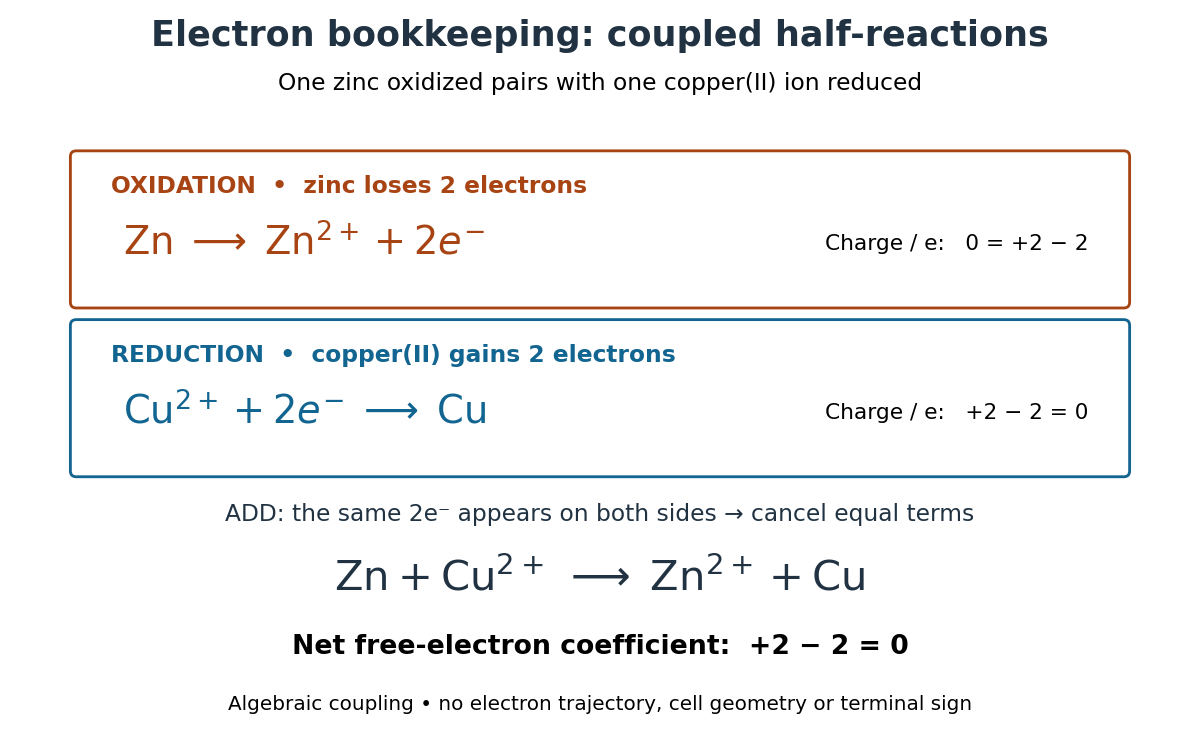

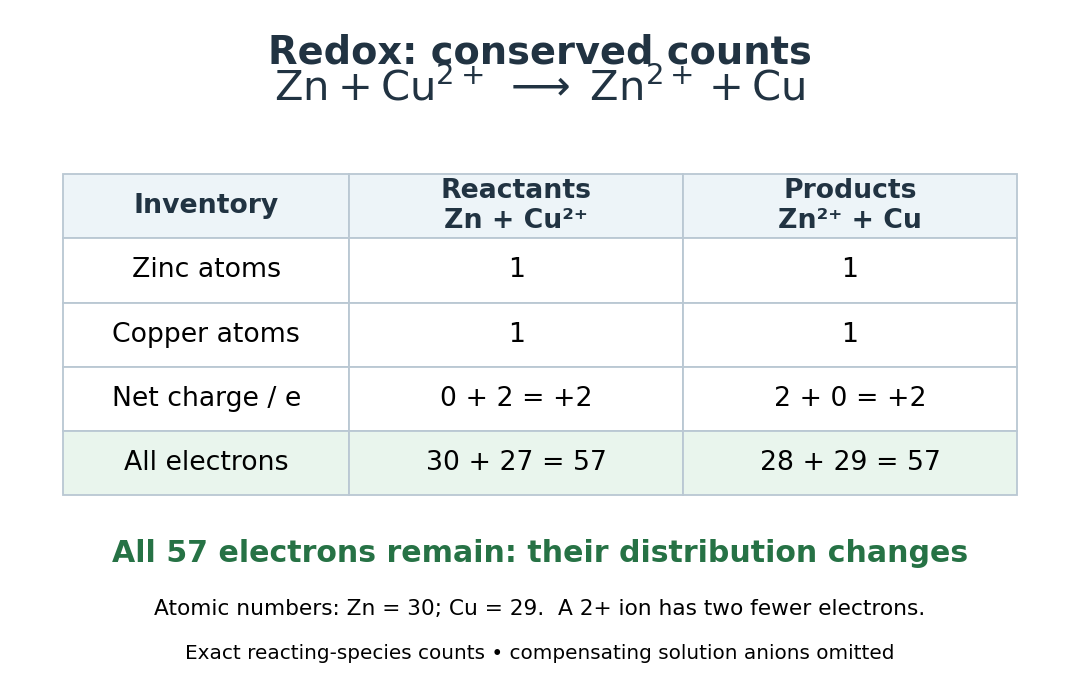
Check both kinds of balance. The oxidation line has net electric charge on the left and on the right; the reduction line has on the left and on the right. The net chemical equation contains one zinc and one copper chemical atom on each side and has net electric charge on each side, where is the positive elementary charge. The written reacting species need not be electrically neutral as a group: the bulk chemical solution also contains compensating anions.
There is an even more literal check. Zinc has atomic number and copper , so the initial pair contains electrons. The final pair contains electrons. Only their distribution has changed. Conserved chemical element counts give the usual chemical mass conservation inventory; changing the counts of neutral and charged species does not create or remove their atomic nuclei.

Matching electrons is necessary but does not replace balancing every chemical element. The acidic permanganate-iron balance illustrates unequal one- and five-electron exchanges, with water and protons also needed. Conversely, a balanced chemical equation alone establishes neither a reaction rate nor a detailed mechanism. Its usefulness is that it fixes the stoichiometry even when those additional questions remain open.
Random: Probability, Mathematical Statistics, Stochastic Processes by Kyle Siegrist Discrete Uniform Distributions Created 2026-10-14 Updated 2026-10-18
An authored section of the online textbook Random. No publication or update date is established.
Born-Oppenheimer approximation 2026-10-14
The Born-Oppenheimer approximation separates electronic and nuclear motion. At leading order, fixed nuclear positions and electric charges specify an electronic potential energy curve, on which the atomic nuclei move with their own masses.
Hyperfine structure Created 2026-10-14 Updated 2026-11-05
Hyperfine structure is the small splitting of atomic or molecular energy levels caused by interactions involving the atomic nucleus's magnetic dipole moment or electric quadrupole moment. It is finer than the electronic fine structure. A leading magnetic-dipole hyperfine interaction couples the nuclear spin to the electronic angular momentum ; their total angular momentum labels the resulting hyperfine levels.
With dimensionless angular momentum operators, the model gives shifts . A hydrogen atom in its electronic ground state has , giving . Resolved microwave transitions between hyperfine levels permit precise spectroscopy and provide the working transitions in many atomic clocks. Applied magnetic fields can split each hyperfine level further into magnetic sublevels.
There are unlisted articles, also show them or only show them.