
Work by Antoni Dymanus 2026-10-14
House mouse Created 2026-10-14 Updated 2026-11-05
The house mouse, Mus musculus, is a small rodent associated with human environments and widely used in experimental biology. Laboratory strains provide controlled inherited backgrounds, while wild populations reveal variation shaped by ecology and ancestry.
Protractor Created 2026-10-14 Updated 2026-11-05
A protractor is a graduated instrument for measuring or drawing planar angles, commonly a semicircular scale from to . Place its centre at the vertex, align its zero baseline with one ray, and read where the other ray crosses the scale. A reading represents radians. A device with oppositely directed scales requires choosing the scale whose zero matches the aligned baseline.
Angle bisector Created 2026-10-14 Updated 2026-11-05
An angle bisector is a ray dividing an angle into two equal angles. For nonopposite unit vectors , its internal direction is : the dot products with and are equal. The direction bisects the external angle. The three internal angle bisectors of a triangle meet at the incenter, equidistant from its side lines. The angle bisector theorem relates each bisector to side-length ratios.
Work by Angela R. Hight Walker 2026-10-14
Work by Andrew V. Sutherland Created 2026-10-14 Updated 2026-10-24
Work by Andrei Tokmakoff 2026-10-14
Work by Andrea Honeycutt Mathis 2026-10-14
Work by André Jürgen Massing 2026-10-14
Threonine residue Created 2026-10-14 Updated 2026-11-05
A threonine residue is a threonine unit incorporated into a peptide or protein chain, conventionally represented by T. Its hydroxyl-bearing side chain can participate in hydrogen bonding and can be phosphorylated by suitable protein kinases. The side chain is retained during peptide-bond formation, while the amino and carboxyl groups become part of the backbone. Residue identity and modification state are therefore distinct information. [ref]
Work by Alfred Pérot 2026-10-14
Work by Alexey Khodjakov 2026-10-14
Work by Alex Gerdes 2026-10-14
Work by Albert W. Tucker 2026-10-14
Work by Alan V. Oppenheim Created 2026-10-14 Updated 2026-11-05
Work by Akiko Kumagai 2026-10-14
Respiration and ATP coupling Created 2026-10-14 Updated 2026-10-20
Glycolysis converts glucose into two pyruvate molecules, with a net two ATP and reduced NADH; it does not directly consume molecular oxygen. Pyruvate processing and the citric acid cycle, also called the TCA cycle, release carbon dioxide and supply reduced carriers. Thus releasing carbon dioxide and consuming molecular oxygen occur at different stages.[ref]
Biology 2e by Mary Ann Clark and others. Biology 2e, §7.2, Outcomes of Glycolysis; §7.3, Breakdown of Pyruvate and Citric Acid Cycle
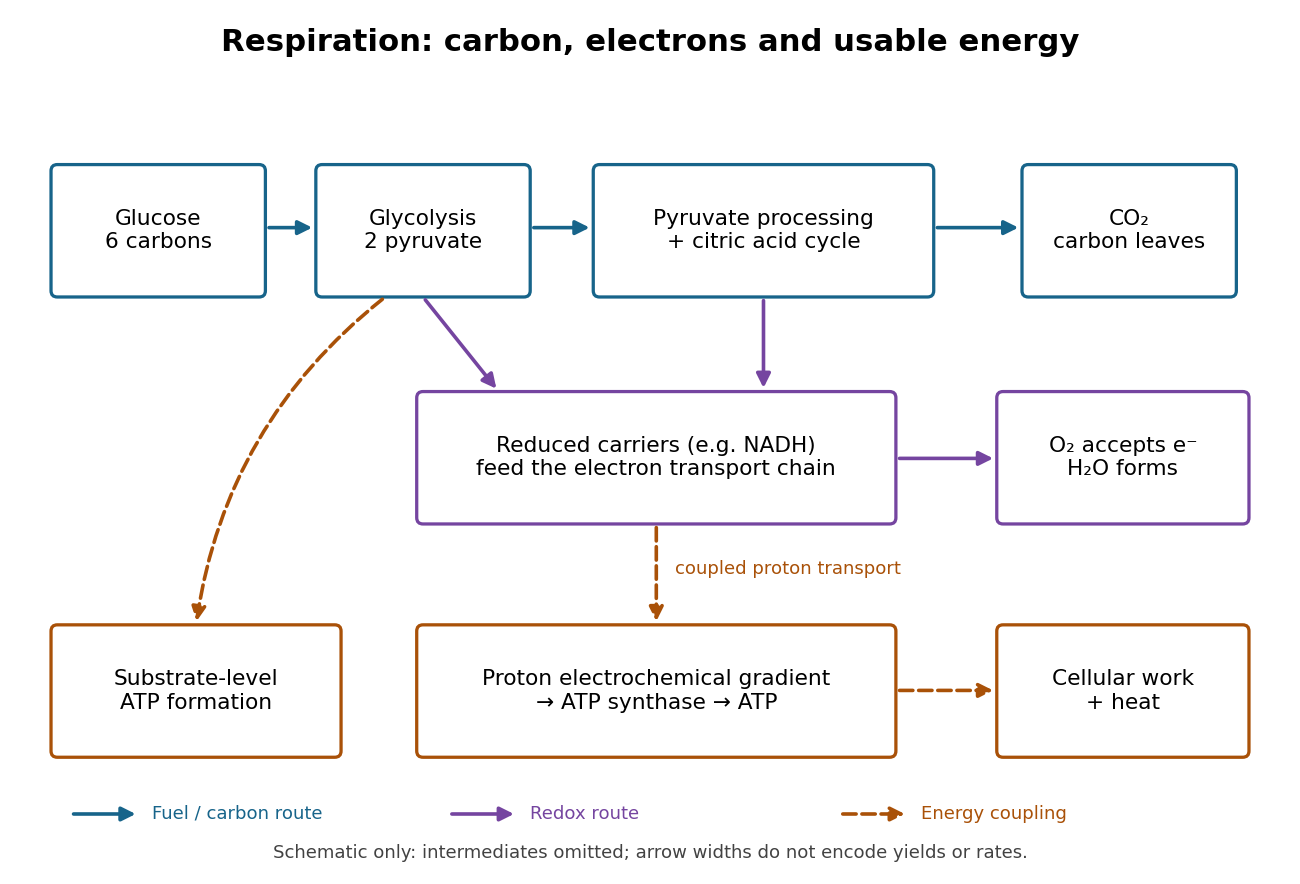

An electron transport chain reoxidizes carriers such as NADH. Coupling some of its redox steps to proton transport establishes an electrochemical gradient; ATP synthase can use that gradient to form ATP from adenosine diphosphate and inorganic phosphate. This is oxidative phosphorylation. A separate route, substrate-level phosphorylation, transfers a phosphate group from a reacting substrate to adenosine diphosphate. In typical eukaryotic biological cells, the respiratory chain occupies the inner membrane of a mitochondrion.[ref]
Biology 2e by Mary Ann Clark and others. Biology 2e, §7.1, Substrate Phosphorylation; §7.4, Electron Transport Chain and Chemiosmosis, Figures 7.12–7.14
The useful achievement is controlled transfer: fuel oxidation can replenish an ATP supply that supports active transport and synthesis. ATP is a reusable chemical carrier, not newly created energy; ATP hydrolysis and the coupled cellular process have their own net free energy balance. Some fuel energy is dissipated as heat.[ref]
Biology 2e by Mary Ann Clark and others. Biology 2e, §7.1, ATP in Living Systems and Energy from ATP; §7.4, ATP Yield
There is no universal yield of or ATP per glucose. Actual ATP recovery depends on carrier transfer routes, coupling and diversion of intermediates to other metabolism. In particular, an oxygen uptake rate cannot be converted into an ATP production rate by assuming one fixed multiplier.[ref]
Biology 2e by Mary Ann Clark and others. Biology 2e, §7.4, ATP Yield: shuttle differences and use of intermediates
Adrenergic adipocyte assay 2026-10-14
In the 1981 study, investigators incubated human adipocytes or their cell membranes from fat near the abdominal lining with epinephrine. They combined detection of bound ligands by radioactive decay with biochemical readouts: adenylyl cyclase activity, cAMP and released glycerol. Blocking alpha-2 adrenergic receptors increased the epinephrine response; blocking alpha-1 adrenergic receptors did not. A separate labeled-phosphate incorporation readout in a phospholipid showed the reverse blocker sensitivity. Thus the comparisons separated response branches.[ref]
Pharmacological Characterizations of Adrenergic Receptors in Human Adipocytes by Thomas W. Burns and others. Abstract, first through fourth paragraphs: human properitoneal preparations, radioligand binding, biochemical readouts; yohimbine versus prazosin comparisons
The glycerol readout indicates lipolysis, rather than directly measuring whole-body fuel use. Isolated adipocytes omit circulation and nervous input; blocker selectivity also limits the inference. These comparisons support receptor-specific responses in that preparation, not identical behavior in all biological cells.
Compound action potential Created 2026-10-14 Updated 2026-10-24
A compound action potential is an extracellularly recorded sum of activity from multiple axons. Amplitude and waveform depend on recruitment and relative arrival times. The documented neuronal paired-pulse recovery experiment illustrates why recovery of a summed response is not recovery of one neuron.
For a deterministic binary operation on an abstract data type, let be its specified operation on abstract values and the implementation on concrete states. For every permitted valid input pair , require bothThe first condition preserves the representation invariant. The second makes a commutative diagram: either execute and then apply the abstraction function, or apply the abstraction function to both inputs and then execute the abstract operation ; both paths reach the same value. These conditions state functional correctness of a completed operation; termination is an additional obligation for algorithm correctness.[ref]
8.3 Module Documentation. Sections 8.3.3, Commutative Diagrams, and 8.3.4, Representation Invariants: matching abstract results and preservation of valid representations
For addition in the unreduced rational representation, chooseFor example, represents , precisely the sum of and . The short correctness argument uses nonzero denominators: and imply , preserving the representation invariant, and
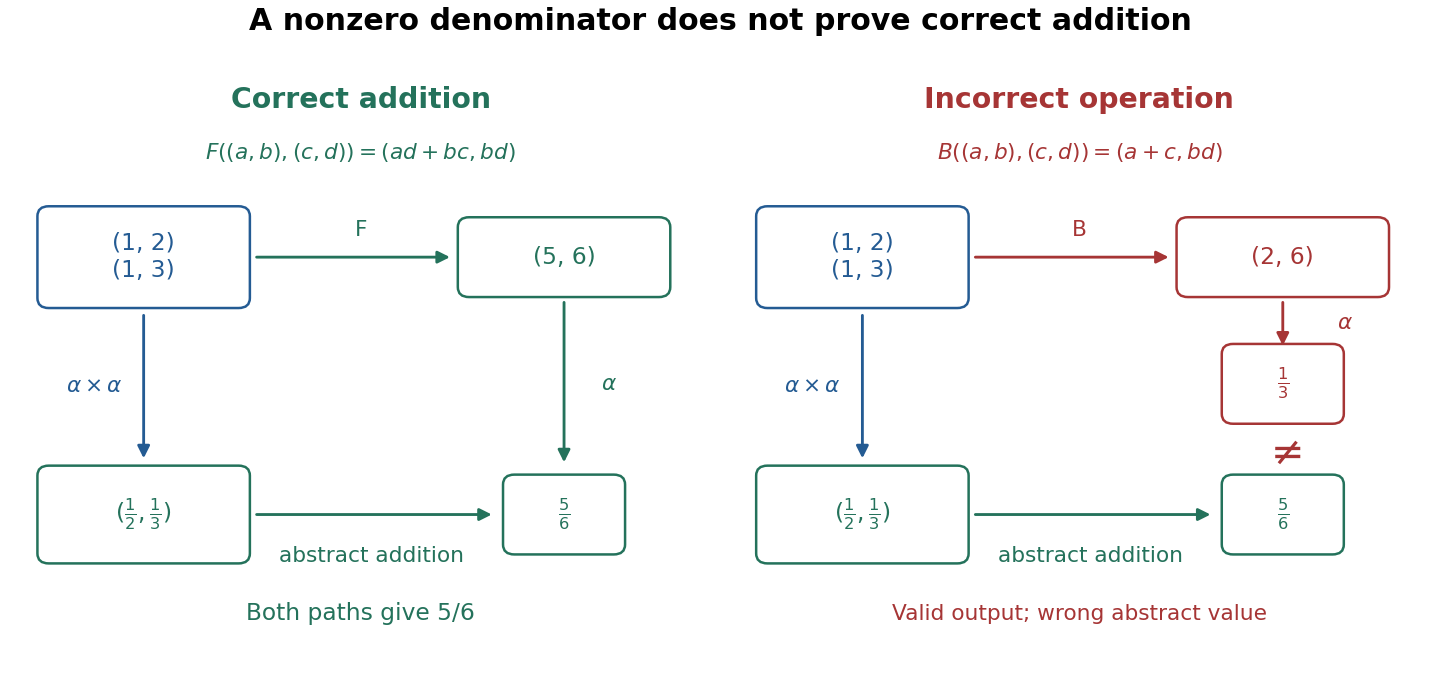
Correct rational addition makes both paths agree; an invariant-preserving incorrect operation gives a different value
. Details. 
Now consider an incorrect implementation that uses addition on the numerators and multiplication on the denominators:It preserves the representation invariant for every valid input pair because its denominator is still . Yet represents , not the specified sum . Even perfect checks of the representation invariant before and after this call would miss the error: the result is a legal representation of the wrong rational number.
The incorrect operation also exposes an accidental dependence on representation. Replace by the equivalent state while keeping . The correct operation gives , still representing ; the incorrect operation gives , representing instead of its previous . A correct addition must yield the same abstract result for equivalent inputs, although its concrete outputs may differ. This is why checks against the formal specification should compare abstract values, including unreduced representations and representations with a negative denominator, rather than demand identical stored pairs.
The calculation assumes exact integers. An implementation with bounded storage must additionally specify how it handles products and sums outside its supported range; the mathematical argument alone does not establish its functional correctness. The bounded queue with encapsulation illustrates the corresponding need to account for returned status values and failed operations, alongside the abstract state transition.
There are unlisted articles, also show them or only show them.