
Work by Gerald Teschl 2026-10-14
Work by Gerald T. Fraser 2026-10-14
Work by George T. Furukawa 2026-10-14
Work by George Pólya 2026-10-14
Work by George C. Rhoderick 2026-10-14
Work by Gaston Floquet 2026-10-14
Sperm Created 2026-10-14 Updated 2026-11-05
Work by Gabriele Rosi 2026-10-14
Work by Gabriele Farina 2026-10-14
External force 2026-10-14
An external force is a force exerted on a member inside the chosen system boundary by a body outside it. Changing that boundary can change which forces are external. Their sum changes the system's total momentum when its internal forces cancel.
Internal force 2026-10-14
An internal force is a force between members inside the chosen system boundary. Changing that boundary can change which forces are internal. Pairwise Newtonian mechanics interactions cancel through third-law interaction pairs in the system's total momentum balance.
Free-body diagram Created 2026-10-14 Updated 2026-10-18
A free-body diagram isolates a body and shows the forces exerted on it. A third-law interaction pair acts on different bodies and belongs in separate body diagrams.
Work by Fiodor Sorrentino 2026-10-14
Zygote Created 2026-10-14 Updated 2026-11-05
A zygote is the biological cell formed by fusion of gametes during fertilization. In a typical haploid-diploid life cycle, two haploid contributions form one diploid cell nucleus, restoring the two sets separated by meiosis.
The zygote begins a new developmental sequence. In land plants, it develops into the sporophyte; the preceding gametophyte generation instead produces the fusing gametes.
Double fertilization 2026-10-14
In the common angiosperm arrangement, one sperm fuses with the ovum to form a diploid zygote; another fuses with the central biological cell's two polar cell nuclei, initiating endosperm with three chromosome sets. The zygote develops into a plant embryo, and the ovule develops into a seed.[ref]
For an original counting example, stipulate a plant with chromosomes and the common two-polar-nucleus arrangement. Each haploid sperm and ovum contributes . The zygote therefore has chromosomes, while the initiating endosperm cell nucleus has . The maternal seed coat remains derived from plant tissue; the whole seed has no single uniform chromosome count. This is bookkeeping for a stipulated example, not identification of a particular species. It follows by counting the chromosome sets entering each fusion, rather than assigning one count to everything enclosed by a seed coat.
Fermat test example 2026-10-14
For the Fermat primality test, a passing base satisfies . Passing proves only this modular congruence, not that is a prime number. An odd composite number that passes a coprime base is a Fermat pseudoprime to that base. A Carmichael number passes every coprime base, so even testing all the units would not certify that is a prime number. [ref]
Fermat's Test by Keith Conrad. Keith Conrad, Fermat's Test, pp. 5–6, Definition 4.1 and the list beginning with 561
This small table uses only the bases , each reduced modulo first. A numeric entry is : one passes, while any other numeric entry gives a Fermat witness. A "factor" entry records a proper greatest common divisor and stops before modular exponentiation. The prime/composite classification is independently established by trial division or the displayed prime factorization, not by the passing entries. These four bases are illustrative, with no asserted universal coverage or error probability.
Table 1.
Finite-base Fermat primality test examples with explicit greatest common divisor checks
. | Independent classification | |||||
|---|---|---|---|---|---|
| 2 | Prime number | Zero residue: excluded | 1 | 1 | 1 |
| 7 | Prime number | 1 | 1 | 1 | 1 |
| 15 | : composite number | 4 | Factor 3 | Factor 5 | 1 |
| 341 | : composite number | 1 | 56 | 67 | Factor 11 |
| 561 | : composite number | 1 | Factor 3 | 1 | Factor 11 |
For , and , so . Yet and , so three is a Fermat witness. One coprime base passes and another fails: being a Fermat pseudoprime depends on the base. Choosing eleven instead reveals the proper factor through .
For , every coprime base passes: each of divides , so Fermat's little theorem gives modulo each prime factor; the Chinese remainder theorem combines the three modular congruences. Equivalently, the Carmichael function gives . Bases two and five have greatest common divisor one and pass, but , and expose factors. The qualification "coprime" is therefore crucial even for a Carmichael number.
The Fermat primality test is useful because a Fermat witness can prove compositeness using repeated squaring without finding a factor. Its failure to certify a passing candidate motivates stronger primality testing methods such as the Miller-Rabin primality test.
Fermat witness 2026-10-14
A Fermat witness for an integer is a nonzero residue class represented by for which . It proves that is a composite number by Fermat's little theorem. Here the definition includes nonunits; some conventions restrict Fermat witnesses to bases coprime to . The Fermat primality test can first compute the greatest common divisor: if , it already has a proper factor. A zero residue class is excluded. [ref]
Fermat's Test by Keith Conrad. Keith Conrad, Fermat's Test, p. 2, Definition 2.4 and footnote 3 on the two witness conventions
Nonzero residue permutation 2026-10-14
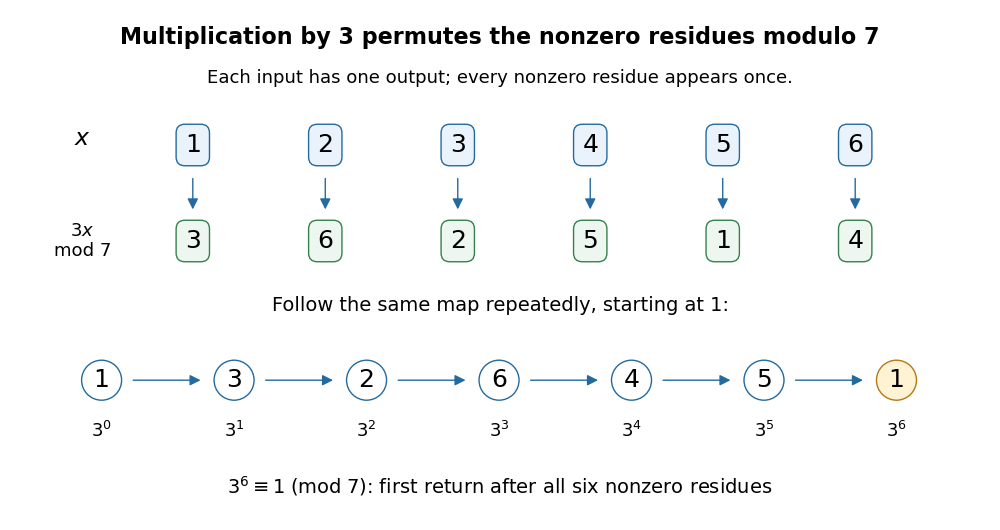
For a prime number and , multiplication by gives a permutation of the nonzero residue classes. For modulo seven, the representatives map to : the same collection in a different order. Repeating this permutation from one visits all six representatives before returning.

For modulo seven, the permutation cycles are instead and . The powers of two visit only the permutation cycle containing one, so their multiplicative order is three. Both permutation cycles return after three steps; applying the permutation six times still fixes every nonzero residue class. Fermat's little theorem guarantees a return at six, not that every base visits every nonzero residue class.
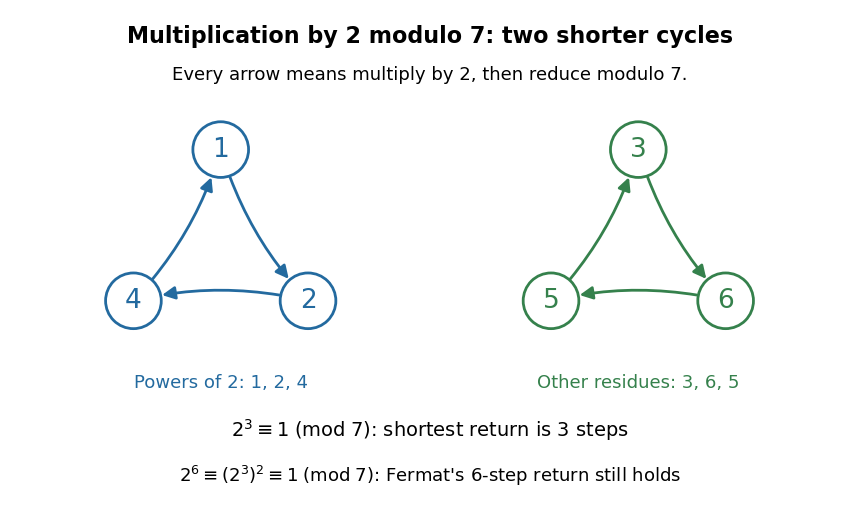

More generally, every permutation cycle of this map has length equal to the multiplicative order of : starting at a nonzero residue class , a return means , and its modular multiplicative inverse allows cancellation of . Thus the nonzero residue classes split into equal-length permutation cycles, which also explains the divisibility of the multiplicative order into .
The product argument gives a short proof outline. Since multiplication by is a permutation of the nonzero residue classes,Every factor is a unit, so their product has a modular multiplicative inverse and can be cancelled. This leaves . The whole argument works for , where the product is just one.[ref]
Exclusive or toggles and parity 2026-10-14
For bits , repeated exclusive or computes the parity of the number of ones:An induction proves this: the first bit gives its own parity, and appending a zero preserves it while appending a one changes it. The binary string has three ones, so its parity bit is one. Append that parity bit to obtain , whose six bits have even parity. Flipping the second bit produces and changes the combined exclusive or to one, detecting an error. Flipping the third bit as well produces , with four ones and combined exclusive or zero: an even number of flips can escape this check.
For three inputs, repeated exclusive or means an odd number of true inputs, rather than exactly one: . The “exactly one” description applies to the two-input exclusive or. This distinction matters when translating a requirement that exactly one option be selected into a program condition.
Work by Eugène Charles Catalan 2026-10-14
There are unlisted articles, also show them or only show them.