
CPython Created 2026-10-14 Updated 2026-11-05
CPython is the principal implementation of Python, developed in the Python project's source repository and distributed through python.org. It parses source code and compiles it into code objects containing bytecode, which its execution machinery evaluates. The
dis module makes the bytecode instructions visible, connecting source-level functions with their compiled representation.[ref]For example, a function that returns
len(items) needs to obtain the callable and argument, perform the call and return its result. A bytecode listing reveals those operations, together with version-specific supporting instructions. CPython can specialize instructions as a program runs. Exact instruction names and layouts are implementation details that can change between releases; the meaning of the Python source expression is specified at the language level.Part of Python 3.14 documentation, issued by the Python Software Foundation. The inspected page reports documentation version 3.14.8; no separate author byline or publication year is inferred.
Online text: docs.python.org/3.14/library/functions.html#compile
Cited passages: Python 3.14 documentation, compile entry: source text or an abstract syntax tree as input, code or AST objects as output, execution through eval or exec, and exec/eval/single modes.
Part of Python 3.14 documentation, issued by the Python Software Foundation. The inspected page reports documentation version 3.14.8; no separate author byline or publication year is inferred.
Online text: docs.python.org/3.14/glossary.html#term-bytecode
Cited passages: Python 3.14 documentation, bytecode entry: CPython compilation, execution, caching and release-dependent bytecode; virtual machine and CPython entries.
Calcium carbonate precipitation experiment 2026-10-14
The University of Utah's teaching module Carbon Captured Chalk by Tony Butterfield describes a supervised demonstration. Its Materials and Methods uses a balance, weighing boats, spatula, separate centrifuge tubes, a volume-measuring vessel and filter paper. Sodium carbonate and calcium chloride are dissolved separately in water before mixing. The reported readout is an initially opaque mixture followed by a milky dispersion of fine solid particles; filtration retains the chalk-like product, which is then dried. The module also proposes observing drops together on a slide using an optical microscope.[ref]
Carbon Captured Chalk by Tony Butterfield. Carbon Captured Chalk, Materials and Methods, steps 1–13; Optional Activities and Extensions, microscope slide
The handout does not report blank trials. Useful additional controls would retain each starting chemical solution separately, mix each with water, and pass water alone through the same filter. A new solid only in the combined sample would support a mixing-dependent chemical reaction; these are proposed comparisons, not reported results. Residue from a filter blank would instead flag contamination.
Cloudiness plus a retained solid supports phase separation; appearance alone cannot establish composition, a particular crystal polymorph, quantitative yield or the solubility product. Fine solid particles may pass through a filter, and retained liquid can leave dissolved salts on drying. Identifying calcium carbonate needs additional chemical or structural evidence. The teaching source supplies no measured ion products, instrument-calibrated cloudiness series or equilibration test. Its concentrated demonstration therefore illustrates precipitation without validating the toy model's conditional constant or proving complete removal of dissolved calcium.
Solubility product 2026-10-14
The solubility product is the equilibrium constant for dissolution of a specified solid into its dissolved ions. For a pure bulk AB solid at the chosen temperature, pressure and standard states,The pure bulk solid's thermodynamic activity is one in this convention. Coexisting solid and chemical solution at chemical equilibrium give this equality. If all available solid dissolves, the final chemical solution may instead be undersaturated; do not impose equality merely because a salt was initially added.[ref]
15.1 Precipitation and Dissolution. Chemistry 2e, §15.1, The Solubility Product: saturated solution with excess solid and dissolution equilibrium
Using the thermodynamic activity definition , with activity coefficients and reference molar concentration , gives the independent conversionThus is dimensionless, while the conditional concentration form has units for this one-to-one model. Treating as constant requires a justified fixed or approximately fixed activity coefficient product. Changing ionic strength can change that product even at fixed temperature; changing temperature can change the equilibrium constant itself. Specify the solid thermodynamic phase too: different crystal polymorphs need not have the same solubility product.
Net ionic equation 2026-10-14
A net ionic equation retains the chemical species changed by a chemical reaction and cancels spectator ions present unchanged on both sides. Dissolved strong electrolytes are represented by their separated ions, while a solid product retains its chemical formula. Cancellation preserves both elemental inventories and electric charge conservation.[ref]
Chemistry 2e by Paul Flowers and others. Chemistry 2e, §4.2, Precipitation Reactions and Solubility Rules: molecular and net ionic equations for silver chloride
For the calcium carbonate example, the complete ionic account isCanceling the sodium cations and chloride anions yields the net ionic equation above. Neither cancellation nor the conventional sodium chloride formula implies that the remaining dissolved ions have become paired molecules.
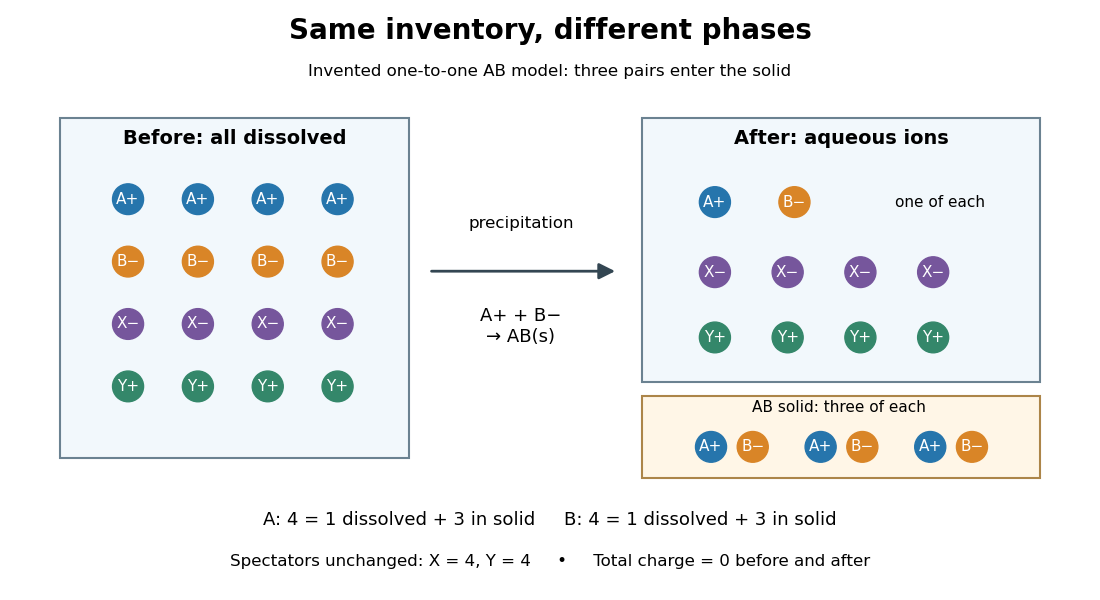

For this schematic, let be the amount of substance of AB formed. With no competing chemical reactions or losses,Adding each dissolved inventory to its contribution in the solid recovers its initial total. Each dissolved pair has net electric charge zero, so transferring a pair into neutral AB also preserves electric charge conservation. This is a short stoichiometry argument; choosing the actual additionally needs chemical equilibrium or chemical kinetics information.
Precipitate Created 2026-10-14 Updated 2026-10-20
A precipitate is the solid formed by precipitation. Fine particles can initially remain dispersed as a particle suspension, rather than immediately settling to the vessel bottom.
Section of Prealgebra 2e, whose senior contributing authors are credited in the book preface. The whole-book citation identifies publication on 11 March 2020; website footer copyright is a different date.
Cited passages: Prealgebra 2e, §3.1: Locate Positive and Negative Numbers on the Number Line; Opposite Notation; Integers.
Carbonate Created 2026-10-14 Updated 2026-11-05
The carbonate ion is , with a planar carbon-oxygen framework and delocalized bonding. Its protonated relative is bicarbonate, .
Carbonate salts, dissolved carbon dioxide, and these protonation states are linked by acid-base and solubility equilibria. Adding acid can release carbon dioxide, while changing pH can alter which carbonate-containing solids are stable.
Online text: www.math.ucla.edu/~sharifi/notes/topology-ch01.html
Cited passages: Definition 1.1.9: finite complement topology; Definition 1.5.5, Proposition 1.5.11 and Proposition 1.6.20: neighbourhood convergence, uniqueness and the metric formulation; Example 1.5.10 and Proposition 1.5.11: closed points, overlapping neighbourhoods, non-repeating sequences and uniqueness in Hausdorff spaces.
Work by PHYWE Systeme GmbH & Co. KG 2026-10-14
Online text: ncert.nic.in/textbook/pdf/leph104.pdf
First edition December 2006; revised edition November 2022; the linked chapter is marked Reprint 2026–27. The issuing body is NCERT; no individual chapter byline is asserted.
Normalized Latin transcription of Axiomata sive leges motus from the 1687 book. The Newton Project published the transcription online in November 2009; host and transcription editors are distinct from Isaac Newton, the book author.
Cited passages: Isaac Newton, Philosophiae Naturalis Principia Mathematica (1687), Axiomata sive leges motus, printed p. 13, Lex III and its explanation; pp. 16–17, Corollarium III; Newton, Axiomata sive leges motus (1687), Lex II.
Pharmacologist Created 2026-10-14 Updated 2026-11-05
A pharmacologist studies interactions between drugs and biological systems. Experiments can connect a molecular target to tissue responses or whole-organism effects. Establishing drug action requires specifying both the biological preparation and the exposure.
Pancreatic acinar cell Created 2026-10-14 Updated 2026-11-05
Oscillator Created 2026-10-14 Updated 2026-11-05
An oscillator is a system capable of repeated motion or variation about a central state. A mass on an ideal spring with spring constant satisfiesThe restoring force accelerates the mass toward zero displacement; inertia carries it through that point, producing simple harmonic motion. The kinetic energy is largest at zero displacement, and the elastic potential energy is largest at the turning points.
Real oscillators can include damping, external driving and anharmonicity. A damped harmonic oscillator distinguishes the free transient from the forced periodic response, and a coupled oscillator adds exchange of energy with another dynamical coordinate. This makes an oscillator useful both as a physical device and as an approximation to small disturbances of much more complicated systems.
Online text: openstax.org/books/organic-chemistry/pages/5-8-racemic-mixtures-and-the-resolution-of-enantiomers
Cited passages: McMurry, Organic Chemistry, §5.8: equal enantiomer populations and cancelling optical rotations.
There are unlisted articles, also show them or only show them.