
Clamped interval derivative norm bound 2026-10-14
For , integrate its weak derivative from the left endpoint, where . The Cauchy-Schwarz inequality gives and . Adding the three squared derivative norms gives the displayed bound. The constant is sufficient, rather than asserted sharp. Thus the second-derivative norm is equivalent to the full Sobolev norm on this clamped space.
Claims inflation Created 2026-10-14 Updated 2026-11-05
Claims inflation changes the monetary size of a claim over calendar time. With a fixed annual rate , a time-zero size becomes the displayed end-of-year amount. Historical claim amounts must be converted to a common price year before their empirical monetary averages are combined. When the per-claim amounts are known, dividing total amount by the year's per-claim amount recovers the claim count.
An inner NFW profile has , where . If the final total circular speed is , circular-shell adiabatic contraction gives and . Thus . The total density producing the flat curve is , so the dark fraction tends to zero as despite its increase relative to the original cusp.
Synchronous circular orbit Created 2026-10-14 Updated 2026-11-05
A synchronous circular Kepler orbit has an orbital period equal to its central body's sidereal rotation period . For the ideal spherical planet of mass , Kepler's third law givesThe satellite's own mass cancels in the test-particle approximation. The radius must exceed the planet's physical radius for an external orbit.
Matching periods alone does not keep the satellite above a fixed surface point. That stronger condition requires a prograde equatorial circular orbit, giving a planet-stationary orbit; the terrestrial case is a geostationary orbit. An inclined synchronous circular orbit moves north and south relative to the equator despite its matching period. This distinction is useful when choosing between repeated ground coverage and an apparently fixed satellite.
Maximum separation of two circles 2026-10-14
For two nonempty planar circles with centers and radii , the greatest Euclidean distance between their points is the displayed expression. The triangle inequality gives the upper bound. When the centers differ, choose the two boundary points outward along the line of centers to attain it; when they coincide, choose opposite radial directions. For any third nonempty circle and a point on it, proves . This is not a metric, since for a positive-radius circle.
For real and complex , completing the square in gives center and radius , when the radicand is nonnegative. The displayed map is reflection in the line through and : it preserves the complex modulus, fixes the center, and squares to the identity. Hence it maps the circle onto itself, including a radius-zero degeneration.
Chord of a circle 2026-10-14
A chord joins two points of a circle by a straight segment. If the circle has radius and the chord midpoint lies a distance from its center, the perpendicular bisector and Pythagorean theorem give the displayed length. The length exceeds that of an inscribed equilateral triangle precisely when .
Semicircle Created 2026-10-14 Updated 2026-10-18
Half of a circle, with endpoints at opposite ends of a diameter. For radius , the upper semicircle in the complex plane is parametrized by , , going counterclockwise from to .
Chromatic polynomial determines a Turán graph Created 2026-10-14 Updated 2026-11-05
For integers , if a simple graph has the same chromatic polynomial as the Turán graph , it has the same number of vertices and edges, and the same chromatic number . It is therefore -free and attains equality in Turán's theorem. The equality case forces it to be isomorphic to .
Mycielskian Created 2026-10-14 Updated 2026-10-14
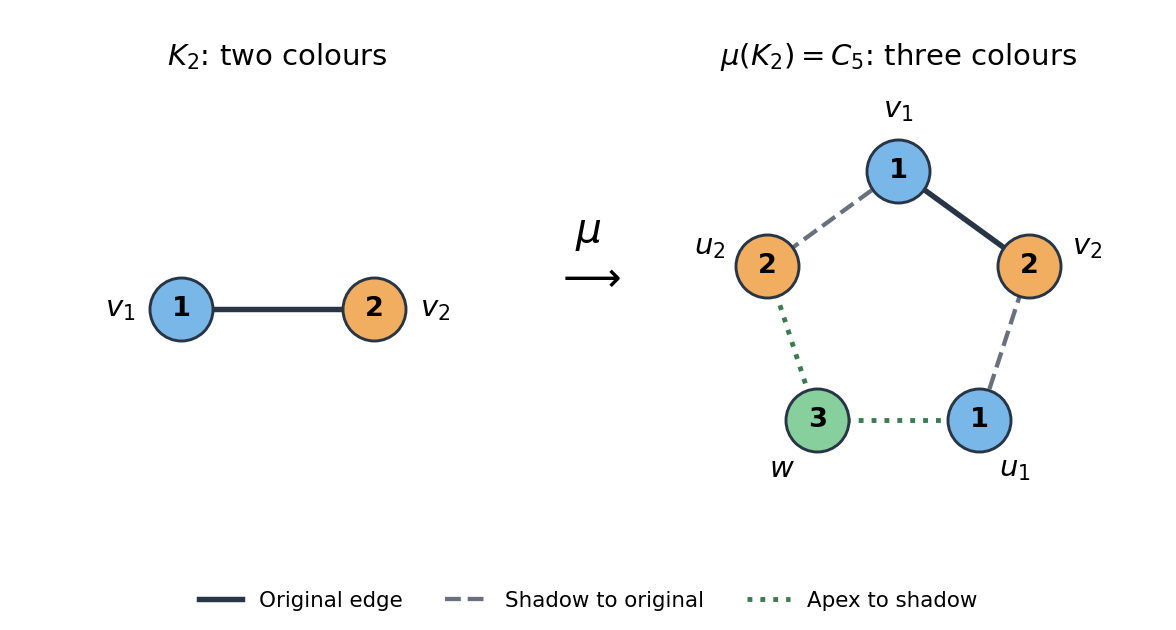
The Mycielski construction replaces a graph with a graph having one shadow vertex for each original vertex and one further vertex adjacent to every shadow. It satisfiesand preserves triangle-freeness. Iterating it from the five-cycle gives triangle-free graphs of arbitrarily large chromatic number.
Here is a finite simple graph with at least one vertex; it need not have an edge. The Mycielskian separates two ways of needing many colours: a large clique forces distinct colours immediately, but a triangle-free graph can impose incompatible choices through its whole pattern of graph adjacency. The Mycielski construction increases that global constraint while preserving the absence of triangles in a graph.
Write the vertex set of as , with . Keep these vertices, add distinct Mycielski shadow vertices , and add a Mycielski apex . The vertex set and complete list of edges areThere are no other edges: the Mycielski shadow vertices form an independent set, has no original vertex as a neighbour, and is not adjacent to . Each Mycielski shadow vertex copies its original vertex's graph neighbourhood within the original vertex set, not its position in the drawing. This is the construction in the inspected research paper.[ref]
For original vertices and original edges, direct counting gives vertices and edges. The original vertices induce a copy of , so no original graph adjacency is lost. A drawing crossing is not an extra vertex.
Start with the complete graph , whose only edge is , abbreviating . Its Mycielskian has exactly the edges . Reading them as gives the cycle graph . A proper vertex colouring gives colour 1, colour 2, and colour 3. Two colours cannot close an odd cycle, so its chromatic number is exactly three.

Chromatic number of Euclidean space 2026-10-14
This is the least number of colors needed to color all points of Euclidean space so that points at Euclidean distance one receive different colors. Any finite unit-distance graph embedded in the space gives a lower bound. If is prime, the characteristic vectors of all -subsets of , divided by , give such a graph: its edges are exactly pairs intersecting in points. The prime-power modular intersection bound bounds an independent set by , and hence gives .
Lateral chromatic aberration 2026-10-14
Lateral chromatic aberration, also called transverse chromatic aberration, is colour-dependent image scale: an object away from the optical axis can have different image heights at different wavelengths. Its changing transverse magnification produces displaced coloured edges. The on-axis parallel bundle in the chromatic aberration diagram illustrates axial chromatic aberration, and does not measure lateral chromatic aberration. [ref]
https://imaging.nikon.com/sport-optics/guide/fieldscopes/choosing/choosing_03/. Nikon, wavelength-dependent focal point and magnification
. Axial chromatic aberration 2026-10-14
Axial chromatic aberration, also called longitudinal chromatic aberration, is colour-dependent focus position along the optical axis. For incident light rays parallel to the optical axis, it appears as a changing focal length. The chromatic aberration diagram isolates this effect using an ideal thin lens at each colour.
Phase locking of a resonant hexagonal triad 2026-10-14
For with all , the translation-invariant total phase is . With , the displayed equation makes stable and unstable. A spatial translation can remove two phases, so the stable locked states have all amplitudes positive real in a suitable origin. This is a statement modulo translation, not that every translated representative is real; the zero solution and rolls belong to boundary strata.
Uniqueness of positive hexagon equilibria with straddling cross-couplings Created 2026-10-14 Updated 2026-11-05
Assume , as in the stable phase-locked branch. At a positive equilibrium set and . The equations imply . Suppose and relabel cyclically so is maximal. If , subtracting equations one and two makes the cubic side positive unless all are equal, whereas is nonpositive. If , subtracting equations two and three gives the opposite sign contradiction. Interchanging the orientation handles . Thus all positive equilibria have equal amplitudes. With , a state with exactly two nonzero amplitudes cannot be an equilibrium because it immediately forces the third.
Chiral hexagon Hopf threshold Created 2026-10-14 Updated 2026-11-05
Assume . For equal positive amplitudes , let and use . The radial Jacobian eigenvalue is . The conjugate pair has real part and imaginary parts . When and , the upper hexagon branch loses amplitude stability through this pair at the displayed radius. The associated parameter is . Nonlinear terms decide the direction and stability of the resulting periodic branch.
Chi-bar-squared distribution Created 2026-10-14 Updated 2026-11-05
A Chi-bar-squared distribution is a mixture distribution , where and , and denotes a point mass at zero. It arises when a Gaussian likelihood is optimized under inequality constraints: projection onto a constraint cone selects different dimensions according to which inequalities are active. For example, if are independent standard Gaussian random variables, then has distribution . On it is ; on it is . Symmetry makes the sign of independent of , proving the stated weights and component laws.
Radial moments of an isotropic Gaussian vector Created 2026-10-14 Updated 2026-11-05
For independent centered normal random variables of common variance , has a chi-squared distribution with degrees of freedom. Its density gives the displayed moments by a gamma integral. In three dimensions, . Radial odd moments need not vanish, although any odd Cartesian product does.
Historical source for Chernoff information 2026-10-14
Stanford's archive records a technical report by Herman Chernoff, dated November 1951, on asymptotic efficiency of hypothesis tests based on sums of observations.[ref]
A Measure of Asymptotic Efficiency for Tests of an Hypothesis Based on the Sum of Observations, technical report by Herman Chernoff. Stanford Statistics technical-report record: SOL ONR 6, author H. Chernoff, report date November 1951
This is historical source metadata, rather than a claim to have inspected the report's full proof. The modern theorem cited above connects that efficiency question to the log-likelihood ratio accumulated across repeated observations.Let be the Bernoulli distribution with success probability and the Bernoulli distribution with success probability . For ,The two summands have product . Their arithmetic mean is at least their geometric mean, with equality at . ThusThe same argument gives for complementary parameters . At the laws agree and .
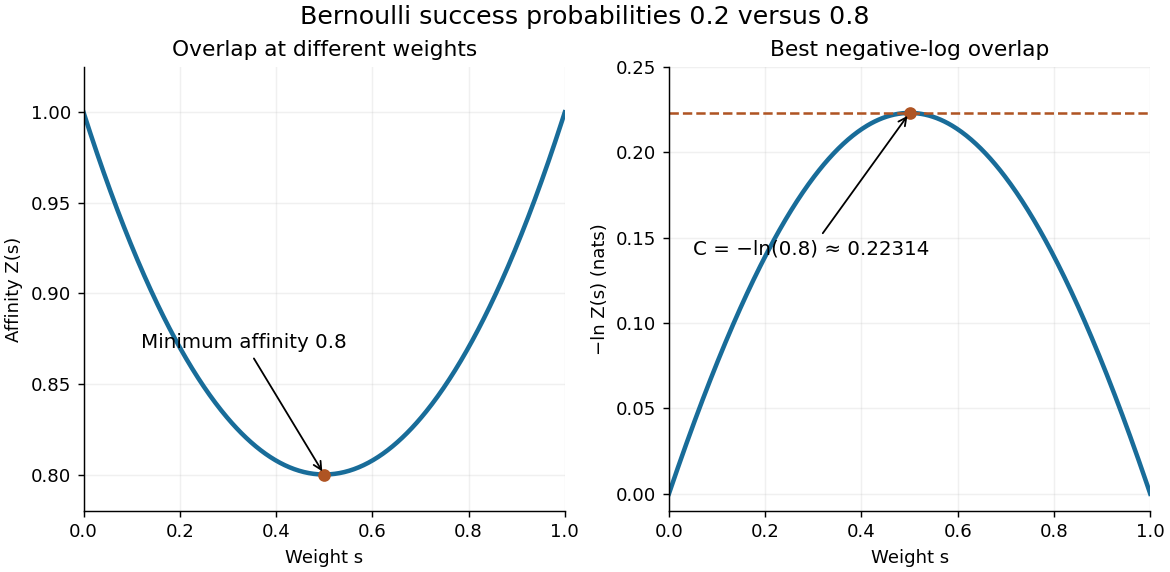

With equal prior probabilities, count the successes among observations. The likelihood ratio is , so choose when and when . If is even, either decision or a fair tie randomization gives the same average error at . Under , has the binomial distribution with parameters . Symmetry therefore gives the exact optimal average errorThe last term applies only for even ; it represents half the tie probability. Direct finite sums give , and . Twenty observations reduce the optimal average error to about 0.158%. The finite-sample Chernoff error bound at is , a guarantee rather than the exact error.
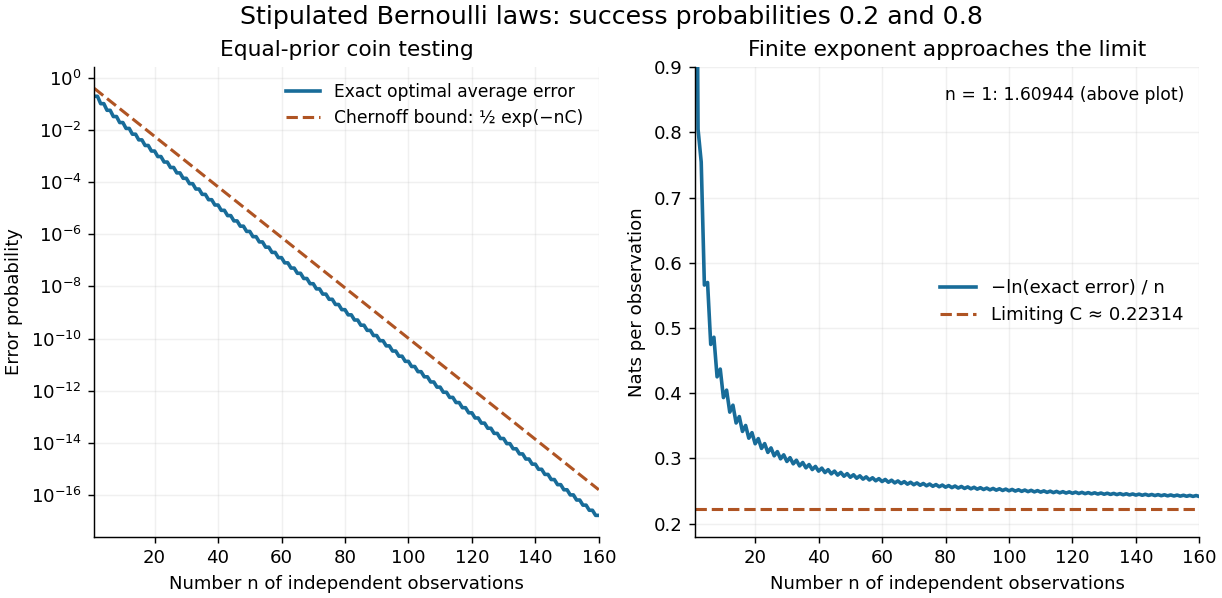
Exact repeated-coin error, the finite-sample Chernoff error bound, and the limiting error exponent
. Original finite-binomial calculations under two fixed independent coin laws with equal priors. The first panel uses a logarithmic scale. The normalized negative log error approaches ; finite-sample error need not equal the simple exponential. Details.
Reducing the exact error from to illustrates the value of repeated evidence. The example assumes a single fixed coin law throughout the experiment. If repeated sensor readings share an unmodelled common error, increasing their number need not supply this much independent information.
There are unlisted articles, also show them or only show them.