
Boundedly complete statistic 2026-10-14
Bounded completeness requires the defining implication for a complete statistic only for bounded measurable functions. Completeness implies it, but the converse need not hold. If a sufficient statistic gives a parameter-independent event probability and the conditional probability of that event is nonconstant, then is a bounded zero-mean obstruction to bounded completeness.
Cantor's intersection theorem 2026-10-14
A metric space is complete if and only if every decreasing sequence of nonempty closed sets whose diameters tend to zero has nonempty intersection. In that case the intersection contains exactly one point.
Cauchy-sequence construction of a metric completion Created 2026-10-14 Updated 2026-10-25
For two Cauchy sequences, , so the displayed limit exists. It defines a pseudometric on the Cauchy sequences, and its metric quotient identifies sequences whose mutual distance tends to zero. Constant sequences embed the original metric space isometrically. Their image is dense, because the class of is approached by the constant classes of . The quotient is complete: from a Cauchy sequence of its points select a subsequence whose successive distances are below and choose original-space points within of these subsequence points. Those original-space points form a Cauchy sequence and its class is the limit of the subsequence, hence of the whole sequence. The original embedding is onto exactly when the original space is complete.
In a one-period complete market with a strictly positive numéraire, at most one positive state-price density prices every traded asset. Suppose do so. For each event , replicate the contingent claim . Linearity of the pricing equations givesBoth weighted densities are integrable because they price the numéraire. An integrable random variable whose integral over every event is zero vanishes almost surely: take the events where it is positive and negative. Therefore , and strict positivity of the numéraire gives . This argument avoids assuming that the unweighted densities themselves are integrable.
In an arbitrage-free one-period market with finitely many assets and an equivalent martingale measure, market completeness is equivalent to uniqueness of the dominated martingale measure. Completeness prices every indicator function, forcing two measures to agree on every event. Conversely, if the attainable payoff span has dimension but is not the whole payoff space, choose disjoint positive-probability events. Their moment vectors against a basis of attainable payoffs are linearly dependent. A nonzero bounded linear combination of their indicators consequently has zero pricing moments. Multiplying an existing equivalent density by , for sufficiently small positive and negative , constructs distinct equivalent martingale measures. This proves the converse without assuming that the original space was finite. On a general probability space, completeness here means replication of all bounded claims, or equivalently all square-integrable claims when asset payoffs are square-integrable.
Star (graph theory) 2026-10-14
A star graph is the complete bipartite graph with one centre and leaves. Any pair of its edges meet at the centre.
Universal set 2026-10-14
A universal set fixes the objects under consideration in a particular discussion; each set under consideration is a subset of . For example, makes the complement of equal to . This use of “universal” is local to the discussion: it does not assert the existence of a set containing every set. Stating makes exclusion rules precise.
EM algorithm for a censored lognormal competing-risks mixture Created 2026-10-14 Updated 2026-11-05
Let eventual outcome have probability , with . An observed outcome at time contributes to the likelihood, while right censoring at contributes . The expectation-maximization algorithm imputes both the censored outcome and its latent log event time. Its E-step uses the displayed conditional weights and the first two moments of a truncated normal distribution above . With and inverse Mills ratio , these moments are and . Observed outcomes use deterministic class weights and moments . The M-step updates each class probability to its average weight, its mean to the weighted first moment, and its variance to the weighted second moment minus the squared new mean. Outcome-specific cumulative probabilities are cumulative incidence functions, not the conditional distributions themselves.
Top compactly supported cohomology from orientation signs Created 2026-10-14 Updated 2026-11-05
For a connected -dimensional manifold without boundary,Choose a locally finite good cover by coordinate disks, each with a local orientation. Compactly supported classes involve only finitely many of these disks at a time. The compact-support Mayer–Vietoris sequence gives one generator per disk and overlap relations , with the sign determined by the two local orientations. Passing to the direct limit over finite unions handles a noncompact manifold; a finite good cover of the whole manifold need not exist.
The overlap graph is connected, so all generators reduce to one up to sign. If local orientations can be chosen coherently, every relation has positive sign and the result is . An orientation-reversing loop imposes , giving . This is also the top-degree case of Poincare duality with the orientation local system, using compactly supported cohomology on the cohomology side.
The compact set generates the additive group , since every positive integer denominator divides some factorial. With its usual topology, is metrizable and is not locally compact. Nor can it have a nonzero Haar measure finite on compact sets: invariance gives equal masses to all singletons; a positive singleton mass makes have infinite mass, whereas zero singleton masses make the countable group have zero total mass.
// Target: analysis.bigb
Let finitely many arcs have centers , half-lengths and . Each summand has positive real part on the closed disk, and . On the th arc its contribution has real part at least . Thus the analytic logarithm obeys , , and throughout the arc union. Approximate by an analytic polynomial and modulate its bounded imaginary part; a partial Fourier sum isolates one half of the polynomial, producing a large value from a bounded function.
Totally bounded space 2026-10-14
A metric space is totally bounded when, for every , it is covered by finitely many open balls of radius .
A metric space is totally bounded when, for every , finitely many open balls of radius cover it. Equivalently it has a finite -net at every positive scale.
Embed into the compact product by and take its closure . The Tychonoff theorem makes a compact Hausdorff space, while is countable, dense and discrete in its subspace topology. Yet is not metrizable. Any convergent subsequence of distinct points would have a convergent coordinate for , whereas that coordinate alternates between zero and one. This contradicts sequential compactness of a compact metric space. Thus a dense metrizable subspace does not force a separable compact Hausdorff ambient space to be metrizable.
Let continuous maps between compact Hausdorff spaces have an underlying split coequalizer with set maps satisfying , and . Its equivalence relation is the image of the closed subset under . One inclusion follows from ; for the other use and whenever . This image is compact and hence closed in the Hausdorff product . The quotient is therefore compact Hausdorff, giving the preserved coequalizer required by the Beck monadicity theorem.
Supremum convergence for decreasing continuous functions Created 2026-10-14 Updated 2026-10-31
On a nonempty compact Hausdorff space, let continuous nonnegative functions decrease pointwise. Their suprema decrease to a finite number . For every , the sets are nonempty nested closed sets; compactness gives a common point with limit value at least . Thus the supremum of the pointwise limit is . The limit need not be continuous, and this conclusion does not claim uniform convergence as in the Dini theorem.
Closed subsemigroup of a compact group 2026-10-14
A nonempty closed subsemigroup of a compact group is a subgroup. For and a neighbourhood of the identity, choose with and cover the compact group by finitely many translates of . Two of sufficiently many powers lie in the same translate, so some positive power of belongs to . Hence the identity is a limit of positive powers and lies in . The preceding powers converge to , which also lies in . Applied to the closure of a positive-word monoid, this proves that it equals the closed subgroup generated by its generators, without assuming they already include their inverses.
The Peter-Weyl theorem makes finite-dimensional unitary representations separate elements of a compact group. Intersecting their closed kernels gives the identity subgroup. If the descending chain condition holds for closed subgroups, choose finitely many representations whose kernel intersection is already trivial: otherwise repeatedly exclude a surviving nonidentity element to obtain an infinite strict chain. Their direct sum is a faithful representation into a finite-dimensional unitary group. Compactness makes its image closed, and the closed-subgroup theorem gives the original group a compatible Lie group structure.
Subgroups generated by circle rotations 2026-10-14
Fix a real angle fraction , and repeatedly multiply by in the circle group. The generated cyclic subgroup is . Equivalently, the angle fractions are the fractional parts of , with one full turn identified with zero.
If is a rational number in lowest terms, with and coprime, then and no smaller positive power is . Hence is a finite cyclic group of order , consisting of equally spaced points. For , the successive angle fractions, starting at , areThe subgroup is finite, so it is a closed subgroup of the circle group; it is also a discrete subgroup. It is not an open subgroup, since every ambient neighbourhood of any of its points contains an arc, rather than only these seven points.
If is an irrational number, no nonzero integer satisfies , so the powers never repeat. The stronger statement is that is a dense set in the circle group: every nonempty open arc contains a power . Thus its closure is all of , while itself is a countable proper subgroup and is not a closed subgroup or a discrete subgroup. See irrational rotation and everywhere interval frequency under an irrational rotation for the corresponding motion and its long-term frequencies.
For , direct computation of the fractional parts of gives, to six decimal places,For example, and . These calculations specify exactly which points the diagram displays.
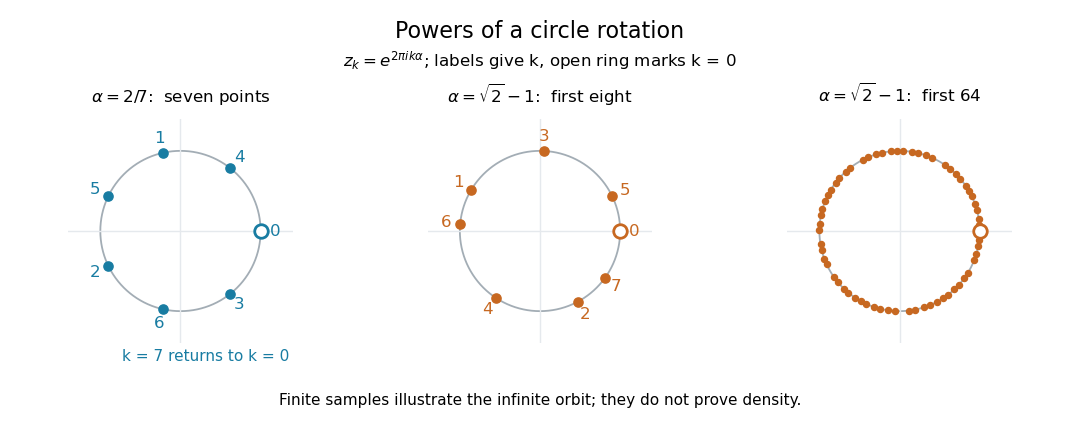
Seven repeating rational-rotation points and the first eight and sixty-four irrational-rotation points
. Labels give the power index ; the points are . The first panel uses , and the other two use . Each finite sample is only an illustration: a finite plot cannot establish that the infinite subgroup is a dense set. Reproduce the diagram with rational-versus-irrational-rotations.py. Details.
This example shows why algebraic generation and closure must be distinguished: one irrational rotation generates a countable cyclic subgroup, yet its closure is the whole uncountable compact group.
Normalized angle integration on the circle 2026-10-14
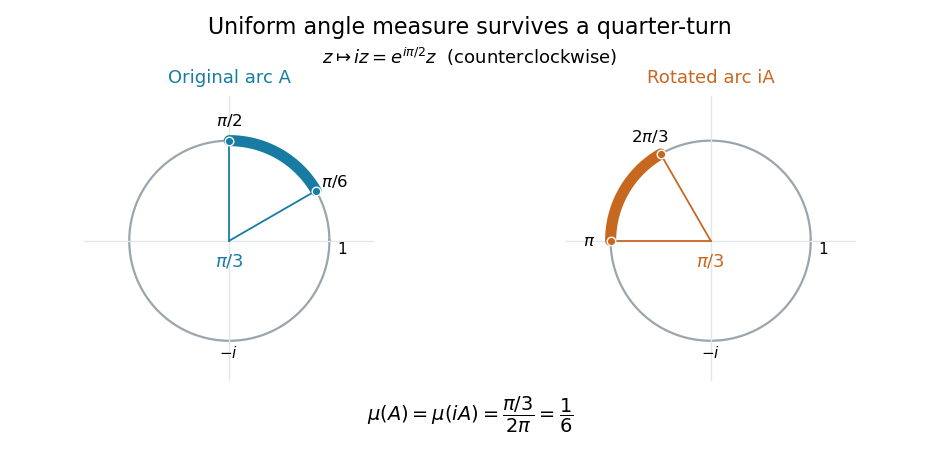
On the circle group , normalized Haar measure is the pushforward measure of uniform angle on . For a continuous function , defineThe factor makes the integral of the constant function equal to . For , a change of angle givesThe last equality uses the -periodic function . Since the circle group is an abelian group, this also verifies right invariance. An arc of angular length has normalized Haar measure . In particular, the arc and its quarter-turn both have measure .

The continuous unitary characters , indexed by integers, give a fully computed family of integrals:Here must be an integer, so is well defined and . Every nonconstant mode cancels exactly over a full turn. For example, the integral of is , and the integral of is . More generally,This is the orthogonality of complex exponentials underlying the Fourier basis and Fourier series: invariant averaging separates distinct frequencies and retains the constant component.
There are unlisted articles, also show them or only show them.