
Composition chains in products with S5 Created 2026-10-14 Updated 2026-10-31
The sign quotient of controls its cyclic composition factors, while its unique nontrivial proper normal subgroup supplies the nonabelian factor. There are four composition chains in : the three maximal normal subgroups are the kernels of the nonzero maps to , and only has two choices for its next term. In there are eight chains: six pass through and one of its two simple direct factors; two instead pass through a single direct factor. The equal-sign subgroup gives two of the six chains. It has no quotient , since its odd diagonal element acts by an outer automorphism on either alternating factor.
Noncommuting rotations about fixed axes 2026-10-14
Use a fixed right-handed Cartesian basis in three dimensions and active rotations in three dimensions through radians. The right-hand rule gives the following rotation matrices about the positive and axes:For the vector , the two orders giveBoth outputs have Euclidean norm , but they point in different directions. Each arrow below is a vector from the origin; the curved paths track its endpoint during each rotation in three dimensions.
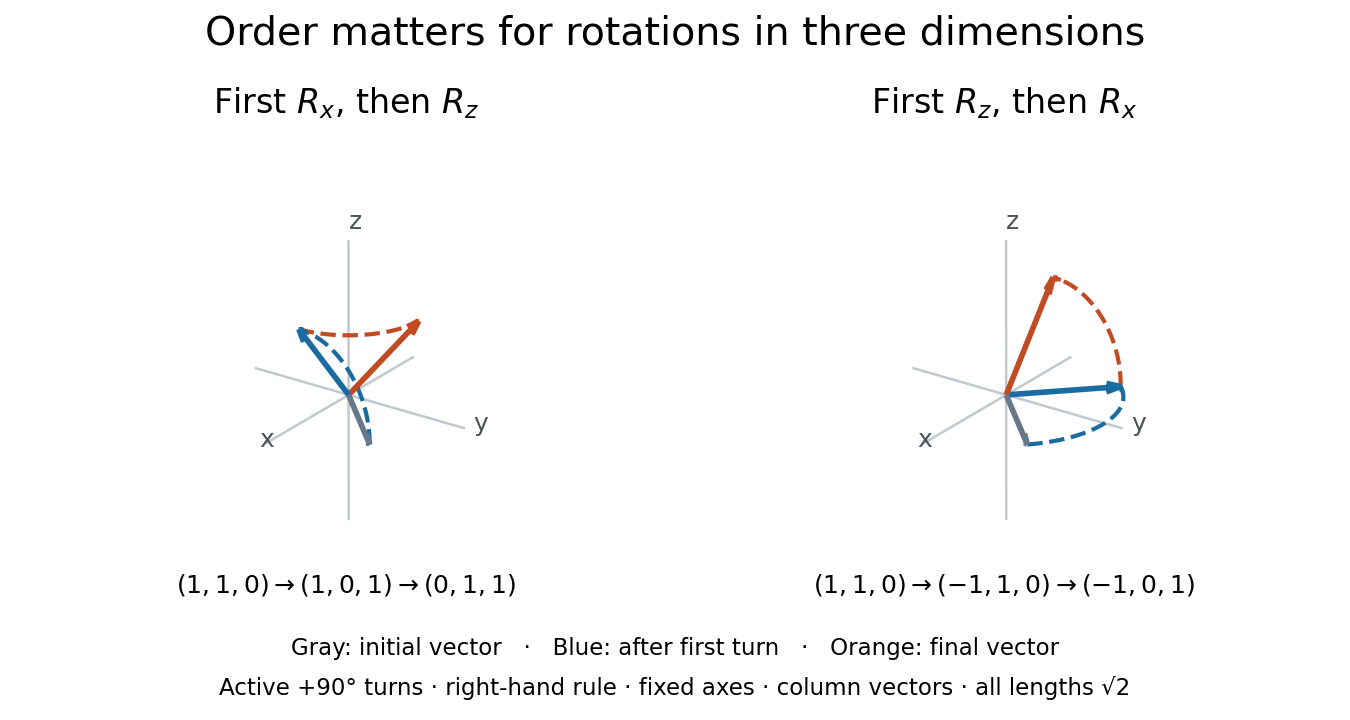
Active rotations in three dimensions about fixed axes: the order changes the final vector
. Details. 
The axes in this example remain fixed throughout. A command to turn about an object's own current axis describes a different operation because that axis can move after the first turn. With an object's orthonormal basis represented by columns of , a fixed-axis rotation matrix acts by , whereas the corresponding rotation expressed in the object's own basis acts by .[ref]
For and real , this equation defines a straight line. Writing and gives , so supplies a normal direction. Conversely every real affine line has this representation with and . The condition excludes an empty set or the entire complex plane.
Complex coordinate 2026-10-14
Represent Cartesian coordinates in the plane by the complex number , whose real part and imaginary part recover them. Multiplication by rotates the coordinates through angle , so a rotating-frame calculation becomes a complex exponential change of variable.
Finite-hole neighborhoods of a planar compact set Created 2026-10-14 Updated 2026-10-25
Given a compact planar set and an open neighborhood , a finite square-grid construction gives a compact polygonal neighborhood inside with finitely many complementary components. Remove thin polygonal corridors disjoint from joining holes that lie in the same component of , and joining holes in its unbounded component to the exterior. Corridors can also include a prescribed point from each of finitely many specified bounded components. There remains a neighborhood whose bounded holes lie in distinct bounded components of , each containing its chosen point. Standard small polygonal rounding gives a finite union of planar surfaces with boundary. The index map from its first integral homology group to one integer per bounded hole is an isomorphism. Triangulate a surrounding disc: a one-cycle bounds a two-chain whose coefficients are constant in each complementary component. Zero hole coefficients give a filling supported inside the neighborhood; the face chain of each hole supplies a dual cycle. The cycles can be sums of boundary curves in different components. This uses finite triangulation, not the general Jordan curve theorem.
Gysin map in complex cobordism 2026-10-14
For a proper map with fixed complex normal orientation, apply the Thom isomorphism in complex cobordism, pull back by the collapse of a tubular neighborhood of a graph embedding, and desuspend the auxiliary Euclidean coordinates. The degree increase is the relative real codimension. Changing the orientation can change this map.
If the right-hand side and initial data are jointly holomorphic, the local solution is jointly holomorphic in its independent variable and parameters. On a smaller closed polydisc, bound by and by . Choose so that stays inside the dependent-variable disc and . The integral contraction mapping has jointly holomorphic iterates converging uniformly, so locally uniform convergence of holomorphic functions proves the assertion. Shifting the dependent variable turns initial values into parameters.
A singular location is fixed if its position is determined by the coefficients, independently of the initial data. Not every solution must actually be singular there. For a rational first-order equation, coefficient poles and exceptional fibres where the reduced numerator and denominator have common zeros are included among the possible fixed locations.
A solution has a movable singularity if its location varies with the initial data. For example has solutions , whose pole moves with . The Painlevé determinateness theorem restricts movable singularities of first-order equations rational in the dependent variable to poles and algebraic branch points.
Painlevé determinateness theorem 2026-10-14
For a first-order ordinary differential equation rational in the dependent variable, with coefficients meromorphic on the chosen independent-variable surface, analytic continuation along an arc ending outside the fixed exceptional set has a definite limit in the Riemann sphere. Its movable singularities are poles or algebraic branch points. To see the limiting assertion, the cluster set of a continuous lifted arc is connected and compact. Any cluster value where the vector field is holomorphic permits uniform local continuation by the Picard-Lindelöf theorem. Otherwise the cluster set lies in finitely many coefficient poles, so it is a singleton. At a pole of the vector field, the inverse equation is holomorphic; its solution has a finite-order critical point, giving a convergent root expansion. The reciprocal dependent variable handles infinity. Points where both reduced numerator and denominator vanish belong to the fixed exceptional set and are excluded from this argument.
Painlevé property 2026-10-14
The Painlevé property excludes movable critical singularities, such as branch points, of the analytically continued general solution of a complex differential equation. A common stronger formulation requires every movable singularity to be a pole, so local solutions are meromorphic there. Fixed singularities determined by the coefficients are distinguished from movable ones whose locations depend on initial data. Riccati equations with meromorphic coefficients have only movable poles at ordinary points: linearization expresses their solutions as logarithmic derivatives of linear-system solutions. More generally, set and solve the holomorphic linear system , . Its quotient satisfies directly. Initial data , recover every local solution, and holomorphic make the quotient a meromorphic function, even at zeros of . At a zero of with , uniqueness prevents there, so and the pole is simple. This proves the absence of movable branching without assuming that the quadratic coefficient never vanishes.
Homothety of complex lattices 2026-10-14
Two complex lattices are homothetic when multiplication by one nonzero complex number takes one onto the other. Changes between oriented integral bases have determinant one, so normalized period ratios classify these classes by . The lattice Eisenstein sums scale as .
Hodge star on top holomorphic forms 2026-10-14
For the complex-linear Hodge star operator and complex orientation on a Hermitian manifold of complex dimension , every -form has the displayed eigenvalue. In an adapted orthonormal real coframe, each factor has two-dimensional star eigenvalue . Regrouping the factors introduces , giving . This is a pointwise metric identity; the metric need not be Kähler.
Use the complex-linear Hodge star operator on the direct sum of all form degrees. Its square on degree is . In positive odd dimension this is always one; in positive even dimension its sign is positive on even-degree forms and negative on odd-degree forms. Complementary basis wedges provide both roots of each sign, so the displayed eigenvalues all occur. On a single degree the Hodge star operator is an endomorphism only in middle degree; on middle degree in dimension its possible eigenvalues are for even and for odd .
For real and , this complex amplitude equation has a destabilizing cubic term and a saturating quintic term. Nonzero uniform intensities solve . The upper branch is radially stable and the lower branch radially unstable; constant phase is neutral because multiplication by preserves the equation. Stable conduction and the stable upper pattern coexist for . At the fold, a zero radial eigenvalue conceals one-sided nonlinear instability, so strict stability cannot be inferred from eigenvalues alone.
Benjamin-Feir stability condition 2026-10-14
For , the uniform oscillation has phase diffusion coefficient . Its amplitude-phase dispersion relation is . Thus gives a long-wavelength modulational instability, whereas gives linear stability of all nonzero Fourier modes. On a fixed periodic domain, instability requires an allowed wavenumber with .
Orientation of a contour 2026-10-14
The orientation of a contour specifies the direction in which its parametrization is traversed. Reversing that direction negates its contour integral. For a simple closed curve in the complex plane, positive orientation of a contour is the direction keeping its bounded interior on the left.
Piecewise smooth curve 2026-10-14
A piecewise smooth curve has a continuous function as a parametrization on a compact interval, with a finite partition into subintervals on each of which the parametrization is continuously differentiable. One-sided derivatives may differ at joining points, so polygonal contours are allowed. A contour integral is the sum of the integrals over those smooth pieces.
Algebraic closure of the p-adic numbers is not complete Created 2026-10-14 Updated 2026-11-05
Choose compatible primitive roots of unity . The partial sums form a Cauchy sequence. Each generates : for a nonidentity cyclotomic automorphism with , the first changed term has valuation , strictly below every later changed term. Thus the conjugate distance is at least . The tail bound is , strictly smaller. If the limit were algebraic, Krasner's lemma would place every one of these unbounded-degree cyclotomic fields in one finite extension, a contradiction.
Quantum operation Created 2026-10-14 Updated 2026-11-05
A completely positive map with is a trace-nonincreasing quantum operation, representing an outcome branch with its probability retained in the trace. A deterministic quantum channel has equality and is trace preserving. Dividing a branch output by its trace gives a conditional state but generally produces a nonlinear update; that normalization is not part of the linear quantum operation.
There are unlisted articles, also show them or only show them.