
Finite-sample Chernoff error bound 2026-10-14
For equal prior probabilities and independent and identically distributed observations on a finite alphabet, minimum sum of errors in a simple hypothesis test givesFor nonnegative and , . Applying this termwise and using the independence of random variables to factor the sum yieldsOptimizing , with an infimum if needed, proves . This short argument gives a bound for every . The theorem identifying the optimal error exponent also needs the converse: no decision rule can achieve a strictly larger limiting exponent. A log-likelihood ratio is a sum of independent contributions, so large deviation principle supplies the relevant converse idea.
Chernoff affinity 2026-10-14
For probability mass functions , their Chernoff affinity at is the sum . It weights pointwise agreement between the two laws. The weighted arithmetic-geometric mean inequality gives , hence . With positive common support, . Smaller affinity means a stronger separation at that weighting.
At , is the Bhattacharyya coefficient. The quantity is the Bhattacharyya distance. Allowing all weights gives Chernoff information at least this large. Symmetry under exchanging sends to , so Chernoff information is symmetric even though an optimizing weight need not be .
Variation of the Chern-Simons 5-form Created 2026-10-14 Updated 2026-11-05
The boundary four-form is . To derive the identity, put and . The variations of the three polynomial terms in are respectively , , and . Their sum gives the identity because . For variations in a Lie algebra with basis , the bulk field equations are , not necessarily the unprojected matrix equation . Conjugation of both the Lie algebra and the gauge curvature proves covariance of these equations under Yang-Mills gauge transformations.
For on a five-dimensional oriented spacetime, the action has bulk variation . Two integrations by parts make the three variations of the Chern-Simons 5-form contribute equally. Under , the extra action is , a boundary term by the Generalized Stokes theorem. Its bulk field equation is gauge invariant. The Chern-Simons term is metric-independent and has no bulk contribution to the stress-energy tensor when the differential-form field is held fixed in metric variation.
Chern-Simons number of a gauge field 2026-10-14
For an oriented three-dimensional slice , use the Skew-Hermitian trace conventionSince the differential of the integrand is , a space-time slab oriented by has instanton charge when the side boundary contributes no flux. For a pure gauge , this reduces to the winding integral . Gauge transformations of nonzero winding can shift it by an integer.
Chern class in complex cobordism 2026-10-14
The complex orientation of complex cobordism defines Chern classes of actual complex bundles by the splitting principle and elementary symmetric expressions in the first Chern classes of line summands. For an actual rank- complex bundle, its top Chern class is its Euler class in a generalized cohomology theory. Chern classes extend stably by the Whitney formula; this stable extension must not be confused with the Euler class of a merely stably complex real bundle.
Todd class 2026-10-14
Here the are the formal Chern roots of a vector bundle. The degree-four term is . Applied to the tangent bundle of a compact complex surface, Riemann–Roch for the structure sheaf gives the Noether formula.
Chern class axioms in the Chow ring 2026-10-14
For a vector bundle of rank on a smooth algebraic variety, algebraic Chern classes have , vanish for , commute with pullback, and obey the Whitney sum formula for Chern classes for every short exact sequence of vector bundles. A line bundle has total class . The projective-bundle splitting construction makes pullback injective and supplies a filtration by line bundles, so these axioms determine all classes as elementary symmetric functions of their first classes. In particular, and in the ordinary Chow ring.
CheZ Created 2026-10-14 Updated 2026-11-05
Accelerated dephosphorylation shortens the lifetime of the motor-regulating CheY signal. The output depends on both phosphorylation and removal, so equal kinase activity can produce different steady signalling when CheZ activity changes. [ref]
Robustness in simple biochemical networks by Naama Barkai and Stanislas Leibler. 1997, bacterial chemotaxis signalling framework
CheY Created 2026-10-14 Updated 2026-11-05
CheY is a bacterial response-regulator protein whose phosphorylation state couples receptor-pathway activity to bacterial flagellar motor behaviour. In Escherichia coli, CheA transfers phosphate to CheY, and phosphorylated CheY interacts with the motor switch, including FliM. CheZ accelerates signal removal through dephosphorylation. Production and removal therefore jointly control motor bias, allowing a biochemical pathway to regulate swimming without the motor directly sensing external attractant. [ref]
Robustness in simple biochemical networks by Naama Barkai and Stanislas Leibler. 1997, chemotaxis signalling and feedback architecture
CheR Created 2026-10-14 Updated 2026-11-05
CheR is an enzyme that catalyzes receptor methylation in chemotaxis, contributing to signaling adaptation.
CheB 2026-10-14
CheB is an enzyme that reverses receptor methylation in chemotaxis; its regulation contributes to negative feedback.
CheA Created 2026-10-14 Updated 2026-10-20
CheA is the signaling enzyme that promotes phosphorylation of CheY and CheB in the chemotaxis feedback regulation pathway.
Chemical potential and Helmholtz free energy Created 2026-10-14 Updated 2026-10-20
Rigid compartments impose a different constraint: fixed volume rather than fixed pressure. With Helmholtz free energy ,This follows immediately by differentiating in the chemical potential differential above. It expresses the same chemical potential through the thermodynamic potential appropriate to fixed temperature and volume.
Consider a closed system consisting of two rigid compartments of equal volume , maintained at a common fixed temperature . A valve permits exchange of the same ideal gas; the partition stays in place. Initially and , with conserved total amount of substance . These are macroscopic moles, modeled continuously, not twelve individual particles. By the ideal gas law, , so initiallyAt with the stipulated , this is approximately , favoring transfer from A to B.
At fixed and equal , integrating the ideal-gas chemical potential gives the total Helmholtz free energy, up to a term independent of the allocation,Here is a positive reference amount of substance; any omitted common term linear in is constant along this exchange. Let be the dimensionless fraction in A. The relative Helmholtz free energy then takes the particularly simple formIts derivative along the allowed transfer and its second derivative areThus the Helmholtz free energy is a strictly convex function of the allocation for positive amounts. Its unique minimum has , or , and equal chemical potentials. Initially its excess above this minimum is at . Relaxation decreases the total Helmholtz free energy by this amount in the model; the final pressures are also equal because both compartments have the same volume.
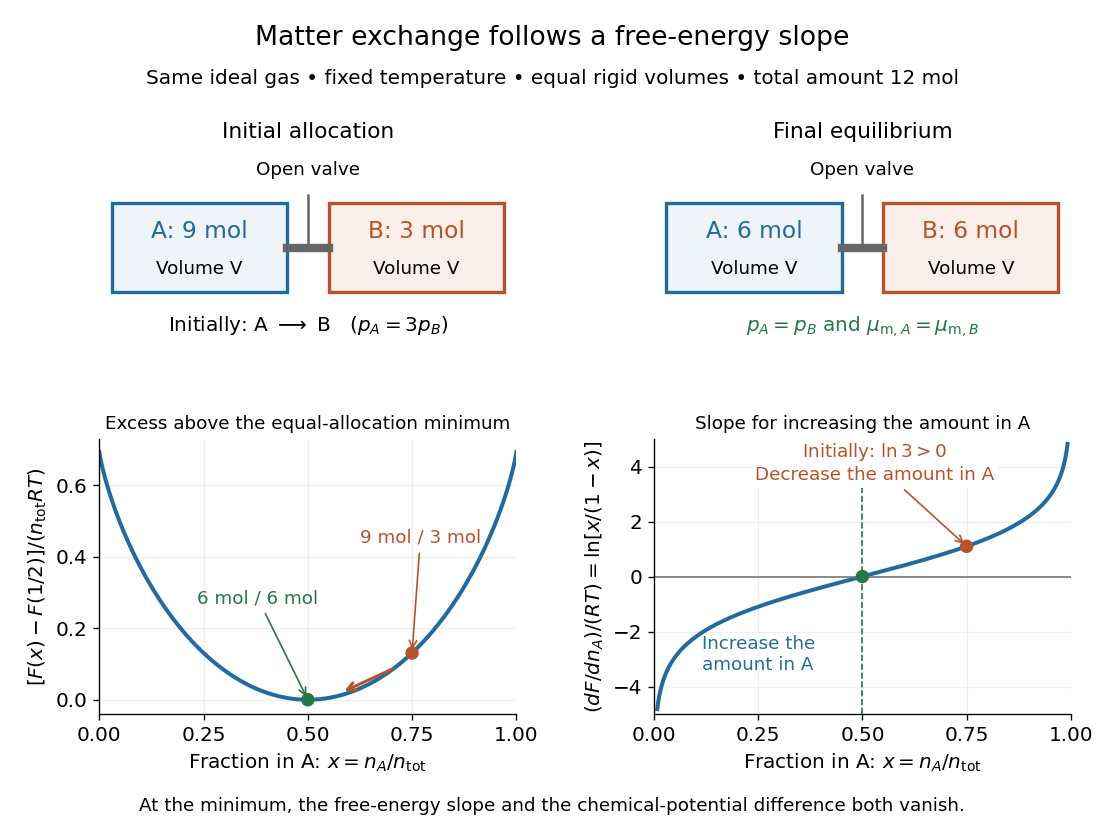

The beautiful connection is that the direction of matter exchange and the slope of a free energy curve are the same calculation. The entropy gained by redistributing the ideal gas makes equal allocation favorable here. As with chemical equilibrium, a free energy minimum identifies the favored state, while transport properties determine how quickly it is reached. The fixed-temperature, fixed-pressure Gibbs free energy criterion is summarized in 16.4 Free Energy; the rigid experiment instead uses Helmholtz free energy.
Reaction quotient Created 2026-10-14 Updated 2026-11-05
For a chemical reaction with signed stoichiometric vector entries , positive for products and negative for reactants, the reaction quotient is the product of the species' thermodynamic activities raised to these powers. It equals the equilibrium constant at chemical equilibrium, with all quantities using the same standard state convention.
Standard state Created 2026-10-14 Updated 2026-11-05
A standard state is a specified reference state used to define a species' standard chemical potential . The reference convention, including temperature, must be consistent when calculating thermodynamic activities, reaction quotients, and equilibrium constants.
Equality in Chebyshev's inequality Created 2026-10-14 Updated 2026-10-31
For , assign probability to each of and , and the remaining probability to . This probability distribution has expected value , variance , and tail probability . Thus Chebyshev's inequality is sharp when only these two moments are supplied. For example, , , gives masses , , . Replacing with would exclude the two extreme points in this example.
Chebyshev interpolation represents external evaluation Created 2026-10-14 Updated 2026-10-31
On real polynomials of degree at most with the uniform norm on , set and let be the Lagrange interpolation basis. If , the denominator of has exactly negative factors while its numerator is positive. Therefore . Since , interpolation gives . Hence , and attains equality. Reflection and Chebyshev parity give the case . Dividing the interpolation weights by yields an exact signed evaluation representation of norm one on nodes. Constants give the immediate degree-zero case.
Character prime sums in the Chebotarev proof 2026-10-14
The logarithm from the Euler product of an Artin L-function has first-prime-power term . Higher powers are uniformly bounded as real : and . The finitely many ramified local factors also have bounded logarithms. The Artin L-function order at one therefore proves the displayed estimate. Expanding a conjugacy-class indicator by character orthogonality leaves only the trivial character's logarithmic term, with coefficient . This proves Dirichlet density directly; a natural-density assertion needs additional analytic arguments.
Quark mixing Created 2026-10-14 Updated 2026-11-05
The up-type and down-type fermion mass matrices need different left-handed transformations represented by unitary matrices to diagonalize them. Their relative transformation appears in the charged weak current as the Cabibbo-Kobayashi-Maskawa matrix. The weak neutral currents remain diagonal in the minimal Standard Model, since the same-charge couplings are generation-independent. Three nondegenerate generations give three mixing angles and one physical weak CP phase after quantum field rephasings.
There are unlisted articles, also show them or only show them.