
Thermal Sunyaev-Zeldovich effect Created 2026-10-14 Updated 2026-10-20
For a Planck photon distribution, the hot-electron Kompaneets equation gives , where . The equivalent thermodynamic temperature perturbation has the displayed form, while the Rayleigh-Jeans law gives . The distortion changes sign at . This first-order expression assumes a small Compton y parameter and nonrelativistic thermal electrons.
Kinetic Sunyaev-Zeldovich effect 2026-10-14
Bulk motion of a scattering electron cloud relative to the cosmic microwave background gives a first-order Doppler temperature shift. With positive directed away from the observer, the displayed sign applies, and is the Thomson scattering optical depth. In the nonrelativistic, single-scattering limit it has the spectrum of a small blackbody temperature change, unlike the thermal Sunyaev-Zeldovich effect.
For a uniform spherical cluster of depth , thermal bremsstrahlung gives received bolometric flux , while the Rayleigh-Jeans law limit of the thermal Sunyaev-Zeldovich effect gives . Eliminating and using yields the displayed angular diameter distance. A model for the density profile fixes its numerical coefficient. Clumping, nonsphericity and temperature structure can bias this distance because the two observables weight the gas differently.
Lexicographic embedding of a sumset 2026-10-14
Represent each element of by the lexicographically least tuple with that sum. Every coordinate projection of the resulting tuple set is itself lexicographically least for its partial sum: replacing it by a smaller representative would improve the original tuple without changing its sum. Consequently projected cardinalities are at most the corresponding partial sumset cardinalities. Projection inequalities, including the box theorem, therefore give sumset inequalities.
Sum of a subset 2026-10-14
For a subset of density in a finite cyclic group, put using normalized convolution on a finite group. Its average is , so choose with . Retain the large spectrum where . The Parseval identity on a finite group gives at most frequencies. Their phases change by at most on the associated Bohr set, contributing at most to the change of . The discarded frequencies contribute at most another , since . Therefore on the Bohr set, proving the containment.
Sumset representation function 2026-10-14
For finite sets in an abelian group , the sumset representation function isIt counts ordered pairs in the Cartesian product, so and are different when , even though commutativity makes their sums equal. It is zero outside the sumset, andFor , its values at are . For , its values at the increasing elements of are . Both lists total sixteen, but the first concentrates more ordered pairs on fewer sums. This distinction is what additive energy quantifies.
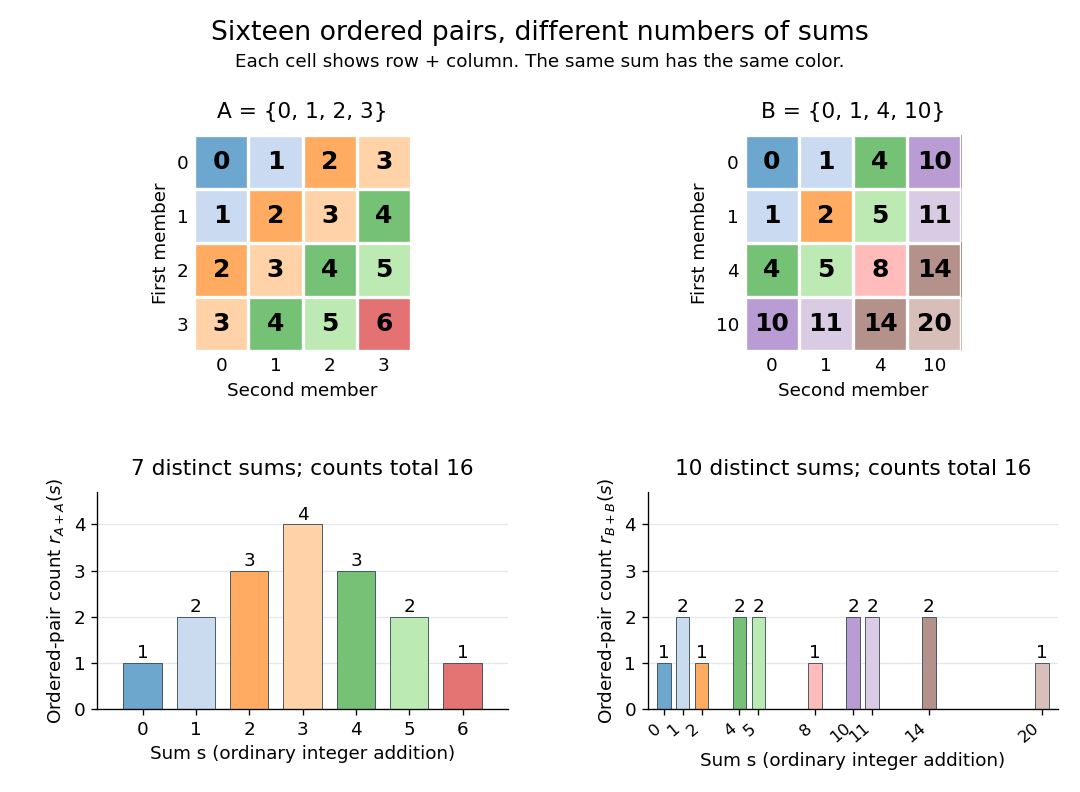
Ordered-pair sums and representation counts for an arithmetic progression and a spread-out integer set
. Details. 
Telescoping sum Created 2026-10-14 Updated 2026-10-20
A telescoping sum cancels intermediate sequence terms, leaving boundary terms. For a finite sequence of real numbers , the displayed identity follows because every occurs once with each sign. Applying it to an infinite series also requires checking the limit of the boundary terms; finite cancellation alone does not prove that the series is a convergent series.[ref]
5.2 Infinite Series. Calculus Volume 2, §5.2 Infinite Series: Telescoping Series definition and successive partial-sum identities
For , expanding the finite sum givesNo monotone sequence assumption is required. Consider the original sequence . Its successive finite differences are , soThe large intermediate rise and fall disappear from the net change. This is useful whenever one knows successive changes rather than every absolute value: adding the changes reconstructs the final value from the initial one. It also checks a cumulative-update calculation without requiring all increments to be positive.
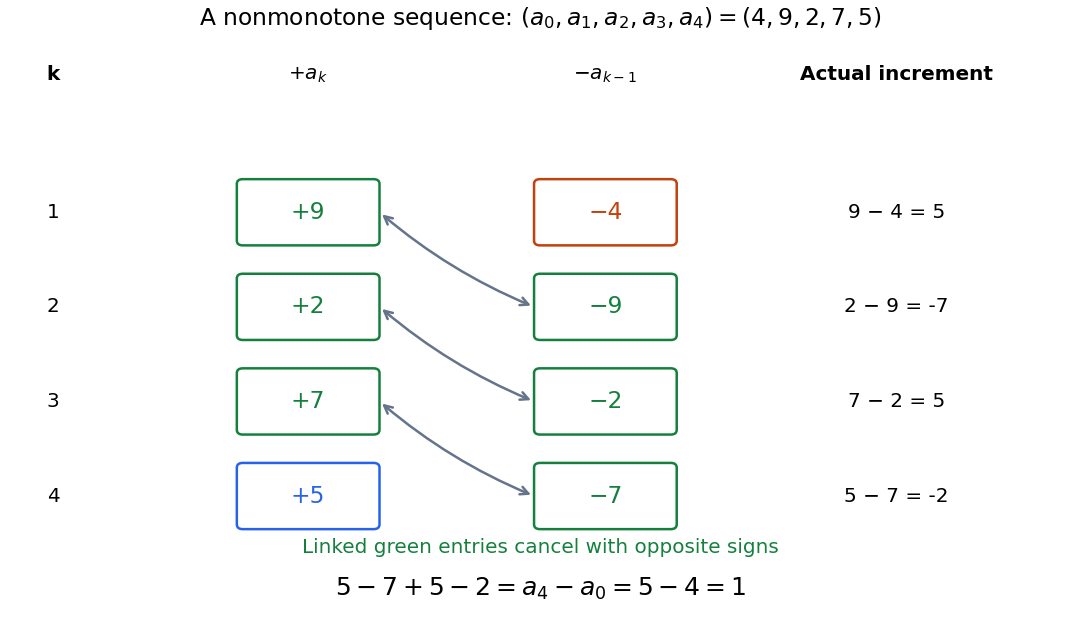
Opposite signs cancel the intermediate sequence terms, leaving the final value minus the initial value
. Original nonmonotone sequence . Linked green entries have the same magnitude and opposite signs; the unmatched entries are and . The increments are , whose sum is one. Details.
A finite difference measures one discrete change. The identity is the discrete counterpart of the fundamental theorem of calculus: accumulation of changes returns the endpoint difference. The related summation by parts transfers a finite difference from one factor of a product to another, with explicit boundary terms.
For with , put using nonzero denominators. If is proper, some lies outside , since invariance under addition of one would give all of the prime field. The map on is injective. Clearing the denominator in a representation of puts a dilate of its image inside . If is the full field, averaging the collision count of gives some with . Clearing its denominator puts a dilate inside . Here is a product set, and the prefactors denote repeated sumsets, not scalar multiplication.
Closure bounds for small skew-sumset scalars 2026-10-14
Write and suppose some nonzero has . The mixed-set Plünnecke-Ruzsa inequality gives and . The Ruzsa covering lemma covers by at most translates of . Covering two dilates proves the addition bound. First covering , then both copies of in , proves the multiplication bound. The Ruzsa triangle inequality also gives . These bounds transfer controlled additive expansion through a bounded-complexity expression in scalars.
Weak-type operator 2026-10-14
An operator has weak type , with finite , if the displayed bound holds for every input and every , with one constant independent of both. It controls the distribution of its output rather than requiring its strong norm to be finite.
Superlinear functional 2026-10-14
In the functional-analytic sense used here, a superlinear functional is real valued, positively homogeneous and superadditive. Equivalently is a sublinear functional. This definition concerns functional inequalities, rather than a comparison of asymptotic growth rates. Such a is concave, satisfies , and can serve as a lower support in the sandwich form of the Hahn-Banach theorem.
Inverse-square weighted Dirichlet spectrum Created 2026-10-14 Updated 2026-10-18
For on with zero endpoint values, write and . The Euler-Cauchy equation becomes . Thus and the exact spectrum is displayed above. Leading WKB quantization omits the constant , while producing the same leading eigenfunction shape after quantization.
For a finite simple graph with at least two vertices, no triangles, and exactly three common neighbours for every nonadjacent pair, the graph is connected. For adjacent vertices , the bipartite graph between and has degree two at every vertex, forcing . Thus the graph is regular. Counting second neighbours gives . The nontrivial adjacency eigenvalues are , and the larger-root multiplicity is . Integrality forces to be an odd integer dividing , yielding the stated degrees. The complete bipartite graph realizes degree three. The one-vertex graph is a vacuous exception with degree zero.
Einstein ring 2026-10-14
An aligned source behind an axisymmetric gravitational lens produces a circular image at an Einstein radius. Its angular radius satisfies . Exact alignment gives a ring; displaced sources generally give arcs or distinct images rather than a complete ring.
Gravitational-lensing critical curve 2026-10-14
A critical curve is a locus in the image plane where the Jacobian matrix of the thin gravitational lens equation becomes singular. Its formal point-source lensing magnification diverges, while finite source size regularizes the measured flux. Its mapped locus in the source plane is a gravitational-lensing caustic.
Spectroscopic test of the Twin Quasar lens Created 2026-10-14 Updated 2026-10-20
The two resolved quasar images of 0957+561 provide an observational question: are they separate sources, or different light paths from one source? In May 1979, spectrophotometry used the McDonald Observatory 2.7 m reflecting telescope, the UVITS spectrograph, and an intensified dissector scanner at the f/9 focus of the Cassegrain reflector. A 600-groove-per-millimetre diffraction grating produced 4100-7100 ångström scans sampled every 2 ångströms, with about 7 ångström resolution over most of that range. Two spectrograph slits, about 52 arcseconds apart, recorded object and sky background simultaneously for subtraction. Interleaving observations of the two images reduced instrumental and atmospheric gain changes.[ref]
Spectrophotometry of the Double QSO, 0957 + 561 by Beverley J. Wills and D. Wills. Section II, printed p. 2: instrument, grating, sampling, resolution, two apertures, sky subtraction and interleaving
The readout was received light versus wavelength for each image. Closely matching absorption line redshifts supported a common source and absorber; differences in continua and line strengths motivated differential interstellar extinction. Spectral agreement supplied evidence for gravitational lensing, rather than proving the point-mass gravitational lens model. The authors discussed a physical double and discrepant optical and radio light ratios. Their note added in proof attributed the redder spectrum to foreground galaxy contamination and emphasized an extended mass distribution.[ref]
Nordtvedt effect 2026-10-14
A violation of the strong equivalence principle can make the gravitational-to-inertial mass ratio depend on a body's negative gravitational self-energy . Bodies with different self-binding fractions would then fall differently in the same external field, even after composition-dependent weak-equivalence effects are removed. For the Earth and Moon this produces a polarization of the lunar orbit toward the Sun, measurable by lunar laser ranging. General relativity predicts .
Length of a word over an alphabet 2026-10-14
The length of a word over an alphabet is the number of symbol positions in that finite string, counting repetitions. Thus and for the empty word. Concatenation satisfies . This differs from the word length of a group element, which minimizes over representing words using a chosen generating set of a group.
There are unlisted articles, also show them or only show them.