
Liveness property 2026-10-14
A requirement of eventual progress, with no finite prefix ruling out its eventual satisfaction. For starvation freedom, a persistent requester must eventually enter its critical section. Establishing such a liveness property requires explicit scheduling and protocol assumptions in addition to mutual exclusion. Exhaustive finite thread interleaving checks alone do not establish eventual service for repeatedly competing software threads.[ref]
Defining Liveness by Bowen Alpern and others. p. 182: every finite prefix can still be extended to satisfy a liveness property
Safety property 2026-10-14
A requirement whose violation has a finite execution prefix that no continuation can repair. Two software threads simultaneously inside a protected critical section already violate mutual exclusion; later leaving does not erase that violation. This contrasts with a liveness property, for which a long finite wait alone does not establish failure.[ref]
Defining Liveness by Bowen Alpern and others. pp. 181–182: finite irremediable prefixes
Mutual exclusion Created 2026-10-14 Updated 2026-10-25
Mutual exclusion allows at most one participating software thread at a time to execute a protected critical section. A mutex is an object used to enforce that rule; the critical section is the region of the program that needs the rule. Several different critical sections can use the same mutex to protect the same shared data. The benefit is reasoning about a complete update without another cooperating software thread observing or changing its intermediate state.[ref]
For a small lost update, shared Assume sequential consistency: each step is indivisible, each software thread keeps the displayed order, and a read sees the latest preceding write to
x initially equals . Each of two software threads, T1 and T2, uses its own local r and performs these three steps:r = read(x)
r = r + 1
write(x, r)x. In the thread interleaving T1 read, T2 read, T1 add, T2 add, T1 write, T2 write, both local values become and both writes store . Final instead of : a lost update despite two correctly executed local additions. Separate indivisible reads and writes are insufficient; the complete read, modify and write must be protected.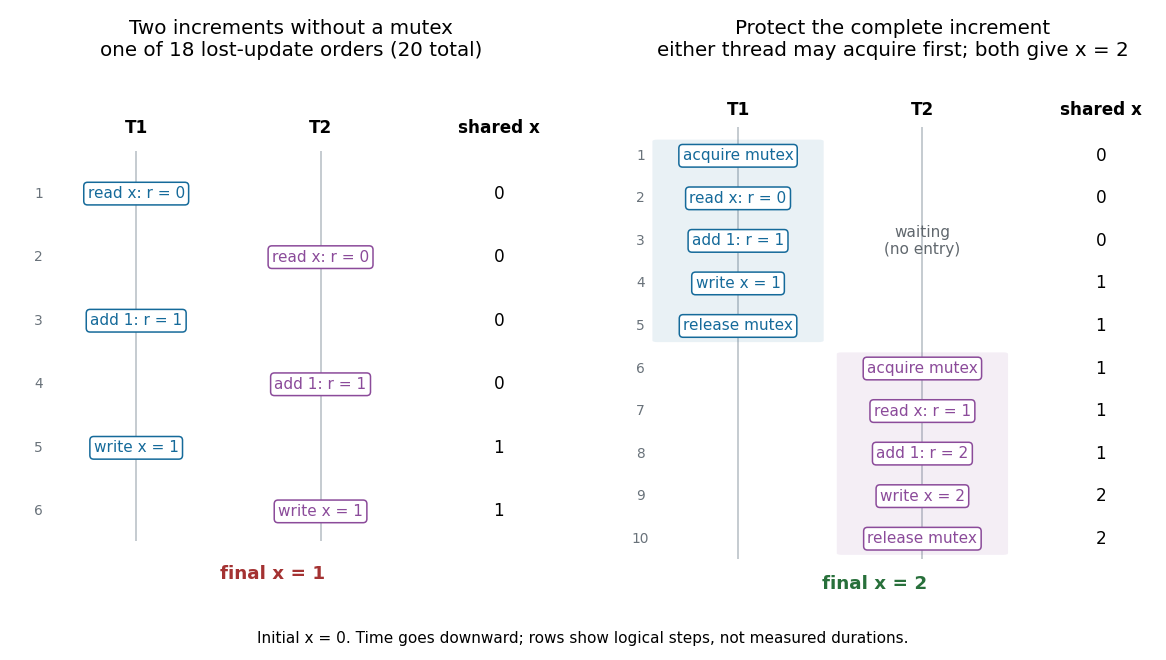

The binomial coefficient counts the thread interleavings preserving the two three-step orders: choose T1's three positions, with the remaining positions belonging to T2. Exhaustive enumeration gives final in 18 orders and in the two serial orders. These counts are not probabilities: no random scheduler has been specified. With the same mutex acquired before reading and released after writing, only the two complete increment orders remain, and both give . Alternatively, an atomic read-modify-write increment updates
x in one indivisible step. Protecting only the write still allows both software threads to read beforehand.Mutual exclusion is a safety property: two participants must never be inside the protected critical section together. Eventual entry for every persistent requester is a liveness property, expressed here as starvation freedom. A protocol that never admits anyone satisfies the first requirement while failing the second. Nor does a mutex alone promise which waiting software thread enters next, or that a producer runs before a consumer. Such application ordering needs an additional synchronization protocol.[ref]
Defining Liveness by Bowen Alpern and others. pp. 181–182: mutual exclusion, finite witnesses to safety violations, and eventual service
The sequential consistency assumptions delimit this calculation. In C++, unsynchronized conflicting accesses to an ordinary shared object can be a data race, which makes behavior undefined; the 20 schedules are not a prediction for that program. An atomic operation with relaxed ordering also supplies no acquire-release synchronization for other data. A real mutex must supply both exclusive entry and the required happens-before ordering between its users.[ref]
Inhibitory postsynaptic potential 2026-10-14
An inhibitory postsynaptic potential is a synaptic potential associated with decreased likelihood of a postsynaptic action potential. It can involve hyperpolarization or depolarization; an inhibitory conductance can even produce no measurable voltage change at rest. See synaptic potential and shunting inhibition for worked examples and sources.
Excitatory postsynaptic potential 2026-10-14
An excitatory postsynaptic potential is a synaptic potential associated with increased likelihood of a postsynaptic action potential. Its size and effect depend on the receiving neuron's state; the definition concerns firing, not a fixed neurotransmitter identity. See synaptic potential for the mechanism and source.
Synaptic conductance Created 2026-10-14 Updated 2026-11-05
Synaptic conductance describes how strongly activated synaptic ion channels conduct electric current for a given driving force. In the passive approximation, , with inward-positive electric current. It is the electrical conductance contribution of a synapse; its postsynaptic voltage response also depends on the driving force, the other membrane electrical conductances, and the capacitance. The synaptic potential model and shunting inhibition example show why a nonzero synaptic conductance can have zero electric current at rest.
Synaptic competition Created 2026-10-14 Updated 2026-10-25
Constraints or interactions make the strengthening of some inputs limit others. In developmental models, competition together with input correlations can segregate ON and OFF subregions or inputs from the two eyes; correlations alone do not specify the full biological developmental mechanism.
Geometric quantization 2026-10-14
Geometric quantization associates quantum states and observables with a symplectic manifold. A first step uses a complex line bundle with a connection on a vector bundle whose curvature is proportional to the symplectic form divided by ; its existence imposes an integrality condition. A real polarization is an integrable half-dimensional distribution with Lagrangian submanifolds as leaves. Requiring sections to be covariantly constant along the leaves reduces the variables to a configuration-space description. Restricting the curvature to a Lagrangian leaf gives zero, permitting local flat sections; global sections can require trivial holonomy. Exact Lagrangian graphs also describe local semiclassical phases through their generating functions.
Symplectic capacity 2026-10-14
A symplectic capacity is monotone under symplectic embeddings, scales by for , and has positive unit-ball capacity and finite unit-cylinder capacity. It is invariant under symplectomorphisms. A normalized symplectic capacity additionally assigns to both unit domains.
Presymplectic form Created 2026-10-14 Updated 2026-11-05
A presymplectic form is a closed two-form, commonly assumed to have constant rank, that need not be nondegenerate. A symplectic form is its nondegenerate special case. Its kernel distribution is integrable: for kernel fields , the identity gives . If the characteristic leaf quotient is smooth and the form descends, that quotient has a symplectic form. A regular Hamiltonian energy hypersurface carries such a form with kernel spanned by its Hamiltonian vector field.
Real symmetric spectral orthogonality Created 2026-10-14 Updated 2026-11-05
A real symmetric matrix is a Hermitian matrix, so is real for every complex vector . If is an eigenvector, its eigenvalue is and is real. Then gives . Reality is used in changing conjugate transpose to transpose; complex symmetry alone does not imply real eigenvalues.
Coaxial symmetric tensors 2026-10-14
Two real symmetric matrices are coaxial when they share an orthonormal eigenbasis. Equivalently they commute. Degenerate eigenspaces can have several choices of shared axes.
Symmetric positive-definite matrix 2026-10-14
A real symmetric matrix is positive definite when its quadratic form is positive on every nonzero vector. By the spectral theorem, this is equivalent to all its eigenvalues being positive. It has a unique symmetric positive-definite square root.
Axis decomposition of a symmetric matrix Created 2026-10-14 Updated 2026-11-05
Fix , put , , and . Any real symmetric matrix on three-dimensional Euclidean space has a unique decomposition with , and :The transverse restriction is a symmetric two-dimensional matrix, whose traceless matrix part has dimension two. Together the two scalars, two components of and two components of give the six parameters of .
Complex symmetric nilpotent matrix Created 2026-10-14 Updated 2026-10-18
The displayed nonzero matrix is symmetric under transpose but not Hermitian. It is nilpotent, so all its eigenvalues are zero and it cannot be diagonalizable. Thus real-symmetric spectral conclusions require reality or a Hermitian hypothesis; complex transpose symmetry alone is insufficient.
Third covariant derivatives of a scalar 2026-10-14
Use the sequential convention and define by . The symmetric Hessian of a scalar field gives symmetry in , but the curvature commutator on a covariant tensor gives . Averaging the three distinct permutations yields . Thus a scalar's third covariant derivative is not generally totally symmetric.
Forgotten symmetric function 2026-10-14
The coefficient of in counts distinct rearrangements of the parts of whose prefix-sum set contains the prefix sums of . Indeed, Hall inner product of symmetric functions duality between turns this coefficient into times the coefficient of in . Expanding expresses each as a signed sum of compositions of . Concatenating these compositions gives precisely the counted rearrangements, and every sign is .
Subshift of finite type 2026-10-14
A subshift of finite type is a closed subset of a finite-alphabet full shift defined by finitely many forbidden finite words, with the restricted left shift. After replacing symbols by sufficiently long blocks, its constraints can be described by a zero-one symbolic transition matrix. In this presentation, membership means that every consecutive pair follows an allowed transition. The resulting sequence space is a compact metric space and the restricted left shift is a homeomorphism.
Sweat gland Created 2026-10-14 Updated 2026-11-05
A sweat gland is a skin gland delivering secretion to the surface or a related follicular route. Eccrine glands are important in human evaporative cooling. Gland activation, fluid transport and environmental evaporation are separate determinants of the cooling achieved.
Additive excess-hazard mixture likelihood 2026-10-14
Suppose an unobserved class has probabilities and , with hazard functions and , and set , . For an independently right-censored observation , its survival-parameter likelihood contribution isThis sums the two class-specific likelihoods before taking a logarithm. All hazards must be nonnegative. A common parameter-free censoring mechanism factors out; class-specific censoring instead alters the mixture weights and cannot silently be discarded.
// Target: probability-and-statistics.bigb
There are unlisted articles, also show them or only show them.