
Softened isothermal lensing potential 2026-10-14
This circular lensing potential has reduced deflection , mean lensing convergence and local convergence . Its central convergence is finite for . As the core shrinks to zero, the deflection tends to that of a singular isothermal sphere lens. This softening of the projected lensing potential must not be confused with replacing a three-dimensional density by a different cored profile.
Point-mass gravitational lens 2026-10-14
A point-mass gravitational lens is the ideal gravitational lens obtained by concentrating a positive mass at one location. Use geometrical optics, the weak-field approximation, small angles in radians, and a stationary lens whose deflecting region is short compared with the observer-lens and lens-source distances. At impact parameter , require , the Schwarzschild radius, and a ray passing outside any opaque body. The physical bend has magnitude from Schwarzschild light deflection; is the gravitational constant and the speed of light. Multiple images can occur within this weak-field approximation: strong gravitational lensing does not require a ray to approach a black hole closely.[ref]
Gravitational Lensing by Matthias Bartelmann. Section 1.2, printed p. 2: geometrical optics, weak fields and slowly moving lenses; compact-object near-field propagation excluded
Let , and be angular diameter distances from observer to lens, observer to source, and lens to source, respectively. They refer to the background geometry used in the thin gravitational lens equation. In nearby Euclidean geometry, ; in cosmology, do not make that subtraction. The angular source coordinate is the direction the source would have without this lens; the observed image coordinate is . Both are measured relative to the observer-lens optical axis.[ref]
Lectures on Gravitational Lensing by Ramesh Narayan and Matthias Bartelmann. Section 2.1.3, pp. 8-9, equations (13)-(15), including the warning that lens-source angular diameter distance is not the difference of the observer distances
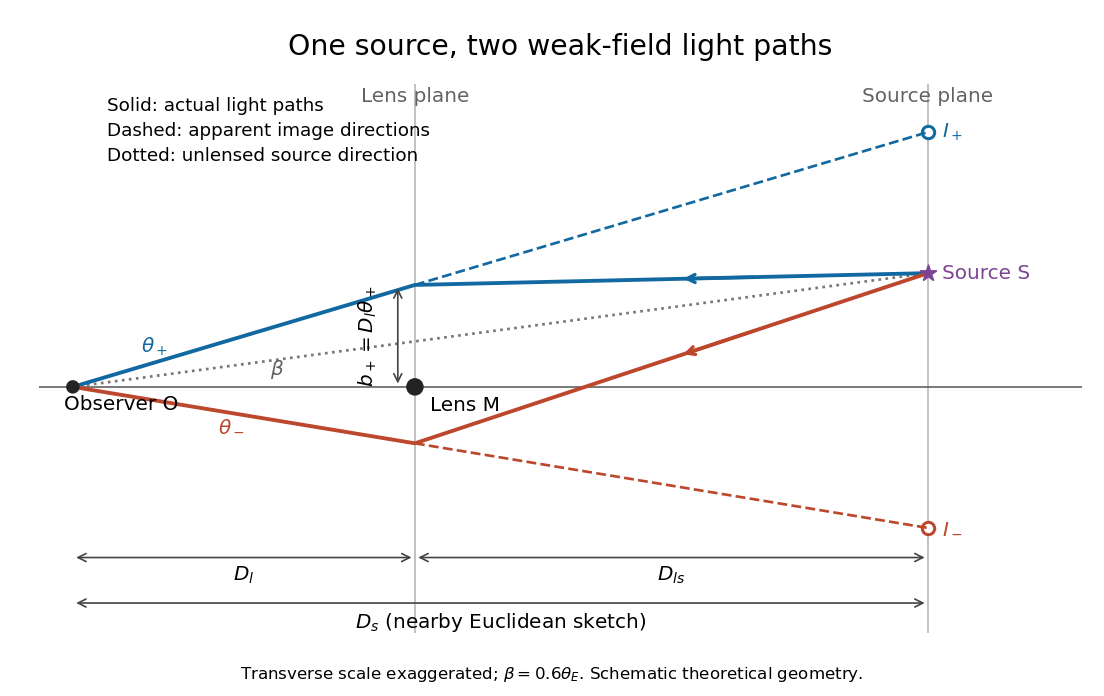
For the flat sketch below, extend the observer-side light ray backwards to the source plane. Its transverse position would be , whereas the actual source is at . Their separation is . Here is defined outward along the lens-plane impact vector, as in the thin gravitational lens equation; the physical ray bends toward the mass. Substituting givesThe same thin gravitational lens equation uses angular diameter distances in the cosmological setting. The factor converts the physical bend into the reduced angular deflection; these are different angles.

Passive disk Created 2026-10-14 Updated 2026-11-05
A passive astrophysical disk receives most of its heat from external irradiation rather than internal viscous dissipation. For a stellar disk, a rough criterion is . The actual local requirement compares absorbed stellar flux with viscous flux; incidence angle, shadowing and absorption can invalidate a luminosity comparison alone.
Thermoelasticity with a temperature-dependent constraint Created 2026-10-14 Updated 2026-11-05
The admissible rates obey . A reaction multiplier in the reversible nominal stress tensor therefore has an accompanying specific entropy contribution:Their reaction contributions cancel in the Clausius-Duhem inequality on admissible rates. Omitting the entropy term would generally violate the constraint's power balance.
Isolated system Created 2026-10-14 Updated 2026-10-14
An isolated system exchanges neither matter nor energy with its surroundings. Its total energy is fixed, while the Second law of thermodynamics requires its total entropy to be nondecreasing. Its internal energy alone is fixed when bulk kinetic energy and external potential energy also remain unchanged. For example, an initially spinning stirrer inside an insulated rigid vessel can lose kinetic energy while the contents gain internal energy, with no external input.
An isolated system need not yet be in thermodynamic equilibrium. Two enclosed bodies at different temperatures can exchange heat internally until they reach thermal equilibrium; their combined energy stays constant. Their internal transfer is absent from the outer boundary ledger. A vacuum-insulated container is only an approximation to isolation: residual thermal conduction and thermal radiation can still carry energy across its boundary.
Closed system Created 2026-10-14 Updated 2026-10-14
A closed system exchanges no matter with its surroundings, but can exchange energy through heat or work. A sealed cylinder with a moving piston is a typical idealized example. “Closed” fixes the material inventory, rather than the volume or the internal energy. An insulated cylinder can receive compression work; a rigid sealed vessel can receive heat. Neither is necessarily an isolated system.
Thermodynamic equilibrium 2026-10-14
A thermodynamic system is in thermodynamic equilibrium when its macroscopic state has no spontaneous tendency to change through any exchange allowed by its constraints. For an isolated system, stable thermodynamic equilibrium maximizes entropy over the accessible states at fixed total energy and conserved material inventories. A wall can forbid an exchange, so always specify what can cross or move. Thermal, mechanical and chemical conditions answer different questions about that same constrained state. [ref]
For example, two compartments separated by a rigid, impermeable wall that transmits heat can reach thermal equilibrium while retaining different pressures and compositions. Allowing an unloaded piston to move adds a mechanical equilibrium condition. Allowing one chemical species to cross adds chemical potential equality for particle exchange; allowing a chemical reaction adds its chemical equilibrium condition. A fixed barrier can therefore support a constrained thermodynamic equilibrium that ceases to be an equilibrium when the barrier is removed.
Uniformity is not the definition of thermodynamic equilibrium. An isothermal atmosphere in hydrostatic equilibrium can have a common temperature while its pressure and mass density vary with height: the pressure gradient balances gravity. In an external field, the exchange condition must include the relevant potential energy; for charged matter this leads to the electrochemical potential. Relativistic gravitational corrections to thermal equilibrium are described separately by the Tolman temperature law.
A steady state only says that the macroscopic description is constant in time. A bar maintained between hot and cold thermal reservoirs has steady heat flux and produces entropy, so it is not in thermodynamic equilibrium. Even matching temperatures at one perfect-contact interface can coexist with heat transfer through the surrounding material; matching those two local values does not establish equilibrium of the whole apparatus. See thermal conduction for that spatial transport problem.
The useful simplification is that equilibrium conditions predict an endpoint without computing every collision or flow during relaxation. The first law of thermodynamics supplies the conserved quantities, and the Second law of thermodynamics supplies the direction of change. For a system held at fixed temperature and volume, the corresponding criterion is minimization of Helmholtz free energy; at fixed temperature and pressure, it is minimization of Gibbs free energy, with the material and exchange constraints still imposed.
Simple compressible system Created 2026-10-14 Updated 2026-10-14
A thermodynamic system for which the reversible mechanical work is entirely pressure-volume work. At fixed composition its internal energy is specified by entropy and volume; additional work modes require additional state variables.
Thermodynamic free energy Created 2026-10-14 Updated 2026-10-18
A free energy is a thermodynamic potential that compares possible states under specified environmental constraints. For a closed system of fixed composition, treated as a simple compressible system with only pressure-volume work, stable thermodynamic equilibrium minimizes Helmholtz free energy at fixed temperature and volume, or Gibbs free energy at fixed temperature and pressure. The choice follows the experiment: a rigid sealed vessel and a sealed cylinder with a freely moving loaded piston impose different constraints. Both may exchange heat with a thermal reservoir. See W. C. Carter, MIT thermodynamics notes, sections 2-1.14 and 2-1.19.
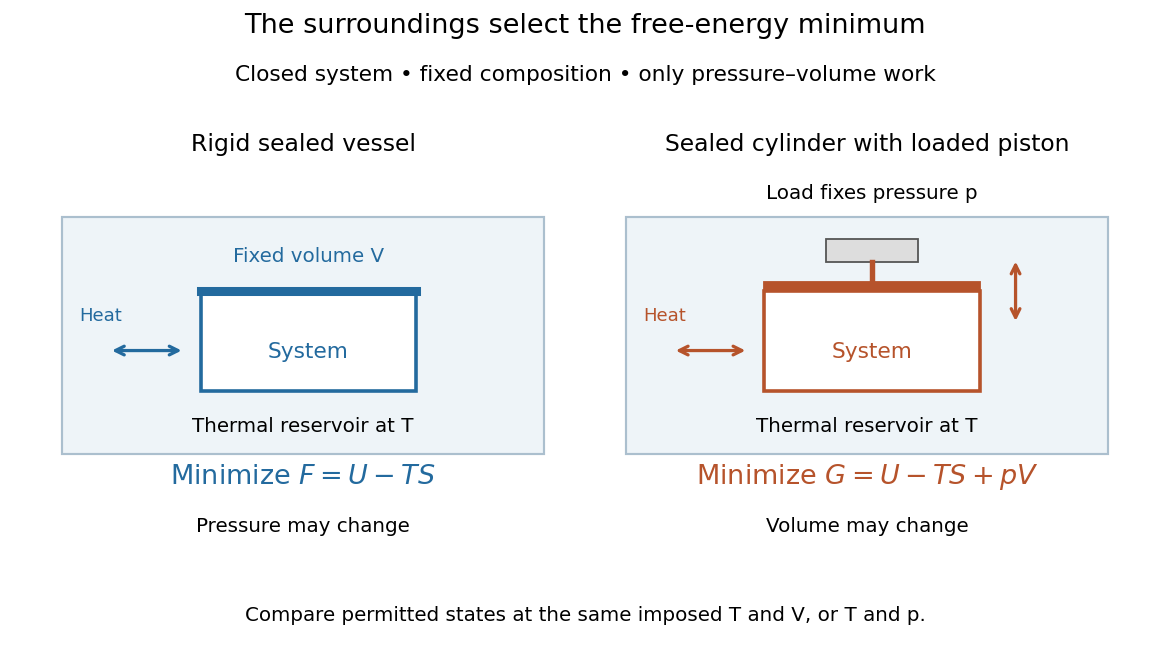
Choose Helmholtz free energy for fixed temperature and volume, or Gibbs free energy for fixed temperature and pressure
. Original schematic of two closed vessels in contact with a thermal reservoir. Composition is fixed, and only pressure-volume work is allowed. The right piston permits the volume to change. Details.
The useful insight is that internal energy alone cannot rank these alternatives: exchanging heat also changes the surroundings' entropy. Subtracting packages that accounting into a property of the chosen system. Adding additionally accounts for displacing the surroundings at fixed pressure. A free energy is a state function; supplied heat describes a transfer during a process. Under the stated constraints, supplied heat is at fixed volume or at fixed pressure, whereas neither nor generally equals .
A lower free energy identifies a thermodynamic preference, without specifying a timescale. A barrier can trap a system in a local minimum, producing metastability although a lower global minimum exists. The enzyme example illustrates the corresponding distinction for chemical reactions: changing the route can change the reaction rate while preserving the endpoint Gibbs free energy difference and chemical equilibrium.
Phase fraction Created 2026-10-14 Updated 2026-11-05
A phase fraction is the proportion of a mixture occupying a specified thermodynamic phase. State the basis: by mass, ; by volume, divide the occupied volume by the total volume. These fractions need not agree when the mass densities differ. The latent heat heating curve uses the liquid fraction by mass, whereas liquid fraction in a mushy layer is defined by volume.
Symbolic potential Created 2026-10-14 Updated 2026-11-05
A symbolic potential is a real-valued function on a symbolic sequence space, for example on a finite full shift. Its orbit sumweights a length- orbit segment in a partition function. Here is the left shift. The potential can encode geometric contraction or a chosen statistical preference; it is not determined by the alphabet alone.
Its variation at depth isSummable variations mean . If and agree on their first symbols, their shifted sequences agree for symbols at step . ThereforeThe right side stays bounded independently of . This uniform orbit-weight distortion is what allows a reference tail to be changed without changing topological pressure.
For a potential depending only on , every variation with is zero. The choice generates independent-symbol weights, while a geometric potential of an expanding map instead describes inverse-branch contraction.
Almost-additive partition-function limit 2026-10-14
The sequences and are respectively subadditive and superadditive. Apply Fekete's lemma to the first and its negative to the second; their normalized difference is , so their limits coincide. For full-shift weighted orbit sums, summable variations of the potential bound the energy change at a concatenation boundary, giving this estimate for the logarithm of the partition function. A fixed initial symbol or fixed remote tail changes only a bounded normalization and not the limit.
Topological pressure Created 2026-10-14 Updated 2026-11-05
For a finite full shift with alphabet and a continuous potential of summable variations, topological pressure is the limiting logarithmic weight per step:Here concatenates a finite word and a fixed reference tail, and is the left shift. Summable variations bound the effect of changing that tail by a constant independent of . The almost-additive partition-function limit consequently proves existence and tail independence.
For a fixed potential , the function is convex. At finite , differentiating twice gives the variance of the orbit sum under its normalized weights, divided by , which is nonnegative. Passing to the limit preserves convexity.
If , then for each orbit weight is multiplied by a factor between and . HencePressure is therefore strictly decreasing and Lipschitz continuous. If the alphabet has symbols, and as . The intermediate value theorem then gives exactly one positive zero. For a one-symbol alphabet the zero is instead at ; the alphabet-size qualification is essential.
Gibbs measure Created 2026-10-14 Updated 2026-11-05
A Gibbs measure gives probabilities controlled by exponential weights from a potential. The precise convention must be specified: finite-volume conditional distributions and symbolic orbit-weight bounds are related formulations with different hypotheses.
For a finite-alphabet full shift, a standard symbolic Gibbs condition for a probability measure is that a constant satisfyfor every length- word and every in its cylinder set . Here , and is topological pressure. The same constant must work for every word and every length. Summable variations make the orbit-weight comparison within one cylinder uniform. In applications to equilibrium states, shift invariance is also required.
For a one-symbol potential , where every and , the independent-symbol law hasThe bound is exact with . Equal symbol probabilities and unequal symbol probabilities are both Gibbs laws, although their geometric images can be very different: an arbitrary Gibbs measure need not be absolutely continuous.
An arbitrary unnormalized list of one-sided weights need not give consistent conditional probabilities for every finite horizon. Normalization and compatibility are part of constructing the measure, rather than consequences of calling the weights Gibbs.
Thermal transpiration experiment with a glass microtube Created 2026-10-14 Updated 2026-10-18
Rojas Cardenas, Graur, Perrier and Méolans studied thermal transpiration in helium using a glass microtube of diameter and length in their 2012 experiment. They heated one reservoir, leaving the other near room temperature, and measured tube-end temperatures of and . Three contact thermometers and an infrared camera checked the thermal conditions; the hot reservoir was warmer than the adjacent tube end, so heater temperature was not an adequate substitute for tube-end temperature. Two capacitance diaphragm gauges recorded the reservoir pressures; a third gauge supported calibration. [ref]
https://www.jstage.jst.go.jp/article/jtst/7/3/7_437/_pdf/-char/en#page=4. Rojas Cardenas et al. (2012), An Experimental and Numerical Study of the Final Zero-Flow Thermal Transpiration Stage, §2.1
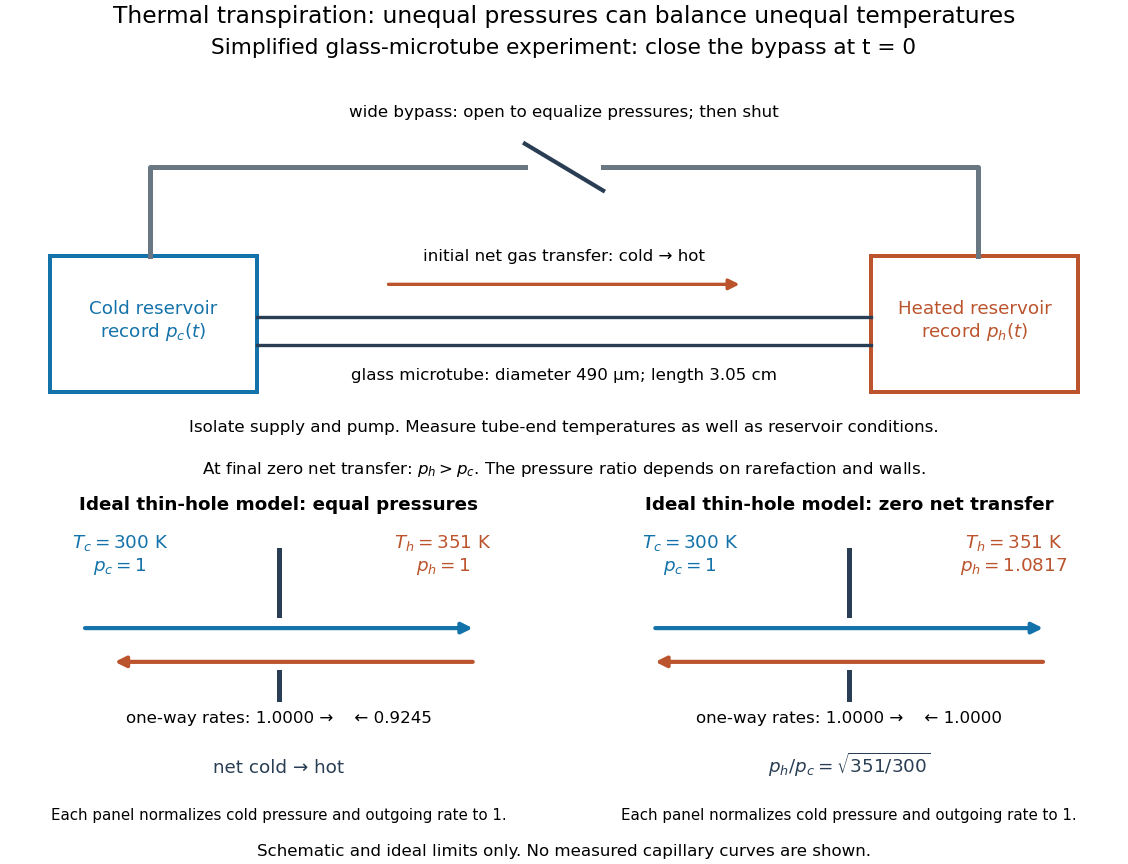

Their earlier 2011 paper explains the measurement sequence. A wide bypass links the reservoirs in parallel with the microtube. After isolating the gas supply and pump, keep the bypass open to equalize pressures with the temperature difference already established. Closing the bypass defines . The hot-side pressure rises and the cold-side pressure falls; ultimately their slopes approach zero at unequal pressures. Repeating at different initial pressures changes the degree of rarefaction without changing the microtube. The 2011 study also compared helium and nitrogen and imposed temperature differences of , and . [ref]
https://doi.org/10.1063/1.3561744. Rojas Cardenas et al. (2011), Thermal transpiration flow: A circular cross-section microtube submitted to a temperature gradient, measurement sequence
The quantities to record are both and , the reservoir volumes, and the temperatures relevant to their particle inventories. In an idealized reservoir of fixed volume and uniform fixed temperature , the ideal gas law gives , so opposite inventory changes test particle conservation. If temperature changes, differentiation instead gives : a thermal drift can imitate particle transfer. The authors' 2011 presentation explicitly checks this thermal correction when extracting an initial mass flow rate from the pressure slope. [ref]
https://www.itep.kit.edu/downloads/12_Rojas.pdf#page=25. Rojas et al., IUVSTA 2011 presentation, mass-flow extraction and thermal correction
The 2012 paper compares the final pressure ratio across near-free-molecular through slip conditions with a kinetic model and empirical corrections. It does not establish the thin-hole square-root law at every measured pressure. [ref]
https://www.jstage.jst.go.jp/article/jtst/7/3/7_437/_pdf/-char/en. Rojas Cardenas et al. (2012), abstract and comparison of final pressure ratios
For a replication, useful additional controls follow from the interpretation: remove the temperature difference to test the null signal; reverse it to test the direction; check gauge zero offsets and leaks; and wait for stable temperatures before closing the bypass. These are suggested controls, not claims that the cited paper performed each one. A reproducible pressure split at zero net transfer makes the failure of a single continuum wall model observable, while the Knudsen number organizes which molecular and apparatus scales are competing. Linear thermal expansion coefficient Created 2026-10-14 Updated 2026-11-05
The linear thermal expansion coefficient is the fractional change in a specified length per change in temperature, at fixed external pressure for a sample free to expand. For small changes, . An isotropic sample with the same response in all directions has volumetric coefficient of thermal expansion , since differentiating gives . Direction-dependent materials require a specified measurement direction. [ref]
https://openstax.org/books/university-physics-volume-2/pages/1-3-thermal-expansion. OpenStax University Physics 2, §1.3: linear and volumetric expansion
. Thermal equilibration of two finite bodies Created 2026-10-14 Updated 2026-10-20
Consider two rigid bodies forming an isolated system, with fixed composition and constant whole-body heat capacity at constant volume values and . Their initial temperatures are and . Assume each body remains internally uniform, their contact stores negligible energy, no phase transition occurs and no work is done or extracted. These are stipulated model values, not material measurements.
Because , write with arbitrary fixed reference constants . The conserved relative internal energy isThis is an energy reference convention, not a claim about actual heat capacities down to zero temperature. At thermal equilibrium the two temperatures equal , so the first law of thermodynamics givesThe larger heat capacity pulls the common temperature closer to its initial value: body 1 warms by , while body 2 cools by .
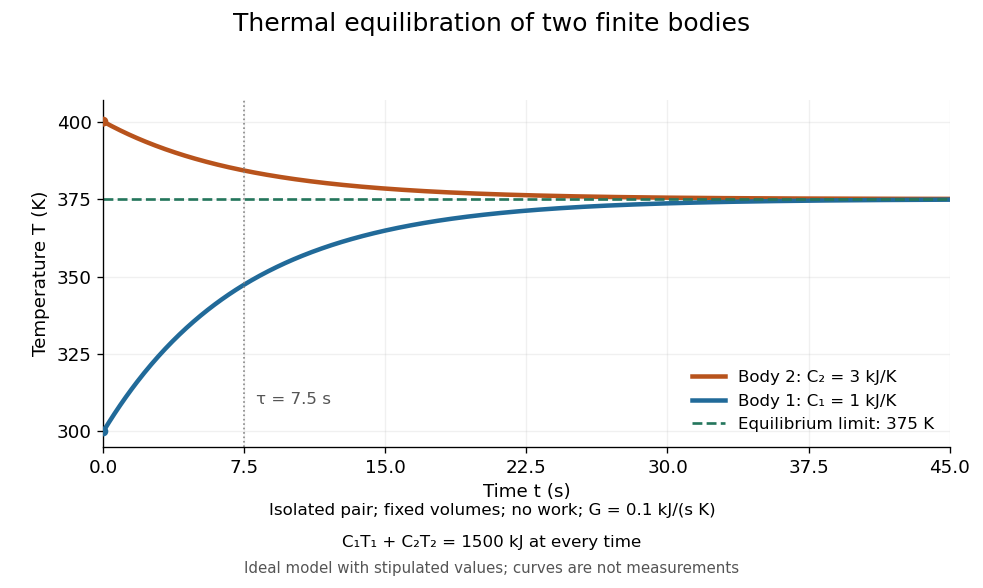
Two finite bodies approach thermal equilibrium at
. Ideal model with and and contact conductance . The weighted temperature stays at and the relative internal energy stays at ; the plotted curves are model predictions. Details.
To predict a timescale, stipulate a constant contact conductance , the reciprocal of the contact's thermal resistance. The rate of heat transfer into body 1 is , givingAdding proves conservation of . Subtracting gives exponential decay of the temperature difference, with time constantand thereforeExact equality is approached as in this ideal model. Changing changes the rate but not : equilibrium and the speed of reaching it are separate predictions. Real bodies can have internal temperature gradients, changing heat capacities and contact losses, so the plotted is an assumed model timescale.
Fractional entropy of a relativistically decoupled species Created 2026-10-14 Updated 2026-11-05
If a species and the remaining bath share a temperature at decoupling, their initial entropy ratio is the ratio of their entropy-weighted degrees of freedom. Subsequent conservation of each sector's comoving entropy keeps that fraction constant, even when the bath heats relative to the relic. For a two-state neutrino species leaving an ideal Standard Model bath, the fraction is .
Hexagonal convection amplitude equations 2026-10-14
A finite-wavenumber convection instability with a resonant three-wave triad can yield three coupled amplitude equations. For the gradient nonlinearity and weak quadratic asymmetry , projection onto a triad of length squared gives the stated equation and its cyclic copies. The quadratic coefficient is , while both self and cross cubic coefficients are for angles of degrees. The finite critical mode requires positive linear damping in the underlying long-wave equation.
Natural convection 2026-10-14
Convection driven primarily by buoyancy generated by heating or cooling, rather than an externally imposed mean flow. In a constant-flux unstable surface layer, the local speed scales as .
There are unlisted articles, also show them or only show them.