
Control limits 2026-10-14
Control limits bound the sampling outcomes expected under a specified reference process. An observation outside a limit is a statistical hypothesis testing signal to investigate the reference model. These are limits for observations under that model, rather than a confidence interval constructed around each observed estimate. Their calibration may be pointwise, simultaneous or sequential.
Hospital mortality funnel plot 2026-10-14
A hospital mortality funnel plot places each hospital's observed mortality proportion against its case volume. Under an independent binomial distribution model with common target p, the standard error is , so uncertainty bands contract as volume grows. This is a provider-performance plot, distinct in purpose and axes from a meta-analysis funnel plot. A signal requires investigation of data quality and patient case mix before drawing a causal conclusion.
CUSUM 2026-10-14
A CUSUM accumulates evidence for a change in a monitored probability distribution. With a log-likelihood ratio increment favoring a specified changed distribution, reset the accumulated score at zero and signal when it exceeds a chosen boundary . For , is the largest nonnegative sum of successive increments ending at . This permits repeated detection of a change with an unknown onset, rather than a single fixed-start test.
Power of a two-sample rare-event comparison Created 2026-10-14 Updated 2026-11-05
For two independent samples of size with event probabilities , put , , and . The normal approximation to a two-sided level- test has powerFor rare events, independent Poisson distributions approximate the counts. Conditional on their total, the null count allocation is binomial distribution with probability one half; under the alternative the allocation probability is . Averaging its exact rejection probability over the alternative total supplies a discrete power calculation.
// Target: probability-theory.bigb
Statistical hypothesis test Created 2026-10-14 Updated 2026-11-05
A statistical hypothesis test is a decision rule calibrated to distinguish a null hypothesis from a specified alternative hypothesis. A randomized statistical test gives a rejection probability for possible data . Its power function of a statistical test is , and a level- test satisfiesThe supremum is the size of a statistical test. Controlling it limits type I error; a useful test also has high statistical power against scientifically relevant alternatives.
For ten independent Bernoulli trials with success probability , test against by rejecting for at least nine successes. The upper-tail probability increases with , so the largest null rejection probability occurs at and equalsIt is therefore a conservative level-0.05 test. Rejecting at eight successes would have size . This illustrates why discrete calibration need not attain the advertised level exactly. A p-value is a null-tail probability for the observation, not a probability that the null hypothesis is true. The decision also does not measure the size or practical importance of an effect.
Informant function 2026-10-14
Power transform 2026-10-14
A power transformation replaces positive data by a member of a parameterized family of powers, commonly to improve the fit of a normal linear model.
Homoscedasticity and heteroscedasticity 2026-10-14
These describe constancy or variation of conditional error variance across observations. A homoscedastic regression model has ; a heteroscedastic model allows this variance to depend on the observation or its covariates.
Scientific control 2026-10-14
A scientific control supplies a comparison or procedure that distinguishes an intended effect from other influences on an experiment or observational measurement. Negative controls should show no target effect; positive controls should show a known effect. A negative control outcome applies this logic to an outcome that the exposure cannot causally affect.
Regression to the mean 2026-10-14
An unusually extreme noisy observation tends to be followed by a less extreme observation even without intervention. Selecting locations for an intervention because they had high prior event counts can therefore bias a simple before-and-after comparison toward an apparent reduction. The effect follows from conditioning on an extreme value with a transient random component, rather than from a causal treatment effect.
Outlier 2026-10-14
An outlier is an observation unusually far from the behavior expected under a statistical model. A large regression residual can identify a candidate, but data validation, regression leverage, and the possibility of model misspecification should be examined before excluding it. An outlier need not be an influential observation.
Nonlinear regression 2026-10-14
Nonlinear regression fits a conditional mean whose dependence on its parameters is nonlinear. In a normal distribution observation model, the likelihood is based on residuals . Nonlinearity can create parameter trade-offs, asymmetric uncertainty and several posterior regions, so prior predictive checks and Markov chain Monte Carlo convergence diagnostics can be especially useful.
Mark and recapture 2026-10-14
Mark and recapture estimates the cardinality of a finite set of individuals when counting everybody is impractical. The useful information is the overlap between observations: with fixed sample sizes, finding many of the same individuals again suggests a smaller population, while finding few suggests a larger one. More elaborate capture-recapture models also estimate survival and changing probabilities of detection.
In a closed-population capture-recapture model, let be the unknown population cardinality. Capture distinct individuals, mark them, release them all, and allow them to mix with the rest. Next take a second sample of distinct individuals using sampling without replacement, and count the individuals carrying a mark. The observed marked fraction estimates the population's marked fraction , giving the Lincoln-Petersen estimatorRelease happens between the two samples; sampling without replacement means that an individual is counted at most once within the second sample. See Richard J. Barker, Open Population Mark-Recapture Models, §1.1.1.
For a constructed teaching example, mark individuals and later capture , including marked individuals. One fifth of the second sample is marked, suggesting that the twenty marked individuals are one fifth of the population:Let and be the sets of individuals in the first and second samples. Their intersection has cardinality five. By the inclusion-exclusion principle, the set union containsThus is an observed lower bound, whereas is the output of an estimator based on the capture-recapture model. These are toy counts, not measurements from a medical or ecological study.
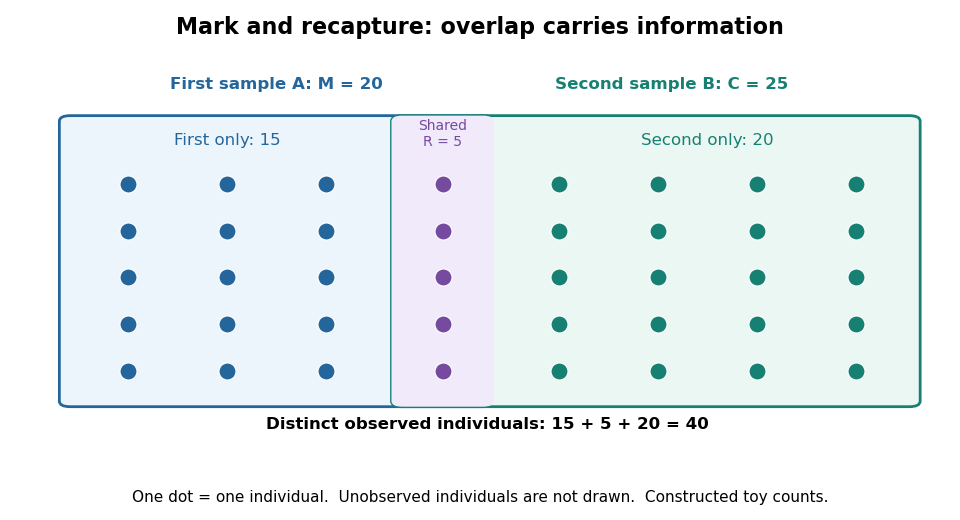
Forty distinct observed individuals: fifteen in the first sample only, five shared, and twenty in the second sample only
. Details. 
The diagram shows only observed individuals. It does not draw an assumed population of one hundred. The capture-recapture model uses the overlap to infer how many individuals may have escaped both samples; its likelihood function shows why one estimator output cannot describe all that uncertainty.
Regression analysis Created 2026-10-14 Updated 2026-10-20
Regression analysis studies how a response variable depends on explanatory variables through a regression model. It estimates that dependence and assesses uncertainty in fitted regression coefficients, predictions and model comparisons. Linear regression is one important case.
Statistical reflection symmetry Created 2026-10-14 Updated 2026-11-05
Statistical reflection symmetry means that the joint distributions of a random field are unchanged by a simultaneous spatial reflection, with each field component transformed according to its vector or pseudovector character. For an isotropic magnetic field, it excludes a parity-odd magnetic helicity contribution to the two-point spectral tensor.
Functional statistic 2026-10-14
A functional statistic evaluates a statistical functional at the empirical distribution . The map acts on distributions, whereas is a statistic. If has an asymptotic linear representation, thenA square-integrable influence function with mean zero consequently gives asymptotic variance by the central limit theorem.
Ratio estimator Created 2026-10-14 Updated 2026-10-25
A ratio estimator divides one statistic by another, for example an estimated joint moment by an estimated marginal probability. Its definition must specify what happens when the denominator is zero. A denominator bounded away from zero permits direct error bounds through .
Decision rule 2026-10-14
A measurable choice of an action from observed data, with a randomized rule allowing a conditional distribution of actions. Its performance under a loss function is the risk function . Admissibility compares risks pointwise, Bayes optimality integrates risk under a prior, and minimax optimality minimizes the worst-case risk.
Bayesian decision problem 2026-10-14
A prior on a parameter, a conditional observation distribution, an action space and a loss specify a Bayesian decision problem. The normal form minimizes prior expected loss over decision rules; the extensive form minimizes posterior expected loss after each observation. Conditional expectation gives the same Bayes risk for these formulations, provided measurable optimal or approximate choices can be made.
Cost-effectiveness analysis 2026-10-14
Cost-effectiveness analysis compares interventions through their costs and effects measured in a common outcome unit. Let and denote mean differences relative to a specified comparator. A positive effect increment with nonpositive cost increment gives dominance; the reverse signs give a dominated intervention. A tradeoff in the positive-positive quadrant requires a willingness-to-pay threshold per outcome unit. Randomized controlled trials can estimate these differences, but their joint sampling distribution is needed to express uncertainty. Outcome units, time horizon and costing perspective must be specified; a survival-day increment is not automatically a quality-adjusted outcome.
There are unlisted articles, also show them or only show them.