
Branch path of a graph subdivision 2026-10-14
A branch path of a graph subdivision is the replacement graph path for one original edge. Its endpoints are the corresponding branch vertices of a graph subdivision; its internal vertices have degree of a vertex two within the graph subdivision.
Branch vertex of a graph subdivision 2026-10-14
A branch vertex of a graph subdivision is a retained original vertex in a specified graph subdivision. Its degree of a vertex in that graph subdivision equals its original degree of a vertex. It need not have degree of a vertex at least three: in the example are also branch vertices of a graph subdivision. When the target itself has vertices of degree of a vertex two, adjacency alone need not identify which vertices were original; the specified target mapping supplies that distinction.
Rooted branch-set reduction 2026-10-14
Let be even, let , and suppose a graph has disjoint nonempty vertex sets , where . Suppose each is connected or every one of its graph components meets , and each is adjacent to all but at most of the other not meeting . Assume also that no rooted separation of a graph of order below avoids of these sets. Then there are disjoint connected vertex sets such that for and each of these first sets is adjacent to all but at most of .
Here adjacency of sets means existence of an edge between them. A rooted separation of a graph is with , , no edges between and , and order . It avoids when . We prove the reduction by induction, first on the vertex count and then on the edge count; any counterexample chosen minimal in this ordering will be impossible.
We may delete edges joining two vertices of . They cannot affect rooted separations of a graph, since lies wholly on the first side. Within a branch set, their deletion can only split a graph component into graph components each containing an endpoint in , so the branch-set hypothesis also persists. An isolated vertex outside and all branch sets can be deleted. An isolated vertex is also impossible, since has order and avoids at least sets. Thus in a minimal counterexample is independent, and every isolated vertex outside belongs to a singleton branch set.
Consider a rooted separation of a graph of order exactly avoiding at least branch sets, and put . Restrict to and . Each is nonempty: any not itself avoided is adjacent to at least one of the avoided sets, and the endpoint of such an edge in must lie in . If a graph component of misses , it lies in and is a whole graph component of , with no vertex of . The original hypothesis then forces to be connected and , entirely outside . Thus each restricted set is connected or all its graph components meet . In particular every missing equals an original set outside , so all its required adjacencies from persist.
A rooted separation of a graph of avoiding restricted sets lifts to in , of the same order: an avoided restricted set misses , hence is an original set outside . The edges removed inside do not obstruct lifting, since . This proves the required separation hypothesis for . If is smaller, induction gives the desired connected sets rooted at . Moreover has disjoint graph paths from to , by the Menger theorem. Indeed a separator of smaller order between these sets would give a rooted separation of a graph of of smaller order still avoiding those original sets. Truncate the graph paths at their first visits to , label their endpoints accordingly, and adjoin each graph path to the corresponding rooted connected set. They meet only in their distinct endpoints, so this gives the desired sets for , a contradiction. Consequently in a minimal counterexample every such separation of order has and , an independent set.
Now contract any edge whose endpoints do not belong to two different branch sets. Its endpoints cannot both lie in , so the image of still has size . The branch-set conditions persist. If the contraction created a forbidden rooted separation of a graph of order below , its lift would have order below , except possibly when the contracted vertex lies in its separator. In that case the lifted order increases by one and is at most . Equality would put the contracted edge inside , contradicting the just-proved independence of for an order- separation avoiding sets. Thus the separation hypothesis also persists. Applying induction in the contracted graph and expanding the contracted vertex would produce the required disjoint connected sets. Hence every edge in a minimal counterexample joins two different branch sets.
Every vertex outside the branch sets would be isolated, since every edge joins two branch sets; such an isolated vertex could be deleted. Thus the branch sets cover the graph. Each nonsingleton branch set is therefore an independent set, and all its vertices belong to , because each of its singleton graph components must meet . Let be the union of the nonsingleton branch sets, and write . There is a matching in a graph from into . Otherwise the Hall marriage theorem gives with neighbourhood satisfying . Since is independent, is a rooted separation of a graph of order . It avoids every singleton branch set outside , of which there are at leastThe penultimate counting bound uses that the nonsingleton sets number at most , so . This contradicts the separation hypothesis.
Use that matching in a graph to make a two-vertex connected set for each terminal in ; terminals outside remain singleton sets. There are at leastunused vertices, all singleton original branch sets. Choose of them for the remaining . Every rooted contains a singleton original branch set: either its terminal, or its terminal's matched neighbour. That singleton misses at most of the selected nonterminal singleton sets. This constructs the desired family and completes the proof.
Topological minor 2026-10-14
A topological minor records a network pattern whose vertices remain individual junctions but whose edges may become longer routes. For finite simple graphs, means that contains a subgraph that is a graph subdivision of up to graph isomorphism. Equivalently, choose distinct branch vertices of a graph subdivision for and a graph path from to for every . These are internally vertex-disjoint paths, and no internal vertex of any is a branch vertex of a graph subdivision. Only endpoints corresponding to a shared target vertex may be shared.[ref]
The Basics (author-hosted chapter preview). §1.7, printed p. 18: subdivisions; printed p. 21: topological-minor embeddings
The graph subdivision example below replaces two edges of a triangle in a graph by routes of two and three edges while retaining its attached leaf of a graph. If the host graph also contains an extra edge , the same routes still witness a topological minor: delete when selecting the subgraph. An induced subgraph is not required. However, routes that merely connect the right pairs are insufficient: using a branch vertex of a graph subdivision as an intermediate junction, or making two routes share an internal vertex, can change the local network structure.
Every topological minor is a graph minor. In each branch path of a graph subdivision, contract all but one edge; the disjoint interiors let this shorten each route without merging distinct branch vertices of a graph subdivision. This recovers after deleting unused vertices and edges.[ref] The converse fails because an ordinary branch set of a graph minor can gather several junctions into one.
For the tree with vertices and edges , contracting produces a star graph : the branch sets of a graph minor are . Both have degree of a vertex three; each of the other four vertices is a leaf of a graph with degree of a vertex one. The new centre has four distinct graph neighbours ; its degree of a vertex is , in agreement with the edge contraction formula.
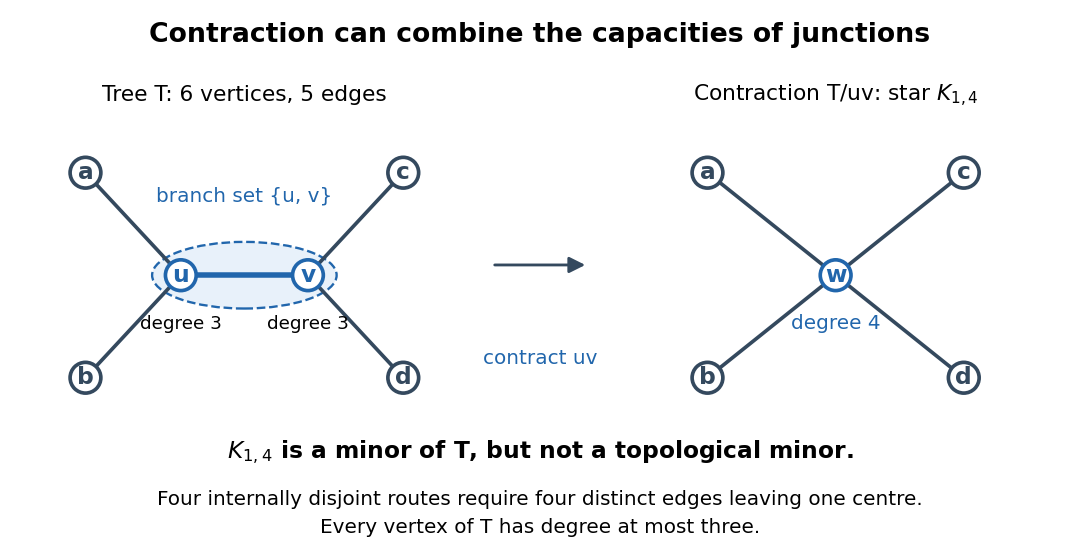
A graph minor can combine two junctions: contracting creates a star graph with a centre of degree of a vertex four
. Details. 
Yet is not a topological minor of . In a graph subdivision of , four branch paths of a graph subdivision must leave the centre through four different edges; sharing their first internal vertex would violate internal disjointness. Thus any host needs a vertex of degree of a vertex at least four, whereas . More generally, implies , where is the maximum degree of a graph. This bound concerns the host graph; extra unused edges may make its branch vertices of a graph subdivision have larger degrees of vertices than their target counterparts.
This distinction matters when a network's individual junctions have a limited number of connections: replacing a connection by a route preserves the number of routes meeting at each chosen junction, while contracting a connected region can combine connections from separate junctions. It also explains why a small nonplanar pattern can hide inside long routes. By Kuratowski's theorem, a finite simple graph is a planar graph exactly when it has neither the complete graph nor the complete bipartite graph as a topological minor. The obstruction is a graph subdivision inside the network, regardless of the number of intermediate vertices.
Graph embedding 2026-10-14
A graph embedding in the subgraph sense is an injective graph homomorphism. It preserves edges, while it may send a nonedge to an edge. An induced embedding additionally preserves nonedges. For directed graphs, every prescribed arrow must be preserved.
Bicyclic graph 2026-10-14
Greedy coloring 2026-10-14
For a finite simple graph, choose an order of its vertices and process them one at a time. Give each vertex the smallest positive colour label not already used by its coloured neighbours, and keep all earlier assignments. This is greedy coloring: each step makes a locally available choice. The resulting graph coloring is proper because, for each edge, its later endpoint avoids the colour of its earlier endpoint.[ref]
https://ocw.mit.edu/courses/6-042j-mathematics-for-computer-science-fall-2010/1ccaf180bcd244fddd32e60789fa922f_h9wxtqoa1jY.pdf. Leighton, MIT Graph Theory and Coloring, transcript pages 12–13
If the maximum degree of a graph is , a vertex has at most previously coloured neighbours, forbidding at most that many distinct colours. At least one label among remains available. Consequently every order givesThis is an upper bound, not a promise that greedy coloring attains the chromatic number.[ref]
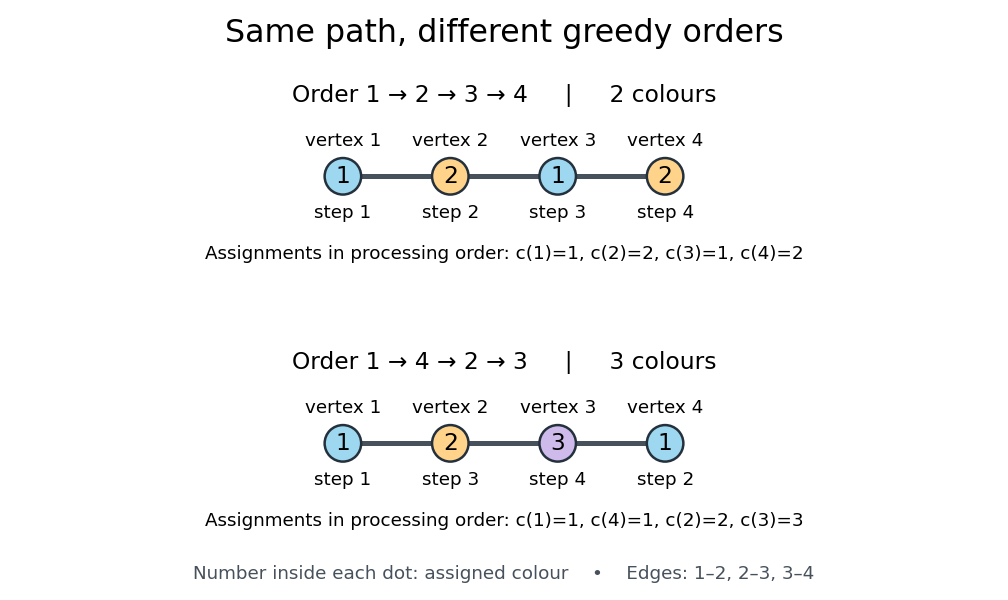

Consider the path graph with edges . In the order , greedy coloring assigns the colours respectively. In the order , it assigns colours in processing order: vertices both get colour , then vertex gets colour , and finally vertex sees colours and at its two neighbours and must take colour . Written in vertex order , this second colouring is .
The path graph has chromatic number two: the first assignment achieves two colours, and any edge rules out one. Its maximum degree of a graph is two, so three colours in the second assignment still satisfy the bound. The extra colour comes entirely from the processing order. The crown graph gives a larger family where a poor order can make greedy coloring use arbitrarily many colours although the chromatic number remains two.
Coloring entropy weight 2026-10-14
Colour savings from sparse neighbourhoods 2026-10-14
If each neighbourhood misses a fixed positive fraction of the possible pairs at a large degree bound, randomly assign about half that many colours and erase vertices with monochromatic incident edges. A nonadjacent neighbour pair can share a retained colour, giving a neighbour-colour saving. Write the number of successful repeated colours as a difference of two certifiable functions: colours with a nonadjacent pair, minus those for which a neighbour loses that colour. Both change by at most two under one-coordinate changes and have constant-size certificates. Talagrand's convex distance inequality and the Lovász local lemma make their linear expected saving simultaneous at all high-degree vertices; low-degree vertices have slack already. This yields a colouring using a fixed positive fraction fewer than the degree bound.
Maintain lists of available colours, tentatively colour small random portions, erase conflicts and prune colours used by neighbours. In a triangle-free graph, a vertex's neighbours form an independent set, which enables local estimates. Track list size and average remaining neighbour congestion per colour; prune unusually congested colours before the next round. Concentration and the Lovász local lemma preserve these invariants until lists have enough slack for completion. Tracking averages matters because triangle-free graphs can still contain many four-cycles and need not have uniform per-colour congestion.
Proper vertex coloring Created 2026-10-14 Updated 2026-10-20
A proper vertex coloring assigns labels to the vertices of a graph so that vertices joined by an edge have different labels. Each colour class is an independent set. The chromatic number is the least number of labels needed for this form of graph coloring.
Graph isomorphism Created 2026-10-14 Updated 2026-11-05
Two graphs are isomorphic when a bijection between their vertex sets preserves and reflects adjacency.
Vertex (graph theory) 2026-10-14
Connectivity (graph theory) 2026-10-14
Connectivity studies the existence of paths between vertices of a graph and the persistence of paths after vertex or edge deletions. A connected graph is the basic case in which every pair of vertices is linked by a path.
Bridge (graph theory) Created 2026-10-14 Updated 2026-10-25
A bridge is an edge whose deletion increases the number of components of a graph. Equivalently, it belongs to no cycle; within its original component, deleting it makes the connected graph disconnected.
Distance-transitive graph 2026-10-14
An automorphism group is transitive on ordered pairs of vertices at every fixed distance. Grassmann graphs provide examples with the finite general linear group as a distance-transitive automorphism group.
Multigraph 2026-10-14
A multigraph permits distinct edges with the same pair of endpoints. Whether loops are also allowed is a convention that must be specified for a particular result. Counting edges with multiplicity differs from counting adjacent vertices.
Amenable graph 2026-10-14
A bounded-degree infinite graph is amenable when there are finite nonempty vertex sets such that , where is the set of vertices outside adjacent to it. These are graph Følner sets. Amenability makes surface contributions negligible compared with volume. The square lattice and any periodic finite decoration of it are examples.
Incidence matrix 2026-10-14
A vertex-edge incidence matrix records which vertices are endpoints of each edge of a graph. The unsigned convention uses entries one at the endpoints, with a convention for loops. Choosing an orientation gives the oriented incidence matrix, with minus one at the initial endpoint and plus one at the terminal endpoint. These are different conventions and should be specified when using the matrix in a computation.
Strong product of graphs 2026-10-14
Its vertices are pairs of vertices. Two distinct pairs are adjacent exactly when, in each coordinate, their entries are equal or adjacent in the corresponding graph. Cartesian products of independent sets are independent, giving supermultiplicativity of the independence number.
There are unlisted articles, also show them or only show them.