
Mod-p cohomology ring of a cyclic group 2026-10-14
For a prime , a classifying Eilenberg–MacLane space for is the infinite lens space , using scalar multiplication by a primitive th root on the complex-coordinate sphere. Its contractible universal cover is . The standard two-periodic free resolution has differentials and , both zero after applying cochains with trivial coefficients. Thus every cohomology degree has dimension one. If , the ring is , . If is odd, it is , with , : graded commutativity gives and the periodicity class induces the degree-two isomorphisms. The Künneth theorem gives two copies of these generators for ; the dimension in degree is for every .
Poincare duality group Created 2026-10-14 Updated 2026-11-05
A Poincare duality group of dimension has a finite-length resolution of the trivial group ring module by finitely generated projective modules, and vanishes except in degree , where it is infinite cyclic as an abelian group. The top module can have an orientation-sign action. Reversing the dual projective resolution gives , equivalently with the appropriate diagonal action. Untwisted duality requires trivial orientation action. In positive dimension , since a finitely supported invariant element cannot exist for an infinite group.
Integral cohomological dimension of a group Created 2026-10-14 Updated 2026-11-05
The integral cohomological dimension is the least length of a projective resolution of the trivial group ring module , equivalently the largest degree in which group cohomology with some module can be nonzero. A group containing torsion has infinite integral cohomological dimension. For the dimension is , realized by its torus classifying space and detected by its top cohomology.
Cellular free resolution from a contractible universal cover Created 2026-10-14 Updated 2026-11-05
For a connected CW complex with contractible universal cover, let and . Lift each cell once and transport its orientation by deck transformations. Its translates form an -basis of the cellular chains of the cover. The augmentation sends every vertex to one, and contractibility makes the augmented chain complex an exact free resolution of the trivial module . An -linear cochain with trivial coefficient action is constant on each orbit of lifts, identifying with the cellular cohomology complex of . Consequently . The same argument with singular simplex lifts works for spaces with a contractible universal cover.
Orbit (group theory) 2026-10-14
For a group action of a group on a set , the orbit of a group action of is the subset of all positions reachable from :Two points belong to the same group orbit exactly when one can be moved to the other by a group element. This is an equivalence relation: the identity element gives , the inverse element of a transformation reverses a move, and a product combines two moves. Hence the group orbits form a partition of a set of into equivalence classes. A transitive group action on a nonempty set has just one group orbit. See Ackerman's algebra notes, lemma 0.5.1.3, for the orbit partition.
For the square and the eight-element dihedral group defined under group action, direct enumeration gives the following separate group orbits:
- On vertices of a polygon, has size four.
- On unoriented sides of a polygon, has size four; and denote the same side of a polygon.
- On unoriented diagonals of a polygon, has size two.
- On the singleton set containing the centroid , has size one, so is a fixed point of a group action.
These counts depend on the chosen group action, not just the group. An orbit of a group action describes all configurations equivalent under the permitted transformations. For ordered pairs under the symmetric group, equality of the two entries is preserved, separating the two group orbits in equality-pattern orbits of ordered pairs; the orbit-stabilizer theorem computes their sizes when the symmetric group is .
Diagonal action on a centerless group Created 2026-10-14 Updated 2026-11-05
For nontrivial centerless , the displayed right group action of is faithful and transitive. Its identity stabilizer is the diagonal subgroup. Subgroups above that diagonal are with : multiply by a diagonal element to isolate the second coordinate, then use diagonal conjugation. Thus the action is primitive exactly when is nonabelian simple.
The convention is right-handed: writing , one has . With left group action notation, the corresponding formula is ; it has the same diagonal stabilizer subgroup.
Multiply transitive group action 2026-10-14
A group action is -transitive if it acts transitively on ordered -tuples of distinct points. In degree this implies . It is sharply t-transitive when each such ordered tuple has trivial stabilizer subgroup.
Fundamental domain 2026-10-14
For a group action, a fundamental domain selects one representative from each orbit. Geometric fundamental domains are often taken with their boundary included, allowing boundary overlaps while their interiors remain disjoint under the action. For translations of the real line by the integers, is an exact representative set and is its closed geometric version. A lattice similarly gives a half-open fundamental parallelepiped.
Free group action 2026-10-14
A group action is free if the only element of the group fixing any point is the identity element. Thus every stabilizer subgroup is trivial. This is a property of an action of any group, not an assertion that the acting group is a free group.
Explicitly, for a left group action of a group on a set with identity element , freeness meansEquivalently, for any there is at most one with . Indeed, if , the group action rules give , so freeness forces ; conversely, take , since the identity element already sends to itself. Thus every orbit map is injective, even when its image of a function is only part of .
For a permutation example, let the cyclic group act on the set by . The nonidentity element exchanges both pairs and fixes no point, so every stabilizer subgroup is . Its two group orbits are and . This is a free group action but not a transitive group action: there is no group element sending to . Each restriction to one group orbit is a simply transitive group action.
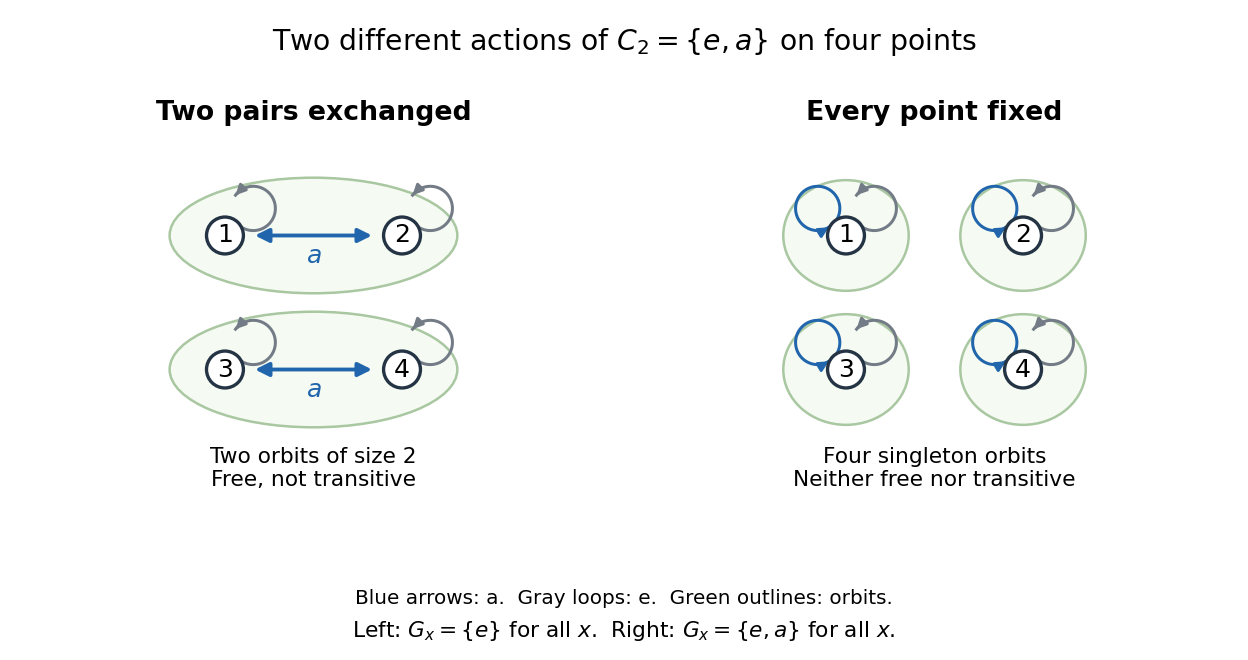

The identity element fixes every point in every group action; freeness excludes fixed points only for nonidentity elements. This also differs from a fixed point of a group action, which must be fixed by every group element. In the left diagram there are no such fixed points of a group action. In the right diagram, the same abstract cyclic group acts by : all four points are fixed points of a group action, every stabilizer subgroup is , and each group orbit is a singleton set. Consequently this second group action is neither free nor transitive. A group action with no fixed points of a group action can still fail freeness: the natural group action of the symmetric group has no point fixed by all of , but fixes .
For a finite group, the orbit-stabilizer theorem makes each group orbit of a free group action have cardinality . If is also finite, is therefore a multiple of the group order, with one copy of for each group orbit. The trivial group acts freely on every set, and acts transitively exactly on a singleton set. On the empty set freeness is vacuous; our convention under transitive group action requires a nonempty set for transitivity.
Free action of a group Created 2026-10-14 Updated 2026-11-05
A group action is free when only the identity element fixes any given point, equivalently when every stabilizer subgroup is trivial. The trivial group acts freely on every set. Each nonidentity element in a free group action induces a fixed-point-free bijection; the fixed-point property of even-dimensional complex projective space obstructs such actions by homeomorphisms.
For a finite group acting freely by homeomorphisms on a Hausdorff manifold, the quotient map is a covering map. Around a point choose a small neighborhood disjoint from all its nonidentity translates, using finiteness and the Hausdorff property. Its translates are the disjoint sheets above its image in the quotient. For an infinite group, freeness alone does not supply such neighborhoods.
Finite support in a permutation action 2026-10-14
Suppose a permutation group acts on an underlying atom set and on a collection of objects built over it. A finite subset supports an object when every permutation fixing all members of fixes . Pairing supported objects uses the union of their supports. A definable subset or functional image inherits a support from its domain and parameters. In a hereditarily finite-supported Quine-atom model, every member is recursively required to have such a support; symmetry then rules out a choice function on the pairs of atoms.
Symmetry group Created 2026-10-14 Updated 2026-10-14
A symmetry group collects bijections of an object to itself that preserve a specified structure in both directions, with function composition as the operation. For a geometric object one may require Euclidean distances to be preserved, giving an isometry group; for a graph, one preserves adjacency, giving a graph automorphism group. For an unstructured finite set, every permutation is allowed. The structure to be preserved is part of the definition.
For a square with its usual geometric structure, the symmetry group consists of four rotations and four reflections. These form the dihedral group of group order eight. The existing group action example shows how its eight elements move the vertices of a polygon; changing the object to its edges or a marked configuration changes the group action being studied.[ref]
Specifying the preserved data makes it possible to test a proposed symmetry exactly. After the preserved data are declared, function composition, the identity map, and inverse maps automatically preserve them too. Symmetry transformations therefore form a group, and questions about equivalent configurations become questions about group orbits, stabilizer subgroups, and group homomorphisms. This supplies reusable mathematics for comparing many different kinds of objects.
Circle action 2026-10-14
A circle action is a group action by . Hamiltonian circle actions are especially useful in symplectic reduction.
Subgroup factorization from coset transitivity Created 2026-10-14 Updated 2026-11-05
In the right multiplication action, the orbit of the coset under is . It is the whole right coset space exactly when every has form , proving the displayed criterion. The factorization need not be unique; for finite groups .
Symmetry enlargement under group translates 2026-10-14
For a group of Euclidean isometries, every element preserves the displayed union of images of a set, because left multiplication permutes its group indices. Its full setwise isometry group can be larger even when itself has no nonidentity symmetry. Take to be the integer translations of the plane and . By rigidity of a scalene triangle, has trivial stabilizer subgroup. Yet , whose quarter-turn about the origin is a symmetry outside the translation group.
n-transitive group action Created 2026-10-14 Updated 2026-11-05
Let and let be a set with at least points. A group action on is n-transitive when it can send any ordered tuple of distinct points to any other such tuple. Here ordered means a sequence of entries, rather than increasing in a total order. For order-preserving group actions, the corresponding notion is order n-transitivity. The size condition excludes vacuous transitivity on an empty collection of distinct-point tuples.
Group element 2026-10-14
A group element is a member of the underlying set of a group. The group operation assigns a product to each pair of elements, the identity fixes every element under multiplication, and every element has an inverse.
Poly-(cyclic or finite) group 2026-10-14
A group is poly-(cyclic or finite) when it has a finite subnormal series in which each quotient is a cyclic group or a finite group. Each term need only be normal in the next term. The polycyclic group condition instead requires every factor to be cyclic.
Triangle group Created 2026-10-14 Updated 2026-10-18
A triangle group is generated by reflections in the sides of a triangular fundamental domain in spherical geometry, Euclidean geometry or hyperbolic geometry. The angles determine the geometry through the sign of . Its orientation-preserving subgroup has group presentation .
Partially ordered group 2026-10-14
A group with a partial order preserved by multiplication on both sides: implies for all . In additive notation this says . Preserving only one side is a different orderability condition.
There are unlisted articles, also show them or only show them.