
Vinogradov's three-primes theorem Created 2026-10-14 Updated 2026-11-05
Every sufficiently large odd integer is a sum of three primes, with repetitions allowed. The weighted count is asymptotic to . Siegel–Walfisz theorem controls the major arcs, and Type I/II estimates for the prime exponential sum make the minor arcs negligible. Removing prime-power contributions gives genuine prime representations. This is the sufficiently-large theorem, not by itself a proof for every small odd integer.
Unlinking an open file 2026-10-14
For an ordinary file under the POSIX rules used here, successful
unlink("a") removes the named directory entry and decreases the hard link count. An existing open file description still refers to the same file; removing a name does not detach an already open file descriptor. When the final hard link disappears, the contents remain available through open references until those references close. This distinction is between the lifetime of a name and the lifetime of the underlying file. [ref]https://pubs.opengroup.org/onlinepubs/9699919799/functions/unlink.html. The Open Group, POSIX.1-2017, unlink: removal of names and deferred removal of open-file contents
Start with names
a and b for inode 42 and one file descriptor 3 referring to one open file description. Let count hard links and count live open file descriptions for this file. Assume successful operations, no additional references, and no memory-mapped file. The stages areAfter the first removal, b still works. After the second, neither name works, but a read through the existing file descriptor can still obtain all six bytes if its open file description's current position is at the beginning. The final close releases the last open reference, allowing the inode and its file data blocks to be reclaimed. Freed storage is reusable; this does not promise that old bytes are securely erased. [ref]https://pubs.opengroup.org/onlinepubs/009604499/functions/close.html. The Open Group, POSIX, close: releasing descriptors, open file descriptions and unlinked-file storage
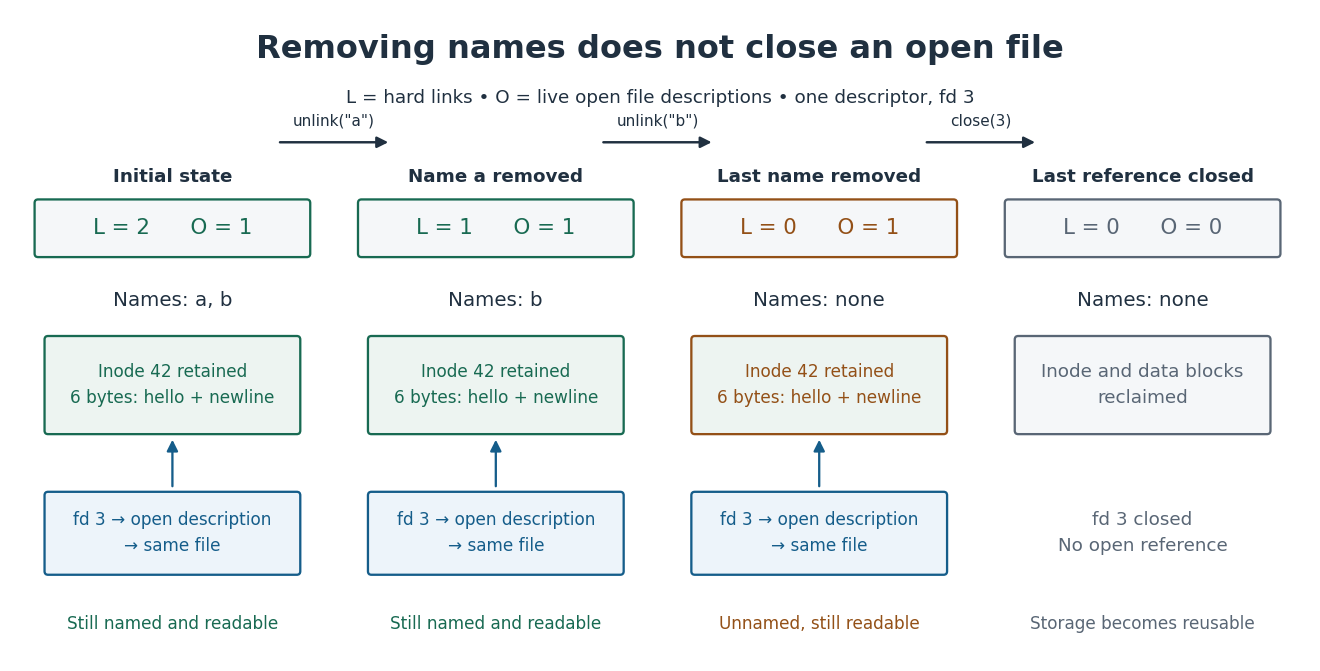

The reasoning is bookkeeping rather than a long proof: each successful removal subtracts one from and leaves unchanged; closing the only file descriptor in this example releases the sole open file description. Storage is reclaimable only at the last stage. is a teaching count, not a count of file descriptors or an asserted internal inode field: several file descriptors can share one open file description, and other references such as a memory-mapped file require additional lifetime accounting. The diagrams are abstract models, not operations on actual user files.
For the Cartesian convention , an isotropic function has . Its inverse is . The self-reciprocal Hankel transform instead uses . In particular . Mixing these spectral conventions changes attenuation coefficients by .
Isotropic transverse covariance spectrum 2026-10-14
For the Fourier transform convention , angular integration of an isotropic power spectrum gives the displayed Hankel transform. A purely radial Hankel transform without the prefactor corresponds to defining its spectrum as .
Asymptotic Hamming bound 2026-10-14
The Hamming bound packs disjoint balls of radius approximately . Taking logarithms and using the Hamming ball volume exponent gives the bound for .
// Target: algebra.bigb
Inverted quartic oscillator phase portrait Created 2026-10-14 Updated 2026-10-18
The autonomous planar system , preserves . Its origin is a center equilibrium and are saddle equilibria. The level is : its two inner arcs are heteroclinic orbits enclosing periodic motion, while its outer branches connect saddles to escaping trajectories. Since on escaping levels, infinity is reached in finite time. Adding to gives , so positive produces outward crossing of central levels and breaks the equal-energy heteroclinic connections.
Resonant quantum control 2026-10-14
A near-resonant drive selects a transition and, in an appropriate rotating frame and rotating-wave approximation, controls a two-level effective Quantum Hamiltonian. If with fixed axis, then . Pulse area fixes the rotation angle; drive phase chooses a transverse axis. Selectivity and neglect of rapidly oscillating terms require the appropriate detuning and drive-strength regime.
Adiabatic quantum control 2026-10-14
Design a slowly varying Quantum Hamiltonian path whose relevant initial eigenstate connects to a desired final eigenstate. Under the gap and slowness hypotheses of the quantum adiabatic theorem, the state follows that instantaneous eigenstate up to phase. The path, spectral gap and duration all matter; a level crossing or excessive speed can spoil the intended state transfer.
Average Hamiltonian engineering 2026-10-14
Fast prescribed pulses change the frame in which the system evolves during successive intervals. To leading order over a short control cycle, the effective Quantum Hamiltonian is the duration-weighted mean of these conjugated generators. The Baker--Campbell--Hausdorff formula supplies commutator corrections. Symmetrizing the cycle can cancel unwanted interactions or retain a desired one. The approximation requires control cycles short compared with the relevant dynamical timescales and a suitable account of finite pulse duration.
Dark state of a driven Hamiltonian 2026-10-14
Such a quantum state remains an eigenstate of for every control input. Its projector commutes with all available generators, so its population is conserved. This obstructs full-space pure-state controllability even when the orthogonal bright subspace can be controlled. An instantaneous dark state of a slowly varying Quantum Hamiltonian instead supports adiabatic quantum control if a spectral gap and slowness condition are maintained.
Half-line drift null contour identity 2026-10-14
For , let be the upper branch , oriented left to right. Above , lies in the lower half-plane, where a decaying half-line Fourier transform is analytic. For , closing upward proves that the displayed integral vanishes. An additional multiplier analytic above with at most polynomial growth is allowed, using exponential decay and, if needed, regularized contours. This supplies a null term in a Fokas method inversion formula without changing the function in the interior.
For , the Half-range Fourier transform is holomorphic in the lower half-plane. Let , and , with their boundaries oriented counterclockwise. The rotated arguments on and on remain in the lower half-plane. For and transform-admissible smooth decay, the Cauchy integral theorem and Jordan lemma give the displayed null integrals. Arbitrary multiples can therefore be added to Fourier inversion without changing the recovered function on the positive half-line.
// Target: integrable-systems.bigb
Half-line NLS global relation 2026-10-14
In a real normed vector space with a specified countable dense subset, a bounded linear functional on any vector subspace admits a norm-preserving extension without the axiom of choice. Add the dense vectors one at a time using the supremum endpoint in the one-dimensional dominated extension of a real linear functional. This makes the recursion deterministic. Extend from the resulting dense subspace by continuity, using the least index in the dense list which approximates a given vector to within .
Sandwich form of the Hahn-Banach theorem 2026-10-14
If is a sublinear functional, a superlinear functional and on a real vector space, there exists a linear functional between them. More generally, a linear functional on a subspace extends with this domination whenever for all ambient and subspace . In a one-dimensional extension the admissible values for a sandwich extension form a nonempty real interval. Positive homogeneity checks the extension on both signs of the new coordinate. Chain unions preserve linearity and the mixed domination, so Zorn's lemma gives a maximal extension, whose domain must be the whole space. Finally in the mixed inequality gives the upper bound; using the pair gives the lower bound. Conversely, any linear between obeys the mixed inequality by .
Convex domination form of the Hahn-Banach theorem Created 2026-10-14 Updated 2026-10-25
A linear functional dominated by a finite real convex function on a vector subspace extends with the same domination to the whole real vector space. To add , choose between the supremum of and the infimum of , over and . Convexity, applied to , makes every lower candidate at most every upper candidate. The candidates at bound the interval by finite numbers. Chain unions preserve domination, so Zorn's lemma gives a full extension. No homogeneity of is assumed.
Mixed-state Hadamard-test quadratures Created 2026-10-14 Updated 2026-11-05
For the Hadamard test with a density operator in the auxiliary register, the output control qubit has Pauli Z gate expectation and Pauli Y gate expectation , where . The minus sign comes from the final Hadamard gate, since . Measuring in therefore estimates the imaginary part using the minus-outcome frequency minus the plus-outcome frequency.
Photon-number reference for a Hadamard gate Created 2026-10-14 Updated 2026-10-20
A flat reference over adjacent Fock states has overlap with a one-photon shift and with a two-photon shift. These overlaps, obtained by counting shared number states, determine the reduced qubit channel of a number-conserving Hadamard interaction. For , its squared fidelity with the desired pure output is for input Bloch vector . Its worst-case infidelity is because . At the two-shift overlap is zero, not , and the fidelity is . Broad coherent number support, rather than merely a large fixed photon number, suppresses distinguishability of the outgoing field states.
H-cobordism theorem 2026-10-14
A compact smooth h-cobordism of dimension at least six between connected simply connected closed manifolds is diffeomorphic to a product, relative to its incoming boundary. The boundary manifolds consequently are diffeomorphic. The dimension and simple-connectivity hypotheses are sufficient conditions, not necessary properties of a product cylinder. The two boundary inclusions being homotopy equivalences are necessary for a trivial cobordism.
For a spherical cell with its centre of mass displaced by from its geometric centre, gravity produces torque . Rotational resistance gives angular velocity . Taking its cross product with gives the displayed orientation equation with . Steady orientation therefore requires the two terms on the right to sum to zero; placing the vorticity term alone on the other side changes its sign.
There are unlisted articles, also show them or only show them.