
Gyrotactic orientation Fokker-Planck equation Created 2026-10-14 Updated 2026-11-05
For orientation probability density on the unit sphere, deterministic drift and isotropic rotational diffusion coefficient give . The derivatives are tangential to the sphere, and normalization is . The spherical divergence of is .
Gyrotactic circular paths in a rotating cylinder Created 2026-10-14 Updated 2026-11-05
For fluid velocity and , the stable deterministic orientation is . Once this orientation has relaxed, swimming at speed shifts the centre of the circular material trajectories to in the plane. Its distance from the cylinder axis is . General initial orientations produce an orientation transient before these circular paths.
Gyrotactic focusing in a downward pipe flow Created 2026-10-14 Updated 2026-11-05
For a bottom-heavy spherical swimmer in axial flow , the bottom-heavy spherical-cell orientation dynamics with aligning rate gives , . On the upward-stable branch , the cells tilt inward in a downward Poiseuille flow. Zero radial cell flux with scalar diffusivity gives , . For , integration and the average normalization give the displayed concentration. A steady deterministic orientation requires ; beyond this shear threshold the stationary orientation closure fails.
First successful Grover iterate Created 2026-10-14 Updated 2026-11-05
For one marked element among candidates, set . The first nonnegative Grover search algorithm iteration count attaining marked probability at least is the displayed integer. Before the first success interval, the angle is below ; entering that interval requires . Rounding up gives an angle less than , so it cannot skip the interval. Moreover . For , the known candidate is already the answer and no iteration is needed; the two-dimensional marked--unmarked plane degenerates.
First half-probability Grover iterate Created 2026-10-14 Updated 2026-11-05
If the marked fraction is and , the success probability after Grover search algorithm iterations is . For , its first value at least occurs atBefore this integer the angle is below , so success is below . At this integer, the angle lies in , contained in , where squared sine is at least . If , no iteration is needed. For small , is asymptotic to .
Smooth representation of a locally profinite group Created 2026-10-14 Updated 2026-11-05
A complex group representation is smooth when every vector is fixed by some compact-open subgroup. Equivalently each vector's stabilizer is open. Smoothness is local constancy of orbit maps with the vector space regarded discretely, not ordinary continuity into a finite-dimensional complex topology.
Distinct-character extensions of an abelian group split Created 2026-10-14 Updated 2026-11-05
A two-dimensional representation of an abelian group fitting into an extension of two distinct linear characters splits. Choose an element on which the linear characters differ. Its matrix has two distinct eigenvalues, and all commuting group operators preserve its two eigenlines. Those eigenlines supply the two invariant linear character summands. The argument does not apply when the two linear characters coincide.
Scalar endomorphisms obstruct a split extension Created 2026-10-14 Updated 2026-11-05
If a representation has one-dimensional endomorphism algebra, it cannot be a direct sum of two nonzero invariant subspaces: the two coordinate projections would be independent endomorphisms. This obstruction does not require either summand to be irreducible, and does not assert that scalar endomorphisms alone imply irreducibility.
Representation over the rational numbers Created 2026-10-14 Updated 2026-11-05
A representation over the rational numbers is a group representation on a finite-dimensional rational vector space. Choosing a basis gives rational matrices. It differs from a rational representation of an algebraic group, where rational refers to regular matrix-coefficient functions rather than the ground field. Scalar extension yields representations over every characteristic-zero field.
Orthogonal representation 2026-10-14
An orthogonal representation is a real group representation preserving a positive-definite inner product, equivalently a group homomorphism into an orthogonal group. Every finite-dimensional continuous real representation of a compact group has this form after averaging an inner product over Haar measure, by orthogonalization of a compact-group representation.
Projective representation Created 2026-10-14 Updated 2026-10-18
A projective representation is a group homomorphism into the projective linear group of a vector space. Choosing invertible linear representatives makes multiplication hold up to nonzero scalar factors. A projective unitary representation chooses unitary operators as representatives, whose scalar factors have modulus one.
Tietze transformations 2026-10-14
A Tietze transformation changes a group presentation without changing the presented group, by adding or removing a consequence of the relators, or by adding or eliminating a generator together with a defining equation expressing it in the others. For example a generator defined by can be eliminated by substitution in every remaining relator.
Word problem for groups 2026-10-14
For a fixed finitely generated group with specified generators, its word problem asks for an algorithm deciding whether an input word represents the identity. For a finitely presented group, positive answers can be enumerated from the relators, but there need not be an algorithm deciding both positive and negative answers. An effective reduction from a nonrecursive halting set proves unsolvability.
Recursive presentation of a group Created 2026-10-14 Updated 2026-10-25
A recursive presentation has an effectively enumerable alphabet of generators and a recursively enumerable set of relators. Usually the alphabet is finite; when it is countably infinite this is specified explicitly. Enumerating finite products of conjugates of relators and their inverses enumerates all null words. Conversely the enumerable null words can themselves serve as the relators. Recursive presentability does not imply a soluble word problem for a group.
Homomorphism of abelian groups Created 2026-10-14 Updated 2026-11-05
A group homomorphism between abelian groups, conventionally written additively. Its kernel and image are subgroups, and the additive formula implies preservation of zero, negation and every integer multiple. Maps on Mordell-Weil groups induced by isogenies of elliptic curves and by good reduction are examples.
Cayley's theorem 2026-10-14
Every group is isomorphic to a subgroup of the symmetric group on its underlying set. The construction uses the left regular action: each group element becomes a permutation of all the group elements, given byFor a finite group of group order , labeling these elements by gives a group embedding into . The same construction works for an infinite group, with the symmetric group of all bijections of its underlying set.[ref]
Group Theory (v4.01) by James S. Milne. Theorem 1.22 and Corollary 1.23, printed page 16: left multiplication embeds a group into its symmetric group
The beauty is that the multiplication rule itself supplies a concrete model. Whatever the group elements originally represent, each one rearranges the entire group by multiplication. A product becomes function composition, and no distinctions between group elements are lost. For a finite group, a row of its Cayley table lists the images under one : the multiplication table is already a catalogue of permutations.
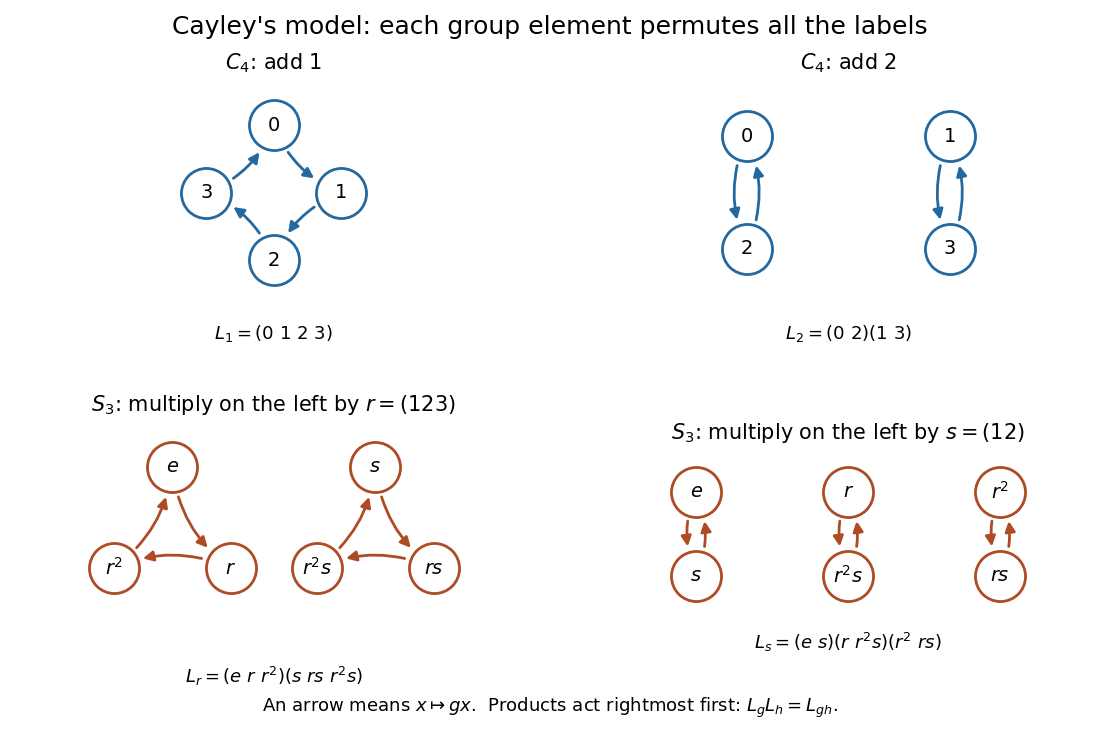
Throughout this construction, products of permutations act rightmost first:Thus first multiplies by , then by . This is a left group action, not a license to reverse the multiplication order in a nonabelian group. Ordinary right multiplication instead satisfies with this convention; replacing it by restores the group homomorphism law.[ref]
Group Actions by Keith Conrad. Example 2.10, printed page 7: left multiplication and the reversed composition law for right multiplication
For an explicit cyclic group example, take under addition, using modular arithmetic. Its left regular action consists of . In permutation cycles on the labels ,The function composition sends to , to , to , and to : squaring the four-point permutation cycle produces two disjoint permutation cycles. Also . These four permutations form a cyclic subgroup of , reproducing addition in exactly.
For a nonabelian group example, let , with , , and its identity element. The six group elements are , where and . Now the labels being permuted are themselves permutations of three points. Computing the left regular action gives permutations of these six labels:For example, ; putting here would accidentally switch to right multiplication. Noncommutativity survives in the model:These different outputs prove that . The group generators become group generators of a six-element subgroup of .

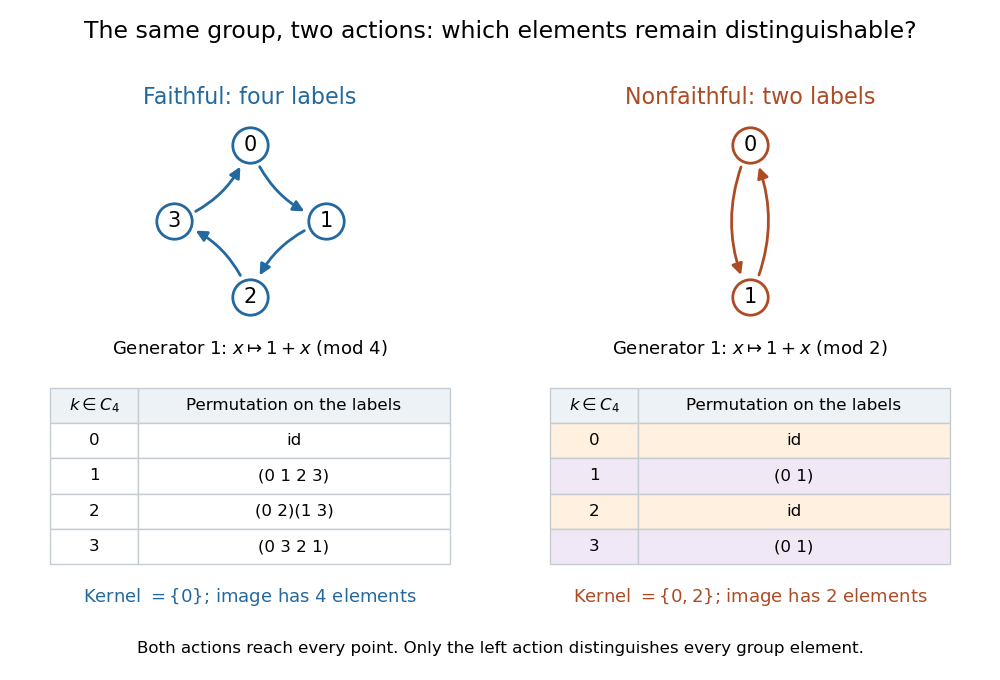
Why does a group action here produce a group embedding? Any group action on a set gives a group homomorphism ; it is a group embedding precisely when it is a faithful group action. The group kernel consists of the group elements fixing every point of . In the left regular action, , so fixing the identity element already forces . In fact every stabilizer subgroup is trivial, since forces ; this stronger property makes the left regular action a regular group action.[ref]
Compare two group actions of the same cyclic group . Its left regular action on four labels distinguishes all four group elements. On , the rule defines a transitive group action, but and both fix both points, while and both exchange them. Its group kernel is , so it is not a faithful group action. Its image is a two-element subgroup of , isomorphic to the quotient group rather than to .

The guaranteed number of labels need not be the smallest possible for a faithful group action. The symmetric group naturally acts faithfully on : a permutation fixing all three labels is the identity element. Its left regular action uses six labels instead. Three is the smallest possible here, since and have fewer than six elements and cannot contain an isomorphic copy of . Moreover, in the natural three-point group action, the stabilizer subgroup of is : a faithful group action can have nontrivial point stabilizer subgroups. Cayley's construction supplies a universal model, while a smaller model can reveal particular symmetries.
The proof is short. Each is a bijection with inverse . Associativity givesso is a group homomorphism. If , evaluating both at the identity element gives . Hence is injective, and its image is the required isomorphic subgroup. No finiteness assumption entered the argument.
The historical connection is unusually close to the notation. The opening paragraph of Arthur Cayley's 1854 paper already treats permutations as one example of operations on a collection of quantities and explicitly performs the rightmost operation first in a product. It also allows noncommutativity while insisting on associativity. The modern left regular action shows how that viewpoint reaches every abstract group, by choosing the group itself as the set to be acted on.[ref]
Abstract awakenings in algebra: Early group theory in the works of Lagrange, Cauchy, and Cayley by Janet Heine Barnett. Abstract awakenings in algebra: Early group theory in the works of Lagrange, Cauchy, and Cayley by Janet Heine Barnett, Section 3.1, printed page 50: reproduced opening paragraph of Arthur Cayley's On the theory of groups, as depending on the symbolic equation theta^n = 1; reference 5, printed page 91: original publication in 1854
Two-generator HNN embedding 2026-10-14
For , put , , , and for . The freely generate by free conjugate bases in a rank-two free group. The do too: projection killing maps them to a free conjugate basis, so no reduced word in them is trivial. The HNN extension adjoining embeds by Britton's lemma. Since and , its generators reduce to . For finitely many and this is a finite group presentation; for effective countably many generators and enumerable it is a two-generator recursive presentation of a group.
Continuous cochains with topological coefficients Created 2026-10-14 Updated 2026-11-05
For a topological group module, use continuous maps with pointwise addition and the inhomogeneous group-cohomology differential. The kernel modulo the image defines continuous group cohomology as an abelian group. With general topological coefficients the quotient topology need not be Hausdorff; the cohomology here is the algebraic quotient of continuous cocycles by continuous coboundaries. With trivial discrete coefficients in a prime field, its first cohomology is the space of continuous group homomorphisms to that field's additive group.
Tate cohomology of a finite group Created 2026-10-14 Updated 2026-11-05
For a finite group , Tate cohomology joins group cohomology and group homology through the norm map . For it equals ordinary group cohomology; for it equals . The middle terms are and , where is generated by . For the trivial module , . With multiplicative coefficients the norm is the product of the translates.
Dimension shifting in group cohomology Created 2026-10-14 Updated 2026-11-05
Embed a module over the group ring in a module with vanishing positive group cohomology, and write . The connecting map in the long exact group cohomology sequence of is an isomorphism for , since the groups involving on both sides vanish. For a finite group and a module with vanishing Tate cohomology of a finite group in every degree, the same argument shifts every Tate degree. Repeating this construction transports computations to a convenient resolution.
There are unlisted articles, also show them or only show them.