
Givens row-pair update 2026-10-14
Left matrix multiplication by a Givens rotation replaces rows of a matrix byBoth right-hand sides use the old entries. An in-place algorithm must save the first result temporarily, update the second entry, and only then overwrite the first. The reference BLAS
DROT implementation follows this order with its temporary DTEMP.[ref]DROT (Reference BLAS, LAPACK 3.12.1) by LAPACK project. DROT source, lines 116–120 and 130–134: temporary first-row value and second-row update
For elimination in column , construct from . This sets the lower component to zero in exact arithmetic. In floating-point arithmetic the computed expression can leave a small remainder; after computing the other updated entries, explicitly store and . Previously eliminated columns stay zero if both participating rows are already zero there. This is why the ordering in QR decomposition by Givens rotations matters.
Stable construction of a Givens rotation 2026-10-14
For finite real numbers , a Givens rotation that annihilates is defined mathematically byHere
hypot means an evaluation of the Euclidean norm of designed to avoid unnecessary range failures in floating-point arithmetic. The zero case selects the identity matrix, avoiding division by zero. If , then ; if , then . Thus the retained component is nonnegative, including when . In exact arithmetic, and .Computing the square root of
a*a + b*b directly can fail even when the final norm is representable. In binary64 floating-point arithmetic, makes the squares overflow, whereas is finite. With the squares round to zero, although is representable. A range-safe hypot avoids these intermediate failures.The simple divisions still need care when is a subnormal number: rounding can cause large relative errors. For the smallest positive binary64 subnormal number , taking rounds to ; dividing by that rounded value gives , which is not an orthogonal matrix. For nonzero finite inputs, compute the coefficients before rescaling the norm:At least one scaled component has absolute value one, and . This construction keeps the coefficients meaningful even when rounding is severe. It cannot make an unrepresentably large finite, preserve an arbitrarily tiny against underflow, or repair inputs already rounded to zero. The row updates themselves can also overflow if their exact results exceed the available range.
LAPACK's
DLARTG uses scaling for numerical stability but a different sign convention: for it chooses and ; for it returns . Its block still has the lower-left minus sign. Do not combine its returned coefficients with an assumed nonnegative .[ref]DLARTG (LAPACK 3.12.1) by Edward Anderson. DLARTG, LAPACK 3.12.1, Purpose: block, signed R, scaling and zero-input cases; implementation lines 137–159
Varshamov bound for linear codes 2026-10-14
For a prime-power alphabet size , a linear code exists if . Choose parity-check columns successively, avoiding combinations of at most earlier columns. Fewer than vectors are forbidden, so such a choice is possible. No set of at most columns is dependent, and the resulting kernel has dimension at least .
// Target: probability-and-statistics.bigb
Asymptotic Gilbert–Varshamov bound Created 2026-10-14 Updated 2026-11-05
For , take logarithms of the Gilbert–Varshamov bound and apply the Hamming ball volume exponent. The Varshamov bound for linear codes gives the same achievable lower bound within linear codes for prime-power .
// Target: algebra.bigb
A binary code rate is guaranteed with correction of every error pattern of Hamming weight at most when and . Choose minimum Hamming distance . The Gilbert–Varshamov bound and entropy bound for a Hamming ball give at least codewords. To deduce vanishing error probability for a binary symmetric channel with crossover probability , use strict inequality in the rate condition and a correction radius ; the weak law of large numbers then controls the tail. Correcting exactly the mean number of errors does not by itself ensure reliable transmission.
// Target: algebra.bigb
Diagonal scaling of Gershgorin discs 2026-10-14
A positive diagonal matrix , with , is an invertible matrix and changes the coordinate scales through the similarity transformation . Its diagonal entries are still , while . Thus the Gershgorin discs have the same centres but different radii. Matrix similarity preserves the characteristic polynomial and eigenvalues, so the original and scaled disk unions are both valid bounds and may be intersected. Suitable scaling can compensate for badly unbalanced off-diagonal entries; it need not shrink every radius.[ref]
https://cklixx.people.wm.edu/teaching/math408/408-note.pdf. Chi-Kwong Li, Math 408 lecture notes, §6.1: similarity transformations for eigenvalue localization
For example,The original Gershgorin discs are and . Their union is simply the huge first disk; the small second disk contains no eigenvalue. After scaling, both radii are , giving or . The two Gershgorin discs overlap, so their individual eigenvalue counts are not certified. The scaled matrix is a real symmetric matrix, however, so matrix similarity now proves that the original matrix has real eigenvalues in and is an invertible matrix. Directly, both matrices have characteristic polynomial , henceThe scaling changes the available bounds, while these eigenvalues stay fixed.
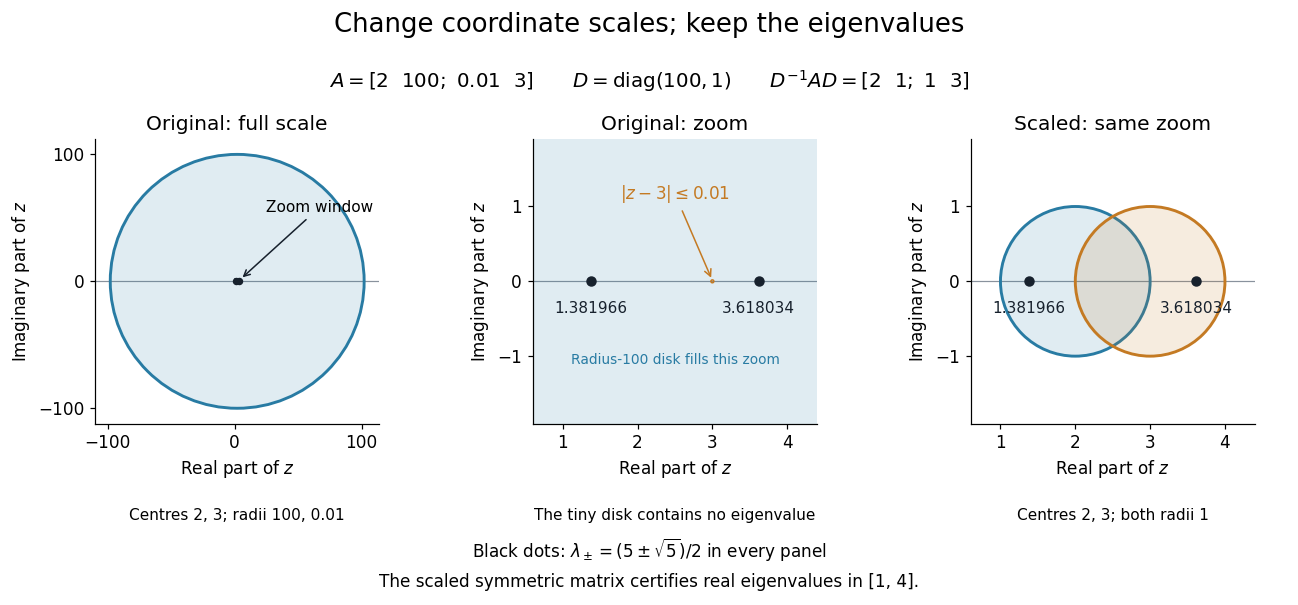
Diagonal similarity scaling replaces a radius-100 Gershgorin disc by two radius-1 discs while preserving both eigenvalues
. Details. 
Gershgorin bounds for symmetric matrices 2026-10-14
For a real symmetric matrix, or more generally a Hermitian matrix, the finite-dimensional spectral theorem makes all eigenvalues real. Intersecting its Gershgorin discs with the real axis givesThe union preserves gaps that the single outer interval loses. If every , all eigenvalues are positive, so the matrix is a positive-definite matrix. This is the positive-diagonal strictly diagonally dominant matrix criterion. For the three-by-three example, gives a positive-definite matrix certificate and bounds its spectral condition number of a positive-definite matrix by ; the computed value is about .
Strictness matters. The symmetric matrix has positive diagonal and is a diagonally dominant matrix, but its eigenvalues are and : it is singular. For a general complex matrix, the condition only puts the eigenvalues in the open right half-plane. The Hermitian matrix assumption is what converts that statement into positive definiteness.
Gershgorin eigenvalue counting 2026-10-14
Let be a connected component of the union of the row Gershgorin discs of an matrix. If comprises of the indexed Gershgorin discs, then it contains exactly eigenvalues, counted with algebraic multiplicity. Coincident disks still count separately, once for each row. In particular, a Gershgorin disc disjoint from all the others contains one simple eigenvalue. More generally, any union of indexed Gershgorin discs disjoint from the remaining contains exactly eigenvalues, whether or not that union is connected.[ref]
The separation is essential: overlapping Gershgorin discs do not individually promise one eigenvalue each. Discs that touch at a boundary point belong to the same connected component. For example, the matrix has Gershgorin discs of radii with centres . The component around comprises two indexed disks and contains the eigenvalue with algebraic multiplicity two; the isolated point at contains the remaining eigenvalue.
For intuition, continuously turn on the off-diagonal entries using the diagonal matrix and , . At the eigenvalues are the disk centres; at every later time the Gershgorin discs stay inside their final union. The continuity of the eigenvalues as a collection means that no eigenvalue can cross a gap between final components. The count gives a useful certificate that an eigenvalue cluster is complete.[ref]
https://www.stat.uchicago.edu/~lekheng/courses/302/notes2.pdf. Gene H. Golub, CME 302, Lecture 2, §6: turning on the off-diagonal entries continuously
For an initially resting shallow water layer whose height rises linearly from to across , let and . Conserved linear shallow-water potential vorticity gives . Boundedness, oddness, and continuity of height and slope give inside the ramp, and outside. The balanced velocity is , . Narrow ramps spread over the Rossby deformation radius; wide ramps retain their initial height except for narrow matching layers.
Geostrophic adjustment of a Gaussian height ridge Created 2026-10-14 Updated 2026-11-05
Consider an initially resting layer governed by the linear shallow water equations, with mean depth , constant nonzero Coriolis parameter , and a localized along-ridge-uniform height disturbance . Define and the positive Rossby deformation radius . The linearized shallow-water potential-vorticity anomaly is , initially .
The stationary geostrophic balance has and . Substituting in conserved givesThe decaying Green function of this modified Helmholtz equation givesIts kernel is positive, has integral one and has width : the balanced surface is a smoothed version of the initial ridge with the same signed excess volume per unit ridge length. For a positive Gaussian function , the final height is positive, even and lower at its central peak; the balanced along-ridge velocity is odd. Reversing changes the sign of this velocity without changing the final height or its decay length. Using as a positive kernel width would instead require the explicit assumption .
For each spatial Fourier transform component, initial rest fixesThe second term consists of inertia-gravity waves. For localized data on the infinite line they spread away and leave the steady component locally. This local geostrophic adjustment does not remove wave energy globally; a finite reflecting basin can retain oscillations.
Rough path translation 2026-10-14
For and a continuous path of bounded variation, translate the first level by and add the mixed integrals , and to the second level. Integration by parts defines the second mixed integral. The operation is continuous in the rough path metric and the variation norm of . For canonical lifts it is precisely the enhancement of the sum of the paths.
Local tidal acceleration scaling Created 2026-10-14 Updated 2026-10-25
The geodesic deviation equation makes the relative gravitational acceleration proportional to the separation and a typical Riemann curvature tensor component . Thus tidal acceleration vanishes as at fixed bounded curvature. A uniform electric field can give different accelerations at the same point, independently of separation. Relative tidal changes accumulated over a fixed long time need not vanish as a fraction of the initial separation; a local spacetime experiment must control its duration as well as its spatial size.
Source (quantum field theory) Created 2026-10-14 Updated 2026-11-05
An external source is a prescribed field coupled to a dynamical field or operator in the action, for example . Functional derivatives of the generating functional with respect to insert the corresponding fields into correlation functions. The source is varied to generate these insertions, rather than integrated over as a dynamical degree of freedom. Transforming it in the appropriate representation maintains an invariant source coupling when deriving a Ward identity.
Polynomial interactions as source differential operators Created 2026-10-14 Updated 2026-11-05
In a finite-dimensional integral, . Expand as a formal perturbation series to obtain . With a finite-mode regulator, a Minkowski source insertion satisfies ; this gives the displayed interacting generating functional. The substitution is a perturbative differential-operator identity, not an assertion that the interaction exponential defines a convergent series. Divide the resulting functional by for normalized correlation functions.
Krull dimension criterion for rank-one generalized Weyl algebras Created 2026-10-14 Updated 2026-11-05
For a commutative Noetherian base of finite dimension , the noncommutative Krull dimension of equals unless a height- maximal ideal is periodic under or contains infinitely many translates . This is the commutative-base specialization of Theorem 5.3 in Krull dimension of Generalized Weyl Algebras with non-commutative coefficients.
Selective quantum measurement 2026-10-14
A selective measurement in quantum mechanics conditions on a known outcome. For Kraus operator , the Born rule gives and the conditional density operator is when . Conditioning changes the state and can change the conditional reduced density matrix of a correlated remote system. That conditional state is available as such only to an observer with the outcome information.
Nonselective quantum measurement Created 2026-10-14 Updated 2026-11-05
A nonselective quantum measurement averages over outcomes that are not read or not communicated. Its quantum channel is , with . The completeness condition makes the channel trace preserving. The average equals , where are the conditional states from a selective quantum measurement. A nonselective projective measurement is the special case in which the operators are orthogonal projectors.
Gaussian evolution in an inverted harmonic oscillator Created 2026-10-14 Updated 2026-10-18
For the Hamiltonian , a Gaussian wave packet satisfies and . The displayed solution is normalizable for real exactly when ; its second moments of a complex Gaussian wave packet areBoth grow as , while their difference and hence the mean energy remain constant.
Gauss-Laguerre quadrature 2026-10-14
For the weight on , use the zeros of a degree- Laguerre polynomial as quadrature nodes. Divide a polynomial of degree at most by that polynomial. The quotient term integrates to zero by orthogonality and vanishes at every node; interpolation of the remainder proves exactness. The two-node rule has nodes and corresponding weights , with the larger weight at the smaller node.
Chebyshev–Gauss quadrature 2026-10-14
The first-kind rule approximates at the zeros of the Chebyshev polynomial . It integrates all polynomials of degree at most exactly. The weights follow by integrating the Lagrange interpolation polynomial at those nodes. Orthogonality kills the quotient when a degree- polynomial is divided by ; its remainder is recovered by interpolation. No -node rule can integrate every degree- polynomial, since the squared nodal polynomial has zero quadrature sum and strictly positive weighted integral.
// Target: probability-and-statistics.bigb
There are unlisted articles, also show them or only show them.