
Past exam of the mathematics course of the University of Cambridge 2020 ib Paper 2 12B ii Solution Created 2026-09-24 Updated 2026-09-29
Past exam of the mathematics course of the University of Cambridge 2020 ib Paper 2 12B i Solution Created 2026-09-24 Updated 2026-09-29
Past exam of the mathematics course of the University of Cambridge 2020 ib Paper 2 10E ii Solution Created 2026-09-24 Updated 2026-09-29
The identity mapis a continuous bijection by . Its domain is compact by part (i), and its codomain is a Hausdorff space because every metric space is Hausdorff. The compact-to-Hausdorff continuous bijection theorem therefore makes the identity a homeomorphism. Consequently
Past exam of the mathematics course of the University of Cambridge 2020 ib Paper 2 10E i Solution Created 2026-09-24 Updated 2026-09-29
HereThe L1 norm and uniform norm satisfyso the identity from the metric to the metric is one-Lipschitz and therefore continuous. The two metrics do not induce the same topology on all of . Forone has but . Thus convergence need not imply uniform convergence.
Choose distinct and defineThe Vandermonde determinant is nonzero, so is a bijection. It is one-Lipschitz for the two uniform metrics. If are the associated Lagrange cardinal polynomials, thenand henceThus is also Lipschitz.
Let be the polynomials whose values lie in . Its image under lies in the bounded cube . It is closed: if , then the Lipschitz inverse gives uniform convergence , and passing to the limit pointwise preserves . By the Heine-Borel theorem, is compact, and the continuous inverse carries compactness back to . Therefore
Past exam of the mathematics course of the University of Cambridge 2020 ib Paper 1 5C b Solution Created 2026-09-24 Updated 2026-09-29
Past exam of the mathematics course of the University of Cambridge 2020 ib Paper 1 5C a Solution Created 2026-09-24 Updated 2026-09-29
Gaussian elimination gives the LU decompositionThe prescribed diagonal entries of are visible, and direct multiplication gives .
Past exam of the mathematics course of the University of Cambridge 2020 ib Paper 1 20H b Solution Created 2026-09-24 Updated 2026-09-29
Let be the expected capture time starting from , so . The Strong Markov property at successive first passages to lower levels and part (a) giveAt , the next state is zero with probability , one with probability , and two with probability . First-step analysis therefore givesorSolving,Substituting now yieldswhich is the required expected capture time.
Past exam of the mathematics course of the University of Cambridge 2020 ib Paper 1 20H a Solution Created 2026-09-24 Updated 2026-09-29
A random time is a stopping time for the natural filtration of a Markov chain when for every . The Strong Markov property says that, conditionally on and , the process after is a fresh copy of the chain started from , independent of the pre- history.
Before capture define the half-separationFor , independence of the two moves gives the transition probabilitiesIgnore the holding steps. The resulting embedded chain is a biased random walk that moves left with probability and right with probability . Its expected number of moves needed to descend one level is ; this follows either from first-step analysis or from its drift . A non-holding move occurs with probability at each time, so its mean waiting time is two. Hence, for every , the expected time to go from separation to is
Past exam of the mathematics course of the University of Cambridge 2020 ib Paper 1 19H d Solution Created 2026-09-24 Updated 2026-09-29
Because , for fixed and sufficiently large ,ThereforeEquivalently, converges in distribution to an exponential distribution of rate one.
Put . The limiting probabilityand the certain inequality suggest the approximate confidence intervalSince , its expected length isas required.
Past exam of the mathematics course of the University of Cambridge 2020 ib Paper 1 19H c Solution Created 2026-09-24 Updated 2026-09-29
The scaled maximumhas cumulative distribution function for . ThusThe mean squared error of the maximum likelihood estimator is therefore
Each from the uniform distribution on has mean and variance . The sample mean is unbiased and has variance , hence
Past exam of the mathematics course of the University of Cambridge 2020 ib Paper 1 19H b Solution Created 2026-09-24 Updated 2026-09-29
A statistic is sufficient for if the conditional distribution of the full sample given does not depend on . It is minimal sufficient if it is a function of every sufficient statistic.
The likelihood factors asso the Fisher-Neyman factorization theorem shows that , and hence its one-to-one transform , is sufficient. Moreover, for two samples and , the ratio is independent of exactly when their maxima agree. The likelihood-ratio criterion for minimal sufficiency therefore shows that and are minimal sufficient.
For , the sample mean is not sufficient: two samples can have the same mean but different maxima, and their likelihood ratio then depends on through the support indicators. It is consequently not minimal sufficient. For the degenerate special case , the sample mean and maximum coincide and both conclusions reverse.
Past exam of the mathematics course of the University of Cambridge 2020 ib Paper 1 19H a Solution Created 2026-09-24 Updated 2026-09-29
Let . The likelihood function isOn its feasible range , this is decreasing in . Therefore the maximum likelihood estimator is
Past exam of the mathematics course of the University of Cambridge 2020 ib Paper 1 18C c Solution Created 2026-09-24 Updated 2026-10-14
The displayed Rodrigues' formula gives the Legendre polynomialA four-node Gaussian rule is exact through degree . Solving first for gives the four nodesThe rule is not exact for every polynomial of degree eight: its quadrature value on is zero because every node is a root of , whereas
Past exam of the mathematics course of the University of Cambridge 2020 ib Paper 1 18C b Solution Created 2026-09-24 Updated 2026-09-29
For fixed interpolation nodes , interpolate any asIntegrating shows that the unique weights making the quadrature rule exact through degree are
Now let the nodes be the zeros of the degree- orthogonal polynomial . Given any , polynomial division givesOrthogonality gives , while makes the quadrature sum for vanish. The rule is already exact on , so it is exact on . This is the defining precision property of Gaussian quadrature.
Past exam of the mathematics course of the University of Cambridge 2020 ib Paper 1 18C a Solution Created 2026-09-24 Updated 2026-09-29
Define the cardinal polynomialsThey satisfy . Hence evaluating the proposed polynomial interpolation formula at gives , so the required coefficients areThe polynomial has degree at most and takes every prescribed value. Its uniqueness follows because the difference of two such polynomials would have distinct roots while having degree at most .
Past exam of the mathematics course of the University of Cambridge 2020 ib Paper 1 17C c Solution Created 2026-09-24 Updated 2026-09-29
Using and the Pythagorean trigonometric identity,so the speed is independent of . Since ,and the speed tends to zero at the vertex. The steady irrotational Bernoulli equation givesThus the fluid pressure is also independent of , withIn particular, the pressure difference between the vertex and is
Past exam of the mathematics course of the University of Cambridge 2020 ib Paper 1 17C b Solution Created 2026-09-24 Updated 2026-10-14
Past exam of the mathematics course of the University of Cambridge 2020 ib Paper 1 17C a Solution Created 2026-09-24 Updated 2026-09-29
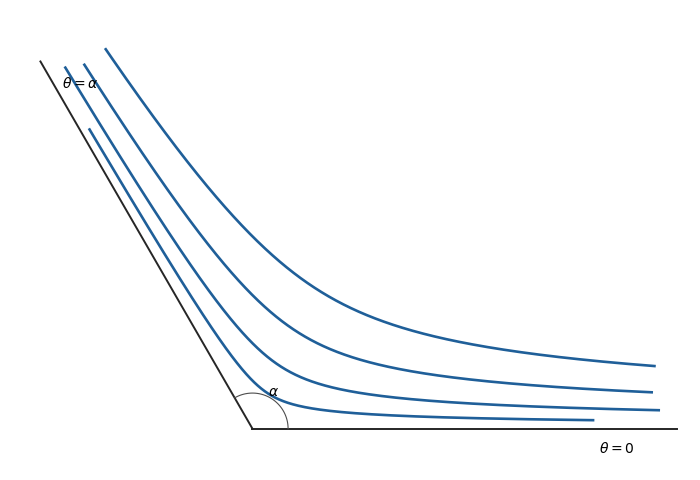
For a velocity potential, . The incompressible flow condition therefore becomes Laplace equation . The Laplace equation in polar coordinates givesso positivity of and requiresThe velocity components areThe no-penetration boundary condition on both walls says at and , hence . If , changes sign inside the wedge. The stated sign condition therefore selects , and
Past exam of the mathematics course of the University of Cambridge 2020 ia Paper 2 9B b Solution Created 2026-09-24 Updated 2026-09-29
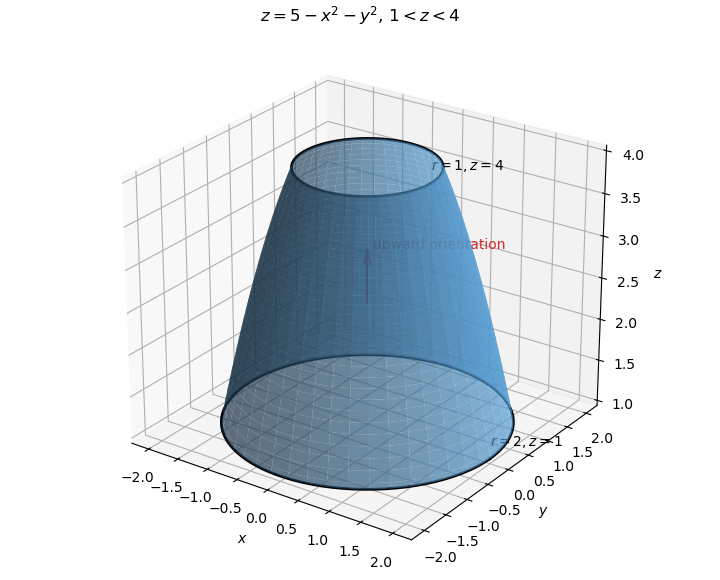
Stokes theorem givesFor the upward orientation, the outer circle is counterclockwise from above and the inner circle is clockwise. On a counterclockwise circle of radius and height ,The outer circle contributes . The inner circle would contribute counterclockwise and hence contributes with its induced clockwise orientation. Thusagreeing with the direct calculation.
Past exam of the mathematics course of the University of Cambridge 2020 ia Paper 2 9B a Solution Created 2026-09-24 Updated 2026-10-14
The surface is an annular band of the downward-opening paraboloid, bounded by the circles and . Choose the upward orientation.


There are unlisted articles, also show them or only show them.