
Choose upward velocity positive during ascent. Gravity and linear drag both point downward, giving the linear differential equationAt the highest point , soThe vertical ascent under linear drag time is smaller than for , because . Its zero-drag limit is , as required by constant-gravity projectile motion.
Write for the imposed constant angular velocity. In inertial polar coordinates, the bead has . Its constrained Lagrangian isThe reduced Lagrangian has no explicit time dependence, so its Lagrangian energy function is conserved:This is the Jacobi integral , since the bead's actual inertial energy and axial angular momentum areThe motor maintaining the stick's angular velocity supplies torque and does work. Indeed , generally nonzero. A time-independent reduced Lagrangian therefore need not imply conservation of the bead's inertial kinetic energy when its imposed constraint is moving.
Treat the ladder as a uniform slender rigid body. While both contacts remain imposed, its centre of mass is , with speed . Its central moment of inertia is . Adding translational and rotational kinetic energy givesTaking the floor as zero gravitational potential energy, the Lagrangian, conjugate momentum and Euler-Lagrange equation areThe positive sign is appropriate: gravity increases the angle from the vertical. These are the constrained equations of a frictionless sliding ladder. Real wall contact is unilateral: a wall cannot pull the ladder. Once the computed normal force would become negative, the two-contact model ceases to apply; the question explicitly assumes that contact persists.
In the pion rest frame, momentum conservation makes the muon and neutrino momenta opposite, with common magnitude . For a massless neutrino, ; energy conservation and the relativistic energy-momentum relation giveSubstitute into the second equation. The terms cancel, leavingFor completeness, the complementary relativistic two-body decay energy is . The result is a total energy, including the muon rest energy, rather than its kinetic energy.
For planets with negligible mass compared with the Sun, Kepler's third law gives , where is the semi-major axis. Relative to Earth,Thus the requested orbital-distance estimates are about 0.39 and 5.2 times Earth's. Strictly, the period fixes the semi-major axis, not a time-averaged radius of an arbitrary eccentric orbit; identifying the two as a mean distance is the usual elementary orbital-size convention.
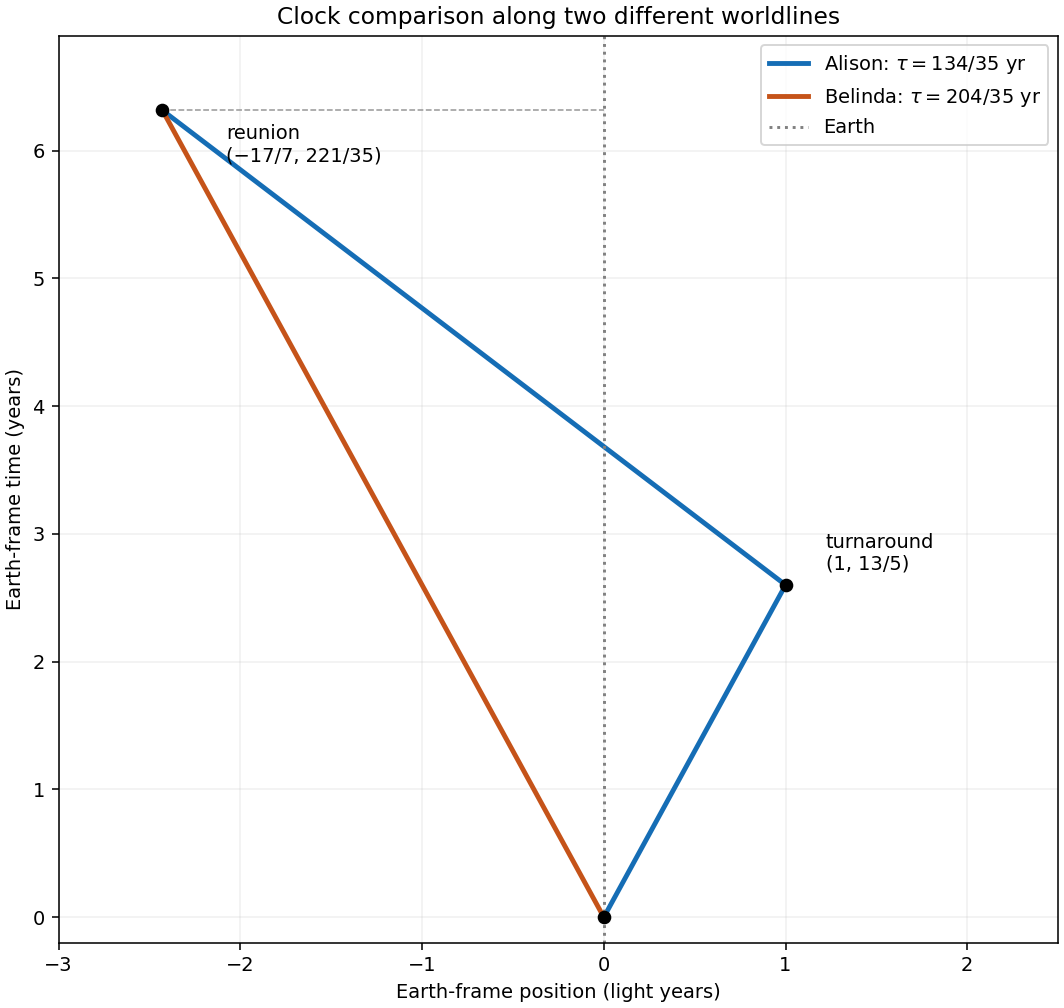
Einstein's postulates state that the laws of physics have the same form in every inertial frame, and that light in vacuum has the same speed of light in every inertial frame, independently of the motion of its source. For a primed frame moving with velocity relative to an unprimed frame, with coincident origins at , the Lorentz transformations areThe following worldlines use Earth-frame time in years and distance in light years, so numerically . The instantaneous turnaround is the idealized limit of a short acceleration stage; the elapsed proper time is calculated along each inertial segment.

There are unlisted articles, also show them or only show them.