
Real Heisenberg quotient has no faithful finite-dimensional representation Created 2026-09-24 Updated 2026-09-24
Let be the real upper unitriangular three-by-three group, let be its centre, and let be the integer subgroup of . Every finite-dimensional continuous complex representation of kills the central circle , and hence is not faithful.
Finite-dimensional representation obstruction from elementary abelian subgroups Created 2026-09-24 Updated 2026-09-24
Commuting complex involutions are simultaneously diagonalizable, so can act faithfully in dimension only if . A group containing for arbitrarily large , such as the full permutation group of , has no faithful finite-dimensional complex representation.
Spectrum orbit bound for a faithful symmetric-group representation Created 2026-09-24 Updated 2026-09-24
For a -cycle , each with is conjugate to . In a faithful complex representation, has a nontrivial th-root eigenvalue , and similarity of and puts all values in its spectrum. Hence the representation has dimension at least .
Regular representation Created 2026-09-24 Updated 2026-10-14
Normal subgroup orbits in a faithful prime-degree action Created 2026-09-24 Updated 2026-10-18
Cell-free layer Created 2026-09-24 Updated 2026-09-24
A cell-free layer is a near-wall region of plasma depleted of suspended blood cells. Because plasma is less viscous than the cell-rich core, the layer can substantially reduce hydraulic resistance.
Mantel theorem Created 2026-09-24 Updated 2026-10-14
The complete bipartite graph has vertex sets and , with every edge between and and none inside either part. Its six vertices support edges and no triangles in a graph: among any three vertices, two belong to the same independent set and have no joining edge.
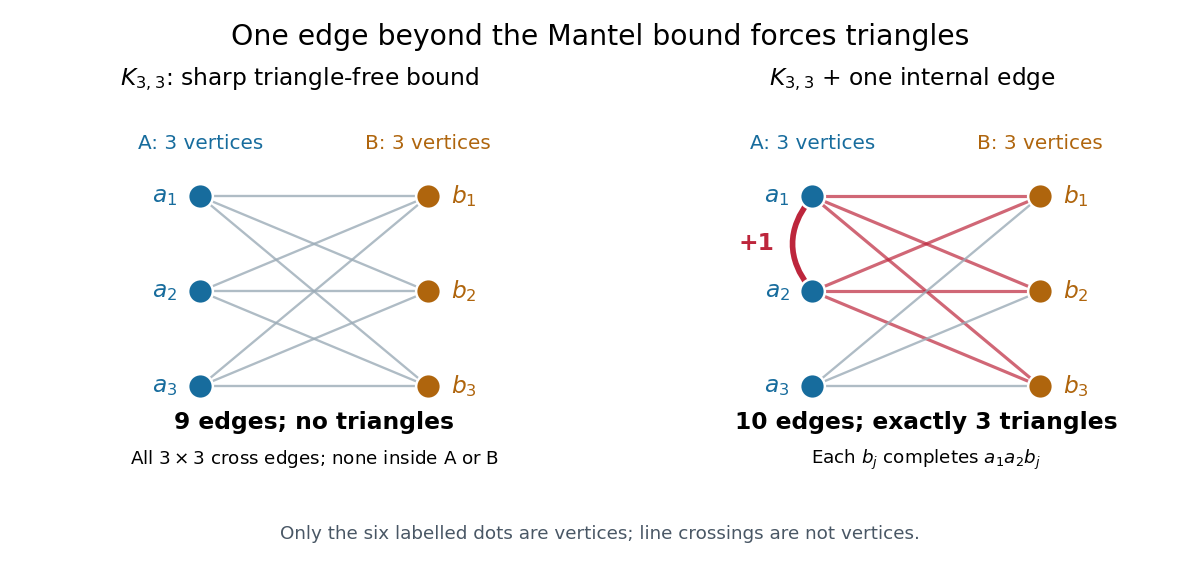
Add the single edge . Each is a common neighbour of its endpoints, producing the triangle in a graph . These are exactly the three new triangles in a graph, because every triangle in a graph must use the only edge inside a part. The new count is ten edges; nine was the last possible count without a triangle in a graph on six vertices.
In general, every simple graph with a finite set of vertices that is triangle-free has at mostedges. This is the case of Turán's theorem, with forbidden clique . Equality holds exactly for the balanced complete bipartite graph , up to graph isomorphism; empty parts are allowed for .[ref]
Graph Theory by Reinhard Diestel. third electronic edition (2005), §7.1, printed p. 165, Theorem 7.1.1 and the definition of Turán graphs, specialized to the forbidden graph K3
The floor function gives the exact integer bound. Splitting vertices into two independent sets of sizes and , and putting in every cross edge, givesThe count is largest when is an integer nearest . For it is ; for it is . Both equal . This proves attainability for every , including the empty graph.
A short proof of the upper bound uses degrees of vertices. In a triangle-free graph, the endpoints of an edge have disjoint vertex neighbourhoods: a common neighbour would complete a triangle in a graph. Thus . Summing over edges counts once for each of the edges incident to , givingFor , the Cauchy-Schwarz inequality and handshaking lemma yieldIf , division gives ; is immediate. Since is an integer, apply the floor function. The case is immediate too. This proves the bound; the full equality characterization follows from Turán's theorem.
The useful reversal is that more than edges force a triangle in a graph, whatever their placement. A global count certifies a local pattern. The extremizer is bipartite, but a triangle-free graph need not be bipartite: a five-vertex graph cycle has five edges, below the bound of six. Historically, Willem Mantel posed the triangle-exclusion question in 1907.[ref]
Wie weet wie Willem Wijthoff was? by Robbert Fokkink. Robbert Fokkink, Wie weet wie Willem Wijthoff was?, Nieuw Archief voor Wiskunde 5/17(4), December 2016, printed p. 279, Wythoffs bewijs van de stelling van Mantel: attribution of problem 28 in 1907
Trouton ratio Created 2026-09-24 Updated 2026-09-24
The Trouton ratio is extensional viscosity divided by shear viscosity. It approaches three for an incompressible Newtonian fluid in uniaxial extension.
Local factorization and extended absolute values Created 2026-09-24 Updated 2026-09-28
If is a finite separable extension and is an absolute value on , the extensions of to correspond to the irreducible factors of the minimal polynomial of over the completion of at .
Witnessing sequence for a nondeterministic automaton Created 2026-09-24 Updated 2026-09-24
Maximum disk Created 2026-09-24 Updated 2026-10-06
The maximum disk hypothesis assigns the largest stellar mass-to-light ratio compatible with a measured rotation curve, conventionally making the disk supply about of the circular speed near .
Hyperbolic secant Created 2026-09-24 Updated 2026-10-05
Hyperbolic cotangent Created 2026-09-24 Updated 2026-10-05
Hyperbolic sine Created 2026-09-24 Updated 2026-10-14
The hyperbolic sine is the odd functionIts derivative is , so it increases strictly from to and is a bijection of onto itself. For example, , , and . It is the vertical coordinate on the unit hyperbola parametrized by .
The Taylor seriesshows that near zero. Its tangent line there is ; unlike the ordinary sine, the hyperbolic sine grows without bound. Its antiderivative is . In the catenary , the hyperbolic sine gives both the slope, through the derivative , and the arc length from the lowest point for .
Hyperbolic cosine Created 2026-09-24 Updated 2026-10-14
The hyperbolic cosine is the even functionIt has derivative and second derivative , so it is a strictly convex function. Its unique global minimum is , and its image is . For example, . On the unit hyperbola, the hyperbolic cosine is the horizontal coordinate; as a graph against , it is a symmetric bowl.
Its Taylor series beginsThe positive fourth-order term explains why the bowl resembles a parabola near its minimum yet differs from one away from it. Restricting to gives the inverse hyperbolic cosine.
Gaussian function Created 2026-09-24 Updated 2026-09-24
A Gaussian function has the form with . Its integral and moments reduce by translation and scaling to the Gaussian integral.
Logarithm Created 2026-09-24 Updated 2026-10-14
For a positive real base , the logarithm is the inverse function of the exponential function :It asks which exponent produces a given positive number. Thus and . The base restrictions matter: would produce only one value, while a negative base does not define as a real-valued function for every real exponent.
The useful transformation isFor example, corresponds to in base two. Products become sums and ratios become differences. The logarithm does not generally convert a sum into a sum of logarithms. Base conversion uses the natural logarithm: . It also gives , positive when and negative when .
Historically, John Napier's 1614 Mirifici logarithmorum canonis descriptio presented logarithmic tables and their use, documented in the Smithsonian Libraries' digitized original. Tables made multiplication-heavy calculations more manageable by replacing products with addition and a lookup. The 1619 Constructio title page below belongs to a later publication from the same work on logarithms. These historical publications preceded the modern inverse function and integral presentation used here.


Variance function Created 2026-09-24 Updated 2026-10-14
Scaled centered risk under concave utility Created 2026-09-24 Updated 2026-09-24
If is concave and , thenis concave in . By Jensen inequality, ; concavity then makes nonincreasing on .
Optimized affine shift of concave utility Created 2026-09-24 Updated 2026-10-14
Let be a vector space of random variables and supposehas an optimizer for every . If is increasing and concave, then is increasing and concave. For concavity, combine optimizers at two values using the same convex coefficient as the values themselves.
There are unlisted articles, also show them or only show them.