
Radial chain of equal hyperbolic discs Created 2026-09-24 Updated 2026-10-14
Vector area element Created 2026-09-24 Updated 2026-10-03
Riemannian distance Created 2026-09-24 Updated 2026-10-14
The distance on a connected Riemannian manifold is the infimum of the arc lengths of piecewise smooth curves joining the endpoints:It answers “how far must I travel while staying in this geometry?” The Riemannian metric measures an instantaneous tangent vector, whereas Riemannian distance is the global result of comparing complete routes.
In Euclidean space the straight segment achieves this infimum, giving . On a round sphere it gives great-circle distance, for positions with unit vectors . For and a central angle , the surface distance is , while the chord length is . On a circular cylinder, routes with different winding lead to the minimum in Riemannian distance on a circular cylinder.
The word infimum matters: a shortest route need not exist. In the Euclidean plane with the origin removed, the points and still have Riemannian distance , approached by paths detouring around an arbitrarily small circle. Every allowed route has length strictly greater than , since the only Euclidean straight segment passes through the missing point. The Hopf-Rinow theorem guarantees a minimizing geodesic between any two points when a connected Riemannian manifold is complete.
Fixed-point-free rotation of an annulus Created 2026-09-24 Updated 2026-10-14
Rotation through any nonzero angle defines a continuous self-map of a circular annulus with no fixed point. Hence an annulus does not have the fixed-point property.
Spin-one-half singlet state Created 2026-09-24 Updated 2026-10-18
For two spin-one-half particles, the singlet isEvery component of the total spin annihilates it, and has eigenvalue zero.
Multivalued inverse hyperbolic sine Created 2026-09-24 Updated 2026-10-14
It is the complex multivalued sine member of the inverse hyperbolic functions.
Analytic continuation by contour deformation Created 2026-09-24 Updated 2026-09-24
Monodromy theorem Created 2026-09-24 Updated 2026-10-14
The monodromy theorem says that, when analytic continuation exists throughout a domain, its ambiguity depends on homotopy. Let be a domain, , and a germ of a holomorphic function at . Assume admits analytic continuation along every continuous path in starting at . Two such paths ending at give the same terminal germ of a holomorphic function if they are homotopic with endpoints fixed in . [ref]
Here a homotopy with endpoints fixed is a continuous map satisfyingEvery intermediate path must stay in . Equality means agreement on a neighbourhood of , rather than merely equal values at . [ref]
The identity theorem provides local rigidity; the monodromy theorem shows precisely how topology controls the remaining global freedom. Deforming a route without crossing a forbidden point cannot change the resulting germ of a holomorphic function. Thus a complicated analytic continuation calculation can be replaced by one on a simpler homotopic route. Distinct homotopy classes can still give the same continuation: a rational function on its domain already gives a single-valued answer along every route, even around a pole.
Thermal stability of an accretion disk Created 2026-09-24 Updated 2026-09-24
A local thermal equilibrium is stable when a small temperature increase raises cooling faster than heating at fixed surface density. The standard total-pressure alpha prescription makes a radiation-pressure-dominated, Thomson-opacity disk thermally unstable.
Magnetorotational instability Created 2026-09-24 Updated 2026-10-14
The magnetorotational instability destabilizes a magnetized differentially rotating flow when angular velocity decreases outward. Magnetic tension couples neighboring fluid elements, allowing the inner one to lose angular momentum and fall inward while the outer one gains angular momentum and moves outward.
Shakura--Sunyaev thin disk Created 2026-09-24 Updated 2026-09-29
The Shakura--Sunyaev thin disk is a geometrically thin, optically thick, radiatively efficient accretion-disk model whose turbulent stress is parametrized by the alpha prescription.
Strong law of large numbers Created 2026-09-24 Updated 2026-10-14
Let be real independent and identically distributed random variables with , and let be their expected value. Their sample mean satisfiesThis is almost sure convergence: with probability one, an entire infinite sequence of observations has averages that eventually stay within every prescribed positive tolerance of . The variance need not be finite. The strong law of large numbers implies the weak law of large numbers, which asserts convergence in probability at each increasing sample size.
For independent trials with a Bernoulli distribution of parameter , is one for success and zero for failure. Then is the observed success proportion, and the strong law of large numbers says almost surely. This turns a theoretical probability into a quantity one can estimate by repetition. It does not say that each new trial improves the estimate: a long string of failures can move the proportion away from before later observations bring it back.
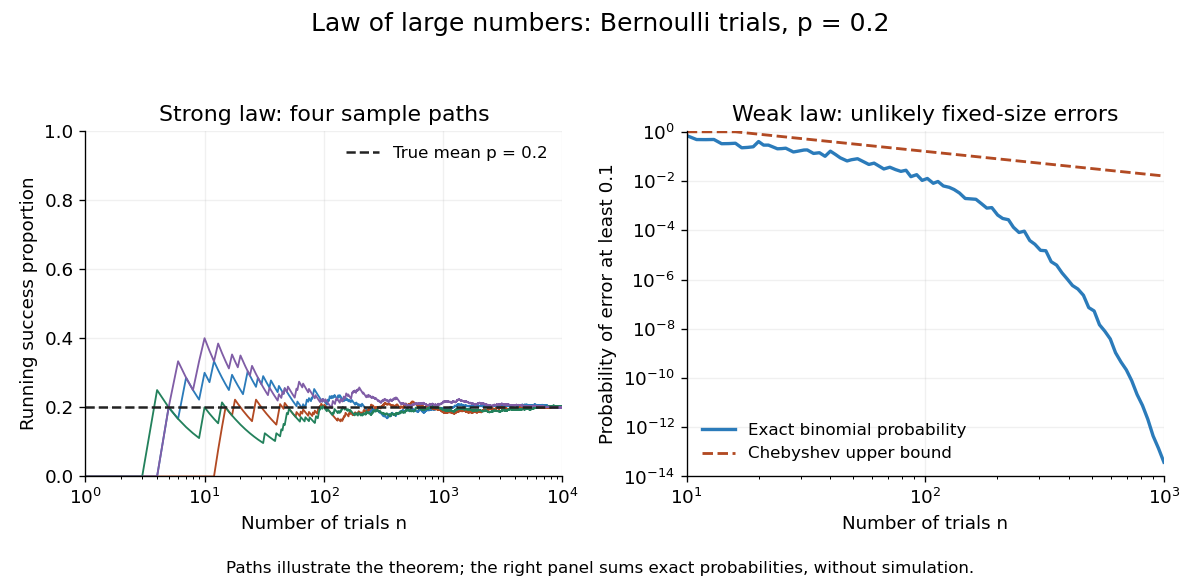

The strong law of large numbers gives the limiting location of the sample mean, while the central limit theorem describes its fluctuations when the variance is finite and positive. The two assertions can hold together:The first error shrinks to zero; the second has been enlarged enough to retain a nontrivial probability distribution. The second assertion is convergence in distribution, not a claim that the enlarged error along one sequence approaches a particular normal random variable.
The assumptions make a practical difference. If every observation repeats the same nonconstant Bernoulli random variable, , then for all : identical probability distributions alone do not make repeated observations informative. For independent observations with a Standard Cauchy distribution, the Cauchy sample mean has an unchanged distribution, so it does not concentrate around a constant. Its expected value is undefined, and ; neither example contradicts the stated strong law of large numbers.
A brief proof outline in the case of finite variance uses the Kolmogorov maximal inequality for the centered partial sums. The probability that their maximum up to exceeds is at most . These bounds are summable, so the Borel-Cantelli lemma controls all sufficiently large such blocks and hence every intermediate sample size. The general case requires truncation to control large observations; the argument using finite variance alone does not prove that full version.
Almost sure equality Created 2026-09-24 Updated 2026-10-14
Random variables and are almost surely equal when . Probability theory conventionally identifies random variables that differ only on a null event.
Rational equivalence Created 2026-09-24 Updated 2026-09-24
Rational equivalence is generated by principal divisors of nonzero rational functions on integral subvarieties one dimension larger than the cycles.
Affine semidirect product of cyclic groups of orders eleven and five Created 2026-09-24 Updated 2026-10-03
Let be the subgroup of nonzero squares in . The affine mapsform the nonabelian semidirect product , with multiplication
Affine Galois group of the splitting field of x to the p minus two Created 2026-09-24 Updated 2026-10-14
For an odd prime , the splitting fieldof has Galois groupThe translation subgroup multiplies by powers of , while the multiplicative subgroup acts on by cyclotomic automorphisms.
Irreducible components of two intersecting complex hyperbolas Created 2026-09-24 Updated 2026-09-24
The algebraic sethas the two irreducible componentsEach is irreducible because the linear change , identifies its coordinate ring withan integral domain.
Vanishing loci of ideal sums and intersections Created 2026-09-24 Updated 2026-09-24
Coordinate ring Created 2026-09-24 Updated 2026-10-03
For an affine algebraic set , its coordinate ring isThe set is irreducible exactly when is an integral domain.
Algebraic-group torsor Created 2026-09-24 Updated 2026-10-14
For an algebraic group , a flat -torsor over is a faithfully flat morphism with a right -action such that , , is an isomorphism. A Zariski torsor additionally becomes on a Zariski open cover of .
There are unlisted articles, also show them or only show them.