Rare-jump counterexample to a strong law with convergent first-moment averages by  Codex 0 2026-10-31
Take independent random variables equal to and with probability each, and otherwise equal to one. Their first absolute deviations are , so in L1 convergence. The same triangle-inequality argument gives convergence in of their arithmetic averages to one. For , however, .
The exceptional jumps occur infinitely often almost surely by the Borel-Cantelli second lemma, since . If the arithmetic averages converged to any finite value along a sample path, then would tend to zero. At each exceptional jump its magnitude is at least one. Thus the averages have no finite almost sure limit. Independence and convergence of first-moment averages do not alone give a strong law of large numbers.
For independent identically distributed random variables, the tail-sum formula applied to shows that for every when the first absolute moment is infinite. The Borel-Cantelli second lemma, followed by a countable intersection over positive integer , gives the first limsup assertion.
If had finite limsup along such a sample path, it would eventually be bounded by some finite constant . Then would imply eventually, a contradiction. This is a necessary-integrability counterpart to the strong law of large numbers; without a finite first absolute moment, the normalized sums cannot converge to any finite value.
Let be a complete discrete valuation ring, , and satisfy and . Suppose the second Taylor coefficient of at every point of has norm below one. One Newton iteration over a valued field step has correction of norm . Its residual has quadratic term of norm strictly below , and all higher terms have norm at most . The derivative changes by a term of norm below , so its norm remains . The strong form of Hensel lemma therefore applies from the new point, producing a root within distance of the original point. The second Taylor coefficient is when that quotient is meaningful, or the division-free binomial-coefficient Taylor expression in arbitrary characteristic. A Newton sequence that reaches a root is thereafter constant; residuals decrease strictly only before that event.
For with constant linear maps, let and let be consecutive Picard iterate differences starting from . The vector Itô isometry gives , proving the displayed estimate by induction. The square roots of these factorial bounds are summable on bounded time intervals. The Doob L2 maximal inequality then makes finite. Tonelli's theorem proves absolute uniform almost-sure convergence of the iterations, in addition to their convergence.
An irreducible Markov chain on a finite or countably infinite state space has at most one stationary distribution. On a countably infinite state space it exists exactly when the chain is positive recurrent. In that case, for every state ,where is the first return time. The expression determines every component uniquely. The formula follows by dividing the one visit to in each return cycle by the mean recurrence time; the strong law of large numbers for successive cycles makes this occupation fraction precise.
Every irreducible finite Markov chain is positive recurrent and has exactly one stationary distribution. On an infinite state space, an irreducible null recurrent Markov chain or transient Markov chain has none. For example, the simple symmetric random walk on the integers is null recurrent. Aperiodicity affects convergence of the one-time laws, but is unnecessary for existence or uniqueness of a stationary distribution.
On states , take an interior step of or with probability each and hold with probability . At an endpoint take the inward step with probability and hold with probability . For and , the chain is irreducible and its stationary distribution has endpoint weights and interior weights .
Detailed balance proves this: the doubled inward endpoint transition requires its stationary mass to be half that of an adjacent interior point, and all interior points have equal mass. The total unnormalized weight is . For there are just two equal endpoint masses.
When , positive self-loops make the chain aperiodic, so its transition probabilities converge to this law. At every move changes parity and two-step returns are possible, giving period two and no such convergence from a fixed starting state. At every state is absorbing and uniqueness of the stationary law is lost.
If a distinguished book is selected with probability and each other book with probability , swapping the selected book with its left neighbor makes the distinguished position a birth-death chain with left rate and right rate . Stationary flow balance gives successive probabilities in ratio , yielding a truncated geometric distribution; the uniform case occurs when all books are equally likely.
Represent a finite sparse vector by a sorted doubly linked list of its nonzero coordinates. A list header stores the dimension; every ordinary linked list node stores a distinct valid coordinate index, its nonzero value, and predecessor and successor references. In a circular linked list, the endpoints connect to the header, and an all-zero vector has the header linked to itself in both directions. The representation invariant requires strictly increasing ordinary indices, valid bounds and mutually consistent forward and backward links. The abstraction function assigns zero to every coordinate absent from the list. The header is metadata, never an ordinary coordinate.
For example, has dimension nine and only three stored coordinates. The header's index field can store nine even though nine is not a valid coordinate index. Keeping the header distinct is therefore essential when searching for or removing entries.
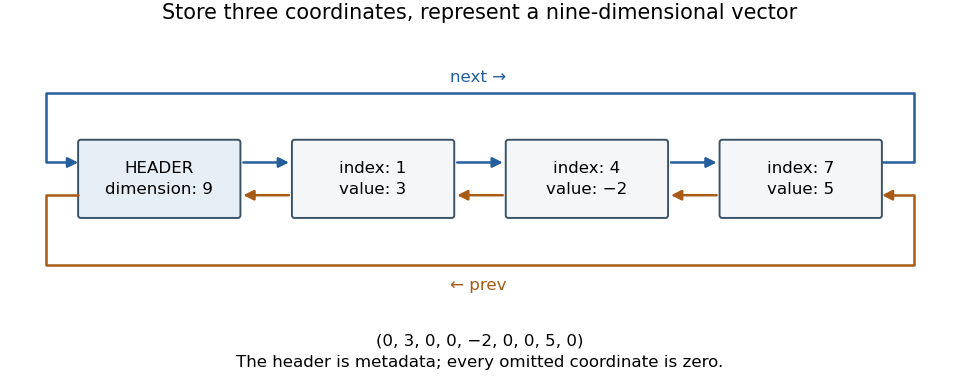
A circular sparse linked vector representation stores only nonzero coordinates
. Details. 
An arithmetic theory is one-consistent if it does not prove while proving every , for a bounded arithmetic formula and all standard natural numbers . If the theory proves all true bounded sentences, this is equivalent to Sigma-1 soundness: a false existential theorem has every standard instance refuted by bounded completeness; conversely a true witness and its provable negation contradict the assumption of a consistent first-order theory.
A theory has Sigma-1 soundness if every Sigma-1 formula that is a closed theorem is true in the standard natural-number structure. It is weaker than full arithmetic soundness. Under bounded completeness it is equivalent to one-consistency. The standard interpretation matters: an existential statement can have a witness in a nonstandard model while having no standard witness.
Pi-1 soundness means that every closed Pi-1 theorem is true in the standard natural numbers. Consistency plus bounded completeness implies it, since a false universal bounded statement has a standard counterexample whose arithmetic verification is provable. It is weaker than full soundness and does not prevent a consistent arithmetic theory from proving a false Sigma-1 sentence.
A first-order theory is Sigma-0 sound when every arithmetic bounded arithmetic sentence it proves is true in the standard natural numbers. For a first-order theory proving every true bounded arithmetic sentence, this is equivalent to first-order consistency: a false bounded theorem would have a provable bounded negation, and an inconsistent first-order theory proves the false bounded arithmetic sentence .
A first-order theory is omega-consistent when it never proves while proving for every standard natural number . Restricting the matrix to arithmetic bounded arithmetic formulas gives one-consistency. This condition concerns standard instances and is stronger tha first-order consistency.
Suppose is holomorphic off , tends to zero at infinity, has sufficiently regular boundary values in the interval interior, and has endpoint growth for some at each endpoint . If its jump is integrable, the displayed reconstruction follows by deforming a Cauchy integral formula contour onto the two sides of the interval. An endpoint circle of radius contributes , which vanishes. The two oppositely oriented banks leave precisely the jump. Without decay at infinity, an entire remainder can survive; a nonzero constant is the simplest example.
For and , the endpoint powers are integrable and the interior pole is taken as a Cauchy principal value. The analytic function , positive for and decaying like , has boundary values . Its jump gives a Cauchy reconstruction, while the mean of its boundary values and the Sokhotski–Plemelj formula give the displayed identity. At the principal value is zero.
There are unlisted articles, also show them or only show them.