
An arithmetical proof relation represents the effective relation that a natural number encodes a formal proof of the logical formula with a specified Gödel number. With the usual coding apparatus its proof-checking relation is bounded. Existential quantification over the formal proof code gives the ordinary arithmetical provability predicate.
A logical formula weakly defines a total numerical function in a first-order theory when, at every standard input tuple, it proves the graph instance with the correct standard output and refutes graph instances with every incorrect standard output. This is numeralwise representation of the graph; it does not yet assert uniqueness against nonstandard outputs inside a first-order model.
Let be the directed set of compact elements below , with least upper bound , and put . A compact element belongs to : a directed set whose least upper bound is at least also has least upper bound at least , so the definition of supplies an element above . Hence .
If , apply the way-below relation to to find above them. Since is directed, it contains a common upper bound for . This belongs to , proving that is directed. Every member of is below , while has least upper bound . Therefore is the least upper bound of , which is the defining property of a continuous poset.
Suppose the distinct required runway lengths are , with users of type , constant cost per unit length, and suffix counts . Then every type- user has the displayed Shapley value. For layer , exactly users require it. The first of them in a uniformly random permutation contributes its entire cost . Each requiring user has probability of being first. Linearity of the Shapley value sums these expected marginal contributions across the layers that user needs.
The allocation lies in the cost core. Its payments sum to the full runway cost. For any coalition , its total payment toward layer is , where is the set of users requiring that layer. This is zero if needs no such layer, and at most the full layer cost otherwise. Summing gives . Suffix counts followed by prefix sums compute all distinct type payments in arithmetic operations.
For a bounded accretive operator, is invertible and the transform satisfies . The identity proves contraction after the substitution . If the real part vanishes for every , this identity proves norm preservation. Both and are then accretive, making both and invertible; hence is onto and is a unitary operator.
For positive weights , the sequence space with norm is isometrically isomorphic to : multiplication by is a linear bijection onto the absolutely summable sequence space, with inverse multiplication by . Thus it is a separable Banach space. Density can also be seen directly by truncating a weighted summable sequence and then approximating its finitely many coordinates by rational numbers.
Suppose the distinct complex numbers satisfy . The geometric sequences in the displayed formula belong to the absolutely summable sequence space and have dense linear span. Otherwise the Hahn-Banach theorem gives a nonzero annihilating functional, represented by a bounded sequence . Its power series is holomorphic in the unit disk and vanishes at every . Compactness supplies an accumulation point inside that disk. The identity theorem forces and hence all its coefficients zero, a contradiction. This is a useful form of density by annihilators that converts a Banach-space problem into uniqueness of an analytic function.
In the upper half-plane, the displayed harmonic function has Dirichlet boundary condition value on the positive axis, zero Neumann boundary condition value on the negative axis, and decay at infinity. Its negative trace is , but its positive normal derivative is . The latter requires a Hadamard finite-part integral in a Fourier transform. For the convention the transformed traces are below and above. The homogeneous corner mode produces the additional lower integral transform proportional to . Higher singular corner modes require a larger distribution class than a locally integrable negative trace.
For ordered distinct values with positive weights summing to one, choose the first value whose cumulative weight reaches one half. The preceding cumulative weight is strictly below one half, and the remaining mass is at most one half, proving the displayed conditions. Stopping on equality chooses the lower value when a cumulative weight is exactly one half. Sorting followed by a scan takes time; median of medians partitioning with a residual weight target gives deterministic linear time.
The constant minimizing is the weighted meanThis follows by differentiating the quadratic error or requiring the residual to be orthogonal to constants. The normalized weight assigns mass to for every . As increases it concentrates at the endpoints, where , explaining the limiting best constant. Although the weight vanishes at zero, its integral against the square of a nonzero continuous function is positive, so the associated weighted inner product is positive definite.
Consider the squared error of approximating , , by a polynomial under a measure containing on . This error is finite exactly when . A nonzero constant term makes the integrand asymptotic to , which is not Lebesgue integrable; a vanishing constant term makes , giving an integrable integrand.
Consequently the full space of polynomials of degree at most is not contained in the weighted L2 space. Its admissible subspace is , or zero when . This finite-dimensional subspace has a unique orthogonal projection of , hence a unique best approximation. Indeed its Gram matrix is positive definite: a nonzero polynomial cannot vanish on an interval, so its squared norm is positive. Thus a singular weight can invalidate the proposed full approximation space while still allowing a unique finite-error minimizer in its admissible part. As usual, weighted L2 spaces identify functions equal almost everywhere.
For positive mean density, this average weights a velocity by local mass rather than volume. It satisfies the exact identity , so it naturally represents mass flux in averaged conservation laws. The ordinary volume mean generally fails that identity when density and velocity are correlated. Applied inside a phase, the same construction uses density times that phase's indicator as its weight.
The Weierstrass elliptic function satisfies the displayed meromorphic function identity. To prove it, the Riemann-Hurwitz formula shows that its derivative has exactly three simple zeros modulo its period lattice, at the nonzero two-torsion points of a complex torus. At each such half-period , evenness around gives , so the right side has principal part , matching . At zero, and give the same principal part and zero constant term. The difference is a holomorphic elliptic function, hence constant by compactness, and its limit at zero is zero.
For the square period lattice, multiplying the defining series by the lattice symmetry gives . At , one has , so periodicity gives and hence the displayed zero. This is one of the three finite branch values of the degree-two Weierstrass elliptic function on its torus. The three values are always distinct but need not all be nonzero. Distinctness is enough for the nonsingularity of the associated elliptic curve .
On its period torus, the derivative has one triple pole, so degree three. The Riemann-Hurwitz formula gives total ramification six, counting each ramification point with weight . The number of distinct ramification points is five when and three when . Indeed by the Weierstrass elliptic differential equation. If , each of its two possible -values has two distinct unramified preimages for , because coincidence with a cubic branch root would force a repeated root. These four simple zeros of give local degree two for , and its triple pole contributes local degree three. If , nonsingularity forces ; the two simple zeros of are double zeros of and each gives local degree three for . Along with its pole these are three distinct points, each of weight two. A hexagonal period lattice realizes this second case by its sixth-root rotational symmetry.
Thinning enlarges the assumptions without changing a conclusion. In a predicate-calculus presentation with context-sensitive generalization, a generalization valid before adding an unused assumption may not be replayable with that assumption open. An explicit weakening step nevertheless imports the already proved conclusion. In propositional calculus with only axiom schemes and modus ponens, weakening is admissible by replaying the proof. The need for a separately stated rule depends on how proof dependencies are represented.
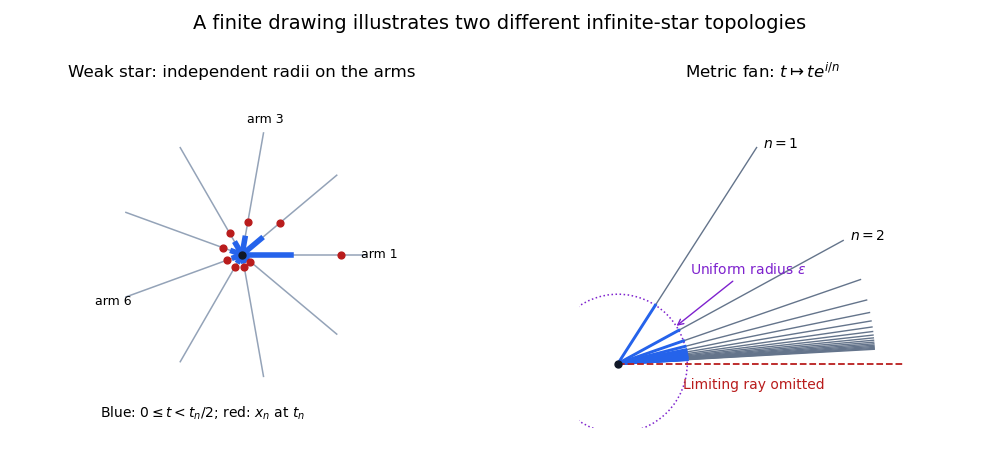
Identify the initial endpoints of countably many closed intervals to a vertex , using the quotient topology. This is the geometric realization of the complex whose only edges are . A neighbourhood of may contain a separately chosen initial interval on each arm, with no positive lower bound on the .
The space is not first countable. Given any proposed countable neighbourhood basis at , choose a point at coordinate on arm with . This is possible by the interval topology on that arm. The set whose intersection with arm is is an open neighbourhood of , by the simplexwise definition. But for every , so no lies inside . Consequently this weak star cannot embed in the plane, or in any metric space.
The terminal vertices form an infinite closed discrete subset: on each closed arm they meet only its terminal endpoint. Hence the star is not compact, by closed discrete subsets of compact spaces are finite.

Suppose the variances of a sequence of random variables are bounded by and whenever , for a fixed nonnegative integer . The Cauchy-Schwarz inequality bounds each remaining covariance in absolute value by . In the variance of a sum, there are at most off-diagonal pairs, proving the displayed bound. The Chebyshev inequality makes the average minus its mean converge to zero in probability. If all means equal , the average therefore converges in probability to . Independence of every summand is unnecessary.
The weak form of includes the same scalar shift as the differential equation. The unshifted identity instead represents and cannot imply the shifted equation for nonzero unless . On a smooth bounded domain choose any nonzero compactly supported smooth and take , for a direct counterexample. For constant drift coefficients, integration by parts reverses the drift sign in without changing this spectral term.
For sufficiently regular coefficients and a function , this boundary quantity is the outward flux appearing when a divergence-form principal operator is integrated by parts. Its zero condition is the natural Neumann boundary condition for the corresponding bilinear form. With only bounded coefficients and a Sobolev solution, the weak formulation can encode that natural condition without asserting that a pointwise boundary derivative exists.
There are unlisted articles, also show them or only show them.