
If a linear system has one solution , every other solution differs from it by an element of the null space: is equivalent to . Its solution set is therefore the displayed affine subspace, of dimension equal to the nullity. If the system is inconsistent, the solution set is empty, rather than a translate of the kernel.
A construct combining mutual exclusion for operations on shared state with condition-based waiting. A waiting caller releases the monitor while asleep and must recheck its predicate after regaining access.
A permit-based synchronization object. A down operation waits until it can consume a permit; an up operation supplies one. Unlike ownership-based mutex use, signalling can pass between different software threads.
Many waiting software threads wake for a state change that can benefit only one or a few of them. Repeated monitor reacquisition, failed predicate checks and context switches add overhead; selective notification can reduce it.
The singular real symmetric matrices of size two form the double cone in these coordinates. Its complement has three connected components: is positive definite, is negative definite, and is indefinite. This follows also from the eigenvalues . The definite cones are convex. In the indefinite region, first move to zero, then move the nonzero planar vector within the punctured plane, proving path-connectedness. Continuous determinant and trace signs prevent joining different regions without crossing singular matrices.
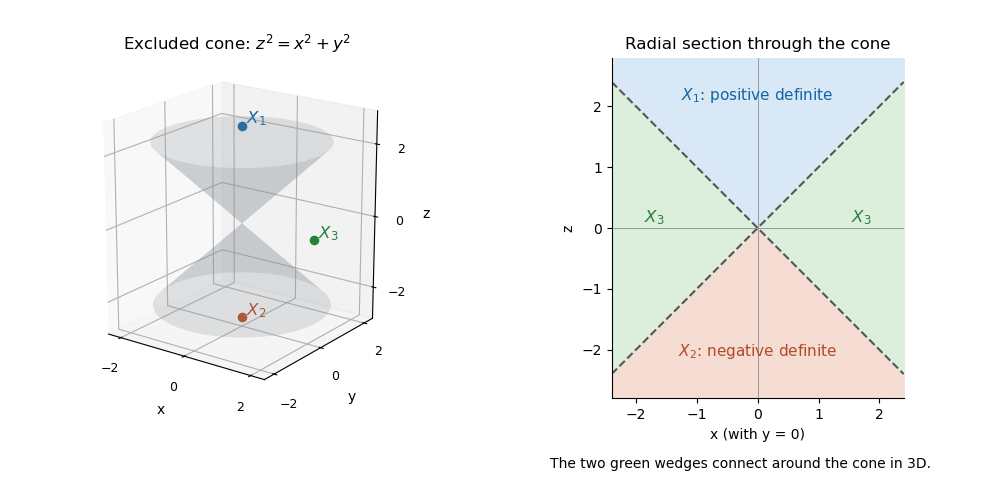
The determinant cone for real symmetric two-by-two matrices and a radial section
. The cone itself is excluded. The two indefinite wedges visible in the section belong to one connected region in the full three-dimensional space. Details.
The tractoid is the surface of revolution of a unit tractrix. For with , its coordinate tangent vectors are orthogonal and have squared lengths . The coordinates , transform this first fundamental form into , giving a local isometry to the hyperbolic plane. Thus its Gaussian curvature is minus one. The angular coordinate is periodic globally, while its unwrapped coordinate is a real variable; this distinguishes the local metric identification from a global embedding of the whole hyperbolic plane.
A smoothed form of the summatory totient function satisfiesUse the Dirichlet series and the kernel to write the left side as a vertical contour integral. Move the line from real part greater than two to . The only crossed pole is at two, with residue ; the remaining vertical integral is by the standard zeta bounds in the half-strip. If and , positivity of the summands makes nondecreasing. The backward and forward difference quotients of bound . Insert , then let the relative difference-quotient step tend to zero, proving the displayed asymptotic. This monotone integral Tauberian lemma justifies the passage from a smoothed estimate to an unsmoothed one.
Effective pressure is ice-overburden pressure minus water pressure beneath the ice. It controls creep closure of channels and cavities; smaller positive weakens that closure and favors separation of ice from bed obstacles. It is therefore central to both basal sliding and subglacial drainage.
Frictional dissipation of water flow melts a channel's ice walls, while ice creep under effective pressure in subglacial drainage closes them. The resulting equilibrium has increasing effective pressure with discharge in the basic channel theory. A route gaining water can lower its water pressure and attract further discharge, widening at the expense of neighbors. This positive redistribution feedback produces arterial drainage.
Sliding opens water-filled cavities behind bed obstacles and ice creep closes them; narrow connections allow drainage between cavities. In a decreasing effective-pressure/discharge relation, a route carrying extra flux needs higher water pressure. That pressure diverts water to neighboring routes, favoring a distributed network instead of concentration into one channel.
At fixed total discharge , remove a small amount from a channel and send it through connected cavities. The equilibrium channel effective pressure drops by , while the cavity pressure difference drops by . Under the displayed inequality the cavity system leaves a common effective pressure higher than the reduced-flux channel can sustain. Excess creep closure then decreases channel discharge further, amplifying the perturbation.
A glacial lake outburst flood is rapid release of water stored in or behind glacial ice or its associated dam. Melt-driven enlargement of a subglacial channel can create positive feedback between discharge, frictional heating and further channel opening. Lake depletion and pressure-dependent material creep closure then alter the event. Channel models explain one mechanism and should not be taken as a universal description of every glacial flood.
The water pressure at a glacier-bed interface affects the effective normal pressure , the difference between ice overburden pressure and water pressure . Higher water pressure at fixed overburden reduces effective compression of the bed contact and can alter cavitation and basal resistance. It is not identical to basal shear stress, and a sliding law depending only on shear suppresses this independent hydraulic influence.
There are unlisted articles, also show them or only show them.