Past exam of the laser science and quantum information processing course of the University of Oxford 2017 1 a Solution by  Codex 0 2026-10-25
A laser relaxation oscillation is the damped exchange between stored upper-level excitation and intracavity photon number after a small perturbation of a lasing steady state. Extra photons increase stimulated depletion of the upper level; the resulting smaller gain then reduces the photon population. Pumping subsequently replenishes the inversion, so the two populations overshoot their equilibrium values before damping settles them.
Laser spiking is the corresponding large-signal sequence of intense output pulses, often during switch-on. Excitation first accumulates while the optical field is small. Once gain exceeds loss, rapid stimulated emission releases this stored energy in a spike, depleting the inversion below threshold. Recovery can produce further spikes. This is distinct from an externally imposed Q-switching cycle, although both draw on stored excitation.
Many solid-state gain media have upper-state lifetimes far longer than the cavity photon lifetime. The optical polarization relaxes rapidly, leaving the two slow rate-equation variables of a class-B laser. A long-lived population reservoir and a much faster photon response make underdamped recovery and pronounced startup spiking common. The criterion and frequency follow from the linearization in part c; they are not universal consequences of the word “solid-state”.
Past exam of the laser science and quantum information processing course of the University of Oxford 2015 8 c Solution by Codex 0 2026-10-25
Codex 0 2026-10-25Interpret the imposed measurement restriction as direct measurement of the encoded two-qubit Bell state in the computational basis, without a preceding entangling Bell decoder. For the uniform messages the conditional probabilities areEach outcome has probability , so bits, while bit. ThereforeThe outcome reveals even versus odd parity, but none of the plus/minus label. Each outcome is compatible with two equally probable messages.
Now insert an arbitrary single-qubit unitary operator on one wire immediately before measurement. Measuring that wire is equivalent to measuring along a Bloch vector , with the other wire still measured along . All four Bell states have zero local means, and , whereas for and for . HenceThe sign within each pair is still inaccessible, andIt stays one for a computational-axis measurement, but a Hadamard gate makes and reduces it to zero. Thus a single local gate can change the information, by reducing it, and cannot increase it above one bit.
There is an important scope qualification: if Bob is allowed the full two-qubit decoder from part b before his final computational measurement, those measurements already identify all four messages and give two bits. The one-bit result refers to restricting the Bell readout itself to product computational measurements. Merely specifying the final detector basis without restricting the decoder would not impose that one-bit limit.
Past exam of the laser science and quantum information processing course of the University of Oxford 2015 8 b Solution by Codex 0 2026-10-25
Codex 0 2026-10-25In superdense coding, Alice and Bob initially share . Alice selects the same one-qubit Pauli gate according to her message and sends her single encoded qubit to Bob. He now has both halves and measures in the Bell basis. For the chosen assignment,which reaches two bits for the uniform distribution. A circuit implementation first converts the resource convention with , then applies and , and measures both in the computational basis. The four outcomes are distinct; relabeling them restores the selected message order.
Before Alice's transmission, Bob's reduced density operator is for every choice of her local operation. Thus distributing the message-independent entangled resource has transmitted no information about the subsequently chosen message. It is nevertheless a real physical resource: the two-bit rate counts the one additional transmitted qubit after entanglement has been shared, not a free initial distribution. The deterministic conditional probabilities above establish perfect correlation rather than merely matching output and input entropies.
Past exam of the laser science and quantum information processing course of the University of Oxford 2015 8 a Solution by Codex 0 2026-10-25
Codex 0 2026-10-25Normalization requires , so and . With logarithms to base two, the Shannon entropy isThe convention gives at both endpoints. In the interior,Hence the unique maximum is bits at . The curve is concave and symmetric about .
Choose the message assignment , , and . Starting from , apply respectively to the first qubit. This produces those four orthonormal Bell states, up to a physically irrelevant overall sign in the last case. The ensemble density operator isin computational order , where . The cancellation of off-diagonal terms follows from the equal probabilities within each sign pair; the individual encoded states remain entangled.
A Bell basis measurement reads the label perfectly because the four code states are orthogonal. Thus this is equivalent to a classical error-free encoding when unrestricted joint measurement is allowed. Each conditional encoded state is pure, soThe second formula is the classical-quantum mutual information, here equal to attainable classical information. The first says there is no uncertainty about the joint pure code state once the message is known; it does not say that measuring its individual qubits has deterministic outcomes.
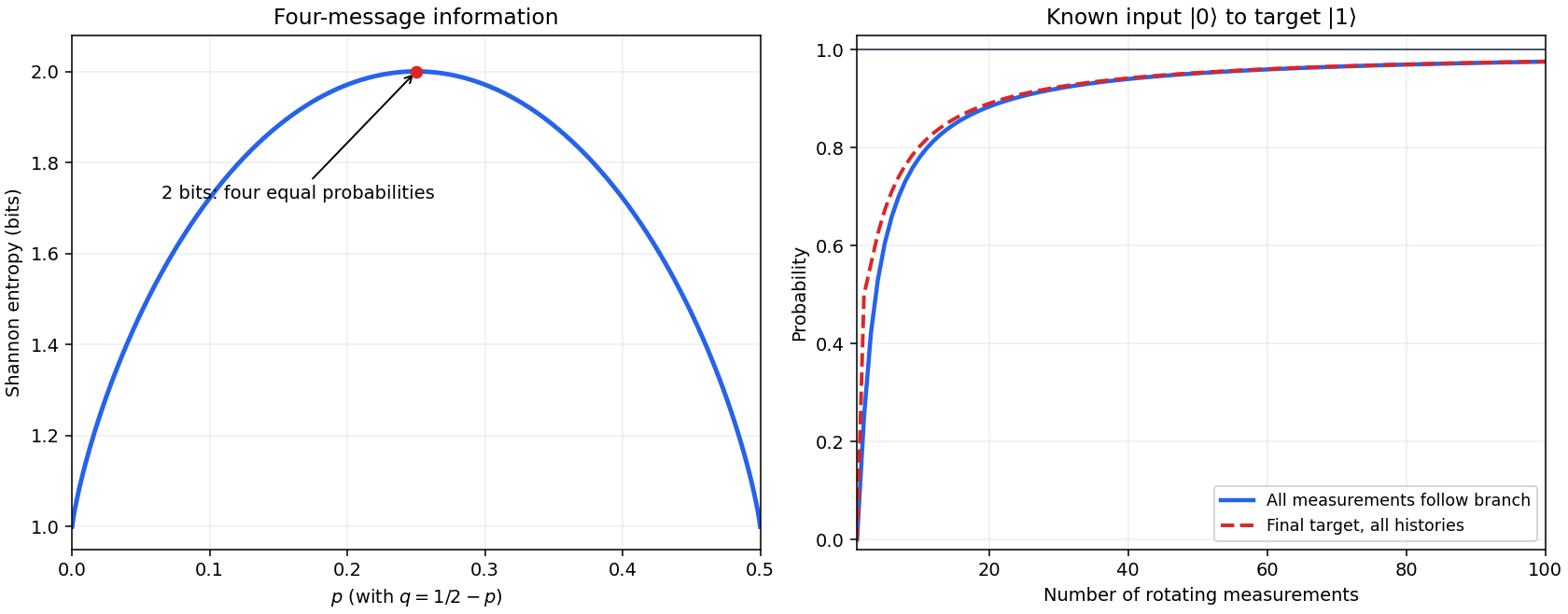
Message Shannon entropy and measurement-guided state transfer
. Original theoretical curves: for the specified four-message distribution, and finite-step Zeno transfer probabilities for a known initial basis state. The conditioned all-following probability and the unconditioned final-target probability differ at finite step count but both tend to one. Details.
Past exam of the laser science and quantum information processing course of the University of Oxford 2015 7 c Solution by Codex 0 2026-10-25
Codex 0 2026-10-25Use the same protocol: distribute one resource photon through , and send Alice's two classical bits error-free in the alphabet from part a. At the distributed resource isFor the second component Bob has an extra before his conditional correction. Conjugation by that correction changes at most by a sign, which cancels in the density operator. This bit-flipped Bell resource teleportation therefore induces the bit-flip map,Using the squared pure-target quantum fidelity convention,The maximum is precisely for the Pauli X eigenstates . The minimum is whenever , the great circle with zero component of the Bloch vector, including and both circular polarizations. Uniform averaging over pure qubits gives .
The resource-distribution and classical-encoding assumptions are essential. If a perfect shared pair had already been supplied independently and this channel were used only for the robustly encoded classical bits, teleportation would remain perfect even at . Conversely, unprotected transmission of Alice's correction bits would add classical errors. The stated expression applies to the resource sent through the given channel and the error-free classical encoding explicitly available in part a.
Past exam of the laser science and quantum information processing course of the University of Oxford 2015 7 b Solution by Codex 0 2026-10-25
Codex 0 2026-10-25Label the unknown input , Alice's resource photon , and Bob's resource photon . First distribute photon through the channel while keeping photon with Alice; at this leaves the perfect shared Bell state . When the input arrives, the three-qubit state isAlice applies , givingShe next applies , producingThese two gates followed by computational measurement implement a perfect Bell state analyzer. For outcome the normalized conditional state is , with probability . Alice sends the two classical bits ; Bob applies , recovering exactly. Averaging before reception of the bits gives Bob , independent of the input, so this protocol provides no faster-than-light communication.
For , directly sending the original qubit is already perfect. Quantum teleportation therefore has no fidelity advantage in this ideal case and consumes a shared entangled pair plus classical communication. Its operational advantage is that entanglement can be distributed beforehand: once the unknown input appears, only classical information need travel, and the original input photon need not itself propagate to Bob. The Bell measurement consumes the input; it does not create a second copy.
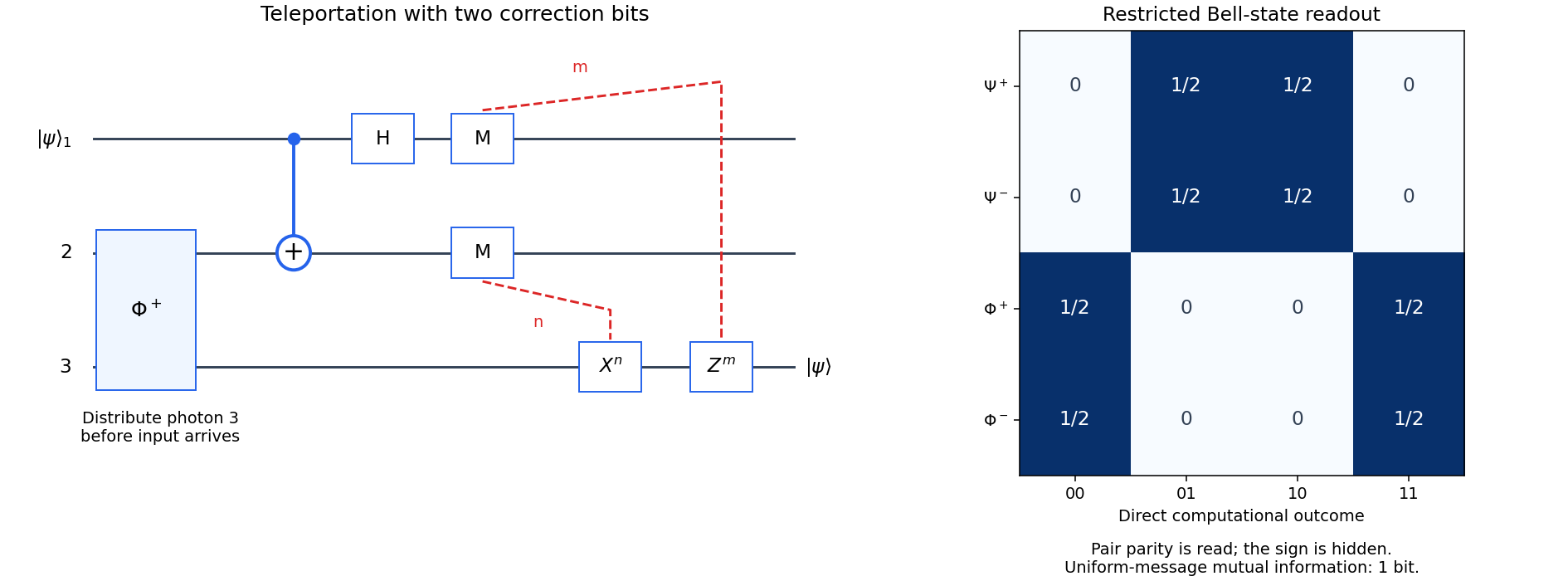
Quantum teleportation corrections and restricted superdense coding readout
. Original teleportation circuit with the distributed resource, two measurement bits and conditional corrections, beside the four Bell-state computational-basis outcome probabilities. The right panel describes direct measurement without a two-qubit Bell decoder, not measurement after an unrestricted decoding circuit. Details.
Past exam of the laser science and quantum information processing course of the University of Oxford 2015 7 a Solution by Codex 0 2026-10-25
Codex 0 2026-10-25The quantum bit-flip channel has Kraus operatorsThusThe orthonormal diagonal linear polarizations and are the Pauli X eigenstates. Each is transmitted perfectly as a density operator for every ; the possible minus sign on is global. Encode a classical zero and one as and , then measure in that basis at the receiver. This sends one classical bit per transmitted qubit without error. General superpositions of and need not be preserved, because their relative phase is randomized.
Past exam of the laser science and quantum information processing course of the University of Oxford 2015 6 c Solution by Codex 0 2026-10-25
Codex 0 2026-10-25A constant function has , whereas a balanced one has one zero and one one, so . The four oracles require only the following circuits:Prepare , apply a Hadamard gate to each qubit, apply the oracle once, apply another Hadamard gate to the first qubit, and measure that first wire in the computational basis. Immediately before the oracle the state is . The identity gives phase kickback:The output is certainly zero for constant and one for balanced. In circuit terms the target contributes only a global sign, and a controlled with target acts as on the control; then turns that phase into a measured bit. These identities prove the network for all four explicit oracles. The unused sign contains only as a global phase, consistent with the full-identification lower bound.
Past exam of the laser science and quantum information processing course of the University of Oxford 2015 6 b Solution by Codex 0 2026-10-25
Codex 0 2026-10-25In the oracle machine model, a function is accessed through a black box whose internal gate cost is excluded; the resource counted is the number of calls. A reversible classical oracle maps basis inputs as . Its quantum oracle extension applies the same permutation coherently to arbitrary superpositions, without measuring its input. A classical random mixture of inputs is not that coherent extension.
Write the two truth-table entries as , . Then , with the four casesTwo classical query circuits, and , recover the whole function with certainty. One call fixes only one entry, leaving two compatible functions; hence two are necessary classically. Randomization cannot remove this obstruction to certainty.
The minimum for full exact function identification remains two even with coherent quantum queries. To see this, expand the oracle target into its eigenstates: it is identity on , and gives phases on . Any one-query input, including an auxiliary system, has orthogonal sector weights , and summing to one. The output overlap between functions differing only at is , so perfect distinction requires ; differing only at likewise requires . Then , but functions differing at both entries have overlap . They are the same ray rather than distinguishable states. Thus one query cannot identify all four functions. The following one-query task recovers only whether the entries agree.
Past exam of the laser science and quantum information processing course of the University of Oxford 2015 6 a Solution by Codex 0 2026-10-25
Codex 0 2026-10-25Use a classical target bit and initialized auxiliary bits. The NOT gate maps , the CNOT gate maps , and the Toffoli gate maps . They are bijections and are their own inverses. Explicit circuits with their retained input wires are:
- AND: a Toffoli gate on produces .
- OR: apply NOT to both controls, a Toffoli gate with target initialized to , then restore both controls. The target becomes .
- CLONE: a CNOT gate on gives .
- SWAP: apply , and . The successive pairs are , , then .
These maps also give the truth tables for all input combinations. AND and OR are not themselves reversible maps if the inputs are discarded; the retained inputs are what make their implementations reversible. Classical CLONE copies a known orthogonal computational basis alphabet; the no-cloning theorem forbids interpreting it as a copier of arbitrary quantum superpositions.
A Boolean circuit can express any finite Boolean function using AND, OR and NOT. Replace its operations by the reversible versions, keeping inputs and intermediate bits. Copy the final output into a fresh answer register with CNOT gates, then run the entire computing network backward. Intermediate auxiliary bits return to zero, yieldingThis compute-copy-uncompute construction proves universality in the usual model with initialized auxiliary bits. If is a reversible permutation, compute , use a reversible implementation of to clear , and swap registers, leaving with clean auxiliaries. The ancillary-resource qualification matters; a blanket claim about all permutations on an arbitrary fixed number of unassisted wires has parity restrictions.
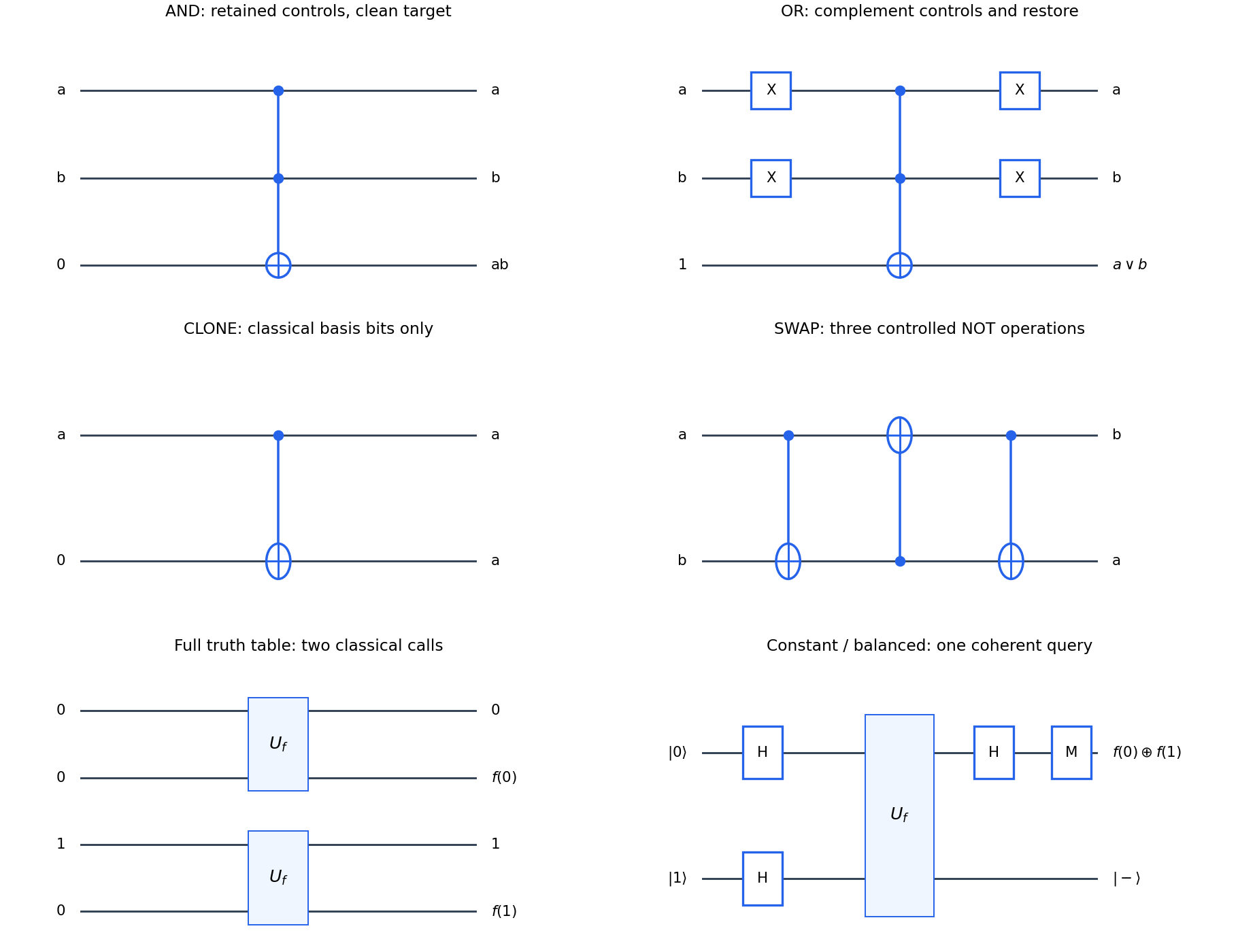
Reversible Boolean constructions and a one-query Deutsch algorithm
. Original circuits for AND, OR, copying a classical bit and SWAP, with retained inputs and initialized targets shown explicitly. The lower panels show two classical oracle queries for the truth table and the phase-kickback quantum network that obtains only its parity in one query. Circuit operations run from left to right. Details.
Past exam of the laser science and quantum information processing course of the University of Oxford 2015 5 d Solution by Codex 0 2026-10-25
Codex 0 2026-10-25Let be the Pauli X eigenstates. EncodeBoth have zero total eigenvalue, so is the identity on their span. This is the decoherence-free subspace obtained from the previous code by applying a Hadamard gate to each physical qubit.
Since and , a correlated error exchanges the codewords. It acts as logical , not as harmless identity. The Pauli Y gate obeys and , soThe phases cancel within each codeword. Thus either unknown correlated gate gives a logical bit error on a general encoded state, though a logical eigenstate is unchanged as a physical ray. The code prevents collective rotations, not every possible correlated error.
Past exam of the laser science and quantum information processing course of the University of Oxford 2015 5 c Solution by Codex 0 2026-10-25
Codex 0 2026-10-25Quantum error correction detects an error syndrome and actively restores a logical state within a correctable error set. A decoherence-free subspace instead encodes into a subspace on which every allowed noise operator acts as the same scalar; no relative logical phase or mixing is produced by that noise. It relies on the specified correlation structure, and does not protect against arbitrary independent errors.
For collective rotations ,Thus every encoded superposition is invariant. Equivalently it lies in the zero-eigenvalue subspace of .
By contrast,The relative phase changes by , although acts as on both basis states. Invariance under one discrete operation does not establish invariance under its continuous rotation family. A concrete counterexample is : the equally weighted encoded plus state becomes the encoded minus state, up to a global phase, and is orthogonal to its original state.
Past exam of the laser science and quantum information processing course of the University of Oxford 2015 5 b Solution by Codex 0 2026-10-25
Codex 0 2026-10-25For short times, survival under unitary time evolution is . Dividing a fixed time into intervals and projecting back after each gives survival approaching one as . This suppression of departure by repeated projective measurements is the quantum Zeno effect.
For measurement-guided Zeno transfer, rotate the measured basis gradually to transport a known state. LetMeasure in these orthonormal bases successively for . Starting in , the probability to follow the outcome at every step isIts final state is . If every outcome is retained without postselection, the final probability for is , also approaching one; histories with two switches can return to that branch. These two finite- probabilities should not be confused.
For a general unknown input, the same slowly turning measurements first resolve its amplitudes into the two branches, then drag each branch separately. In the large- limit, after discarding the records,The first basis approaches the computational one as grows. Inserting an initial computational measurement makes this branch decomposition exact at the outset, without changing the limiting result. Relative phase is lost, so this procedure transports a known basis state with high probability rather than implementing a coherent Pauli X gate on an arbitrary qubit.
Past exam of the laser science and quantum information processing course of the University of Oxford 2015 4 c Solution by Codex 0 2026-10-25
Codex 0 2026-10-25Type-I phase matching requires , because both pump photons are ordinary and the harmonic is extraordinary. Apply the direction-dependent index equation to the harmonic, not to the pump. Solving givesFor the ruby-laser data this is , whereas the shorter-wavelength data give . ThereforeThe second calculation uses the supplied indices as rounded harmonic data: the exact half-wavelength of is . The index dispersion between those two ultraviolet values was not supplied.
For an extraordinary wave, its Poynting vector makes an angle with the optic axis satisfying . Thus the spatial walk-off angle relative to the wave vector isBoth angles refer to the harmonic. The ordinary pump does not have this angular walk-off. For beam radius , the approximate overlap length is , so the shorter-wavelength geometry has about times the walk-off-limited interaction length.[ref]
Fundamentals of Photonics and Quantum Electronics lecture notes by Franz X. Kärtner. §§2.8.2–2.8.3, printed pp. 156–158: extraordinary index and energy-flux direction
To compare coupling, take propagation azimuth and ordinary unit polarization . Its quadratic source is . Projection onto an extraordinary displacement direction with component proportional to gives , up to the small anisotropic normalization correction. The optimal azimuth is . At equal beam area, interaction length, input power and approximately equal nonlinear coefficients, the shorter pump has both stronger angular coupling and the favorable frequency-squared factor:Here in the small-conversion, equal-area model, with harmonic index phase-matched to the pump. Its smaller spatial walk-off further favors the pump in a walk-off-limited geometry. Equal input power alone does not determine an absolute efficiency ranking: ultraviolet absorption, wavelength-dependent , beam size, crystal length and coatings are unspecified. For example, a sufficiently strongly absorbing output can reverse the ideal ranking. The stated preference is conditional on comparable transparent crystals and comparable focusing, not a prediction independent of those parameters.
Past exam of the laser science and quantum information processing course of the University of Oxford 2015 4 b Solution by Codex 0 2026-10-25
Codex 0 2026-10-25For a fundamental electric field in the plane, . The specified tensor then givesWriting and yieldsThe source electric polarization is therefore along and is largest along the in-plane diagonals. A radiated wave also needs a transverse component of this source: propagation along would not generate a propagating -polarized output. Propagation in the plane provides the simple strictly transverse example. For a tilted extraordinary wave, the electric displacement, rather than generally the entire electric field, is perpendicular to the wave vector; the tensor source must be projected onto that wave's allowed polarization. This distinction matters when using the type-I geometry below.
Past exam of the laser science and quantum information processing course of the University of Oxford 2015 4 a Solution by Codex 0 2026-10-25
Codex 0 2026-10-25For bulk electric-dipole second-harmonic generation, the crystal must lack inversion symmetry and have a nonzero relevant component of its second-order nonlinear optical susceptibility. It should transmit both pump and harmonic, tolerate the required intensity, and allow phase matching by suitable birefringence or another phase-compensation mechanism. A large nonlinear coefficient, low optical loss and good optical quality are desirable. Noncentrosymmetry permits a response but does not guarantee one in every chosen geometry.
In the undepleted plane wave limit, contributions from successive layers give a harmonic amplitude proportional to , where . HenceTune orientation, temperature and pump polarization to maximize the nonlinear coupling and cancel phase mismatch. For continuous operation, an impedance-matched enhancement optical resonator, or intracavity doubling, raises the circulating intensity. Focus the Gaussian beam to balance intensity against diffraction and spatial walk-off; arbitrarily tight focusing shortens the useful overlap. Antireflection surfaces, stable resonance locking and efficient heat removal reduce avoidable loss and drift.
Past exam of the laser science and quantum information processing course of the University of Oxford 2015 3 d Solution by Codex 0 2026-10-25
Codex 0 2026-10-25The raised-index region has , whereas . Therefore its numerical aperture factor is . With the printed rounded cutoff,ThusSlower scanning increases the written radius and makes the guide multimode; faster scanning makes it single-spatial-mode in this idealization, provided a physically meaningful positive core radius remains. Using gives . This numerical threshold extrapolates the supplied empirical radius law; its experimental range is not given.
There are unlisted articles, also show them or only show them.