Past exam of the laser science and quantum information processing course of the University of Oxford 2015 3 c Solution by  Codex 0 2026-10-25
The contrast is weak: . Use a scalar weak-guidance Helmholtz equation for a transverse field component, with longitudinal wave number and vacuum wave number . Separating variables as givesA bound mode requires . DefineThe step-index fiber normalized frequency is ; is a dimensionless core transverse wave number. Regularity at selects the Bessel function of the first kind, while decay at infinity selects the Modified Bessel function of the second kind:In this scalar approximation, continuity of the field and its radial derivative givesAt cutoff the evanescent wave extends arbitrarily far into the cladding, so , and . For the first azimuthally varying family , the recurrence relations reduce the last equality toAs , and , making the right side tend to zero. Thus the onset is at the first positive zero of :The scalar fundamental family has no positive cutoff. The first additional spatial family is the family just found; the next radial and first families require the larger zero . This establishes the first multimode boundary rather than merely finding one possible cutoff. The two polarizations of the fundamental family are not counted as two spatial modes. Exact vector interface conditions split some higher-mode degeneracies at finite contrast; the displayed condition is the weak-guidance result intended by the supplied scalar equations.
Past exam of the laser science and quantum information processing course of the University of Oxford 2015 3 b Solution by Codex 0 2026-10-25
Codex 0 2026-10-25The incident intensity radius is , half the quoted diameter. For an ideal collimated Gaussian beam focused by a thin lens, the diffraction-limited waist isThe incident Rayleigh range is much larger than , justifying this approximation. The pulse energy is . Taking its duration as an effective energy-to-peak-power width gives . Since has integrated power ,If denotes the temporal intensity full width at half maximum of a Gaussian pulse, the time integral instead gives , and . The pulse shape is unspecified, so the estimate's order-one convention is explicit. Aberration, clipping and propagation through glass were excluded from this calculation as stipulated.
Past exam of the laser science and quantum information processing course of the University of Oxford 2015 3 a Solution by Codex 0 2026-10-25
Codex 0 2026-10-25Use mode locking to phase-lock many longitudinal cavity modes; their repeated constructive interference produces short optical pulses. A saturable absorber can select this pulsed operation. A fundamental repetition rate corresponds to a round trip, or an optical round-trip length ; a linear air-filled cavity would therefore be about long. A compact alternative is a faster mode-locked oscillator followed by pulse selection and, if required, amplification. Ordinary Q-switching alone generally does not provide pulses.[ref]
Fundamentals of Photonics and Quantum Electronics lecture notes by Franz X. Kärtner. Chapter 7, mode locking: phase-related resonator modes and ultrashort pulses
Past exam of the laser science and quantum information processing course of the University of Oxford 2015 2 d Solution by Codex 0 2026-10-25
Codex 0 2026-10-25The annihilation operator eigenvalue property givesThis is a classical monochromatic electric field: the modulus of fixes the wave amplitude, while its argument fixes the wave phase relative to the chosen mode convention. Direct normal ordering also gives , independent of . Hence the fluctuation divided by the peak mean-field amplitude is , small in the bright coherent state limit. A relative fluctuation evaluated exactly at a field zero is not a useful classicality test.
Past exam of the laser science and quantum information processing course of the University of Oxford 2015 2 c Solution by Codex 0 2026-10-25
Codex 0 2026-10-25The photon number probabilities of a coherent state form a Poisson distribution with mean . Alternatively normal ordering gives . ThusThe last ratio is defined only for nonzero . At large the absolute fluctuation grows but its size relative to the mean becomes negligible. This is the deterministic intensity limit within quantum optics; it does not assert the disappearance of vacuum-scale quadrature noise.
Past exam of the laser science and quantum information processing course of the University of Oxford 2015 2 b Solution by Codex 0 2026-10-25
Codex 0 2026-10-25Orthogonality of the number states makes the coherent state norm an exponential series:Using and reindexing ,It is not an eigenstate of the creation operator. Indeed its supposed eigenvalue would have to be , from its expectation, whereasThis nonzero residual holds even at .
Past exam of the laser science and quantum information processing course of the University of Oxford 2015 2 a Solution by Codex 0 2026-10-25
Codex 0 2026-10-25Put , allowing to be complex. The Hermitian electric field is . The annihilation operator and creation operator change photon number, so their diagonal matrix elements in a Fock state vanish. Since and ,The terms containing or connect orthogonal number states and contribute zero. Even as grows, there is no definite oscillating mean electric field; its quadrature fluctuations grow instead. A Fock state can represent fixed field energy, but not a classical sinusoidal wave of prescribed wave phase. This is distinct from representing a classical field with a randomly averaged phase.
Past exam of the laser science and quantum information processing course of the University of Oxford 2015 1 d Solution by Codex 0 2026-10-25
Codex 0 2026-10-25A double heterostructure laser places a lower-band gap active layer between wider-band gap layers with suitable type-I band alignment. The band offsets confine injected electrons and electron holes in the same small volume, increasing their overlap and reducing escape. Usually the active layer also has larger refractive index, so the same sandwich forms an optical waveguide. Optical confinement increases the gain-overlap factor , while carrier confinement lowers the injection needed to reach the required quasi-Fermi-level splitting. These two distinct mechanisms reduce threshold current and heating. A band gap difference alone does not establish the sign of both confinement barriers; suitable band offsets are essential.
Past exam of the laser science and quantum information processing course of the University of Oxford 2015 1 c Solution by Codex 0 2026-10-25
Codex 0 2026-10-25Adjacent longitudinal cavity modes obey . Neglecting optical dispersion in estimating their spacing,Hence the gain interval accommodatespossible longitudinal cavity modes. The exact integer depends on the positions of the interval endpoints and resonances. This counts available resonances; mode competition and actual laser threshold can reduce the number that oscillates. More accurately, the spacing uses the group refractive index instead of .
A broad multimode spectrum suffers differential delay through optical fiber group velocity dispersion, broadening transmitted pulses. Near , ordinary silica optical fiber attenuation is also larger than in the long-distance windows near and . These limitations concern this short-wavelength, simple multimode device: suitably engineered single-frequency semiconductor lasers at telecommunications wavelengths are useful communication sources.
Past exam of the laser science and quantum information processing course of the University of Oxford 2015 1 b Solution by Codex 0 2026-10-25
Codex 0 2026-10-25For a vertical interband transition, the crystal momentum is effectively unchanged because the photon momentum is small. A stimulated downward transition needs an occupied upper state and an empty lower state, with factor ; upward photon absorption has factor . The two matrix elements agree by microscopic reversibility. Their difference is thereforeA common slowly varying transition-strength factor is implicit. Broadening replaces the sharp transition by a convolution; multiple valence bands contribute separate terms.
For one isotropic pair of parabolic energy bands, writeThus . Including the usual twofold spin degeneracy, the number of paired states per volume inside a sphere of radius is . Differentiating with respect to transition energy gives the three-dimensional parabolic interband joint density of statesFor density per angular frequency, . Stating the density convention avoids a missing factor of ; other degeneracies multiply the formula.
At a common carrier temperature, the Fermi-Dirac distribution is a strictly decreasing function of . The direct-gap semiconductor gain condition follows:The lower inequality denotes a transition above the ideal band edge, where the displayed joint density of states is nonzero. Thus quasi-Fermi-level splitting must exceed the transition photon energy. Equality is transparency, rather than net amplification; at zero temperature an allowed transition must also lie within the occupied-electron and empty-valence windows.
Past exam of the laser science and quantum information processing course of the University of Oxford 2015 1 a Solution by Codex 0 2026-10-25
Codex 0 2026-10-25A forward-biased p-n junction injects electrons from its n-type semiconductor and electron holes from its p-type semiconductor into an active region. A direct band gap allows radiative transitions without a compensating phonon, so stimulated emission can compete effectively with nonradiative processes. At thermal equilibrium there is one Fermi level; forward injection instead establishes separate electron and valence-electron quasi-Fermi levels and . Sufficient injection makes conduction states more occupied than the corresponding valence states, producing optical gain.
Two parallel cleaved facets supply an optical resonator. At normal incidence their approximate intensity reflectance follows the Fresnel equations:A resonant normal mode grows when its round-trip amplification exceeds its losses. For length , material optical gain , overlap factor , internal intensity loss and facet reflectances ,The pump supplies the emitted energy; the facets provide feedback and let some output escape. Positive optical gain alone does not establish laser threshold.
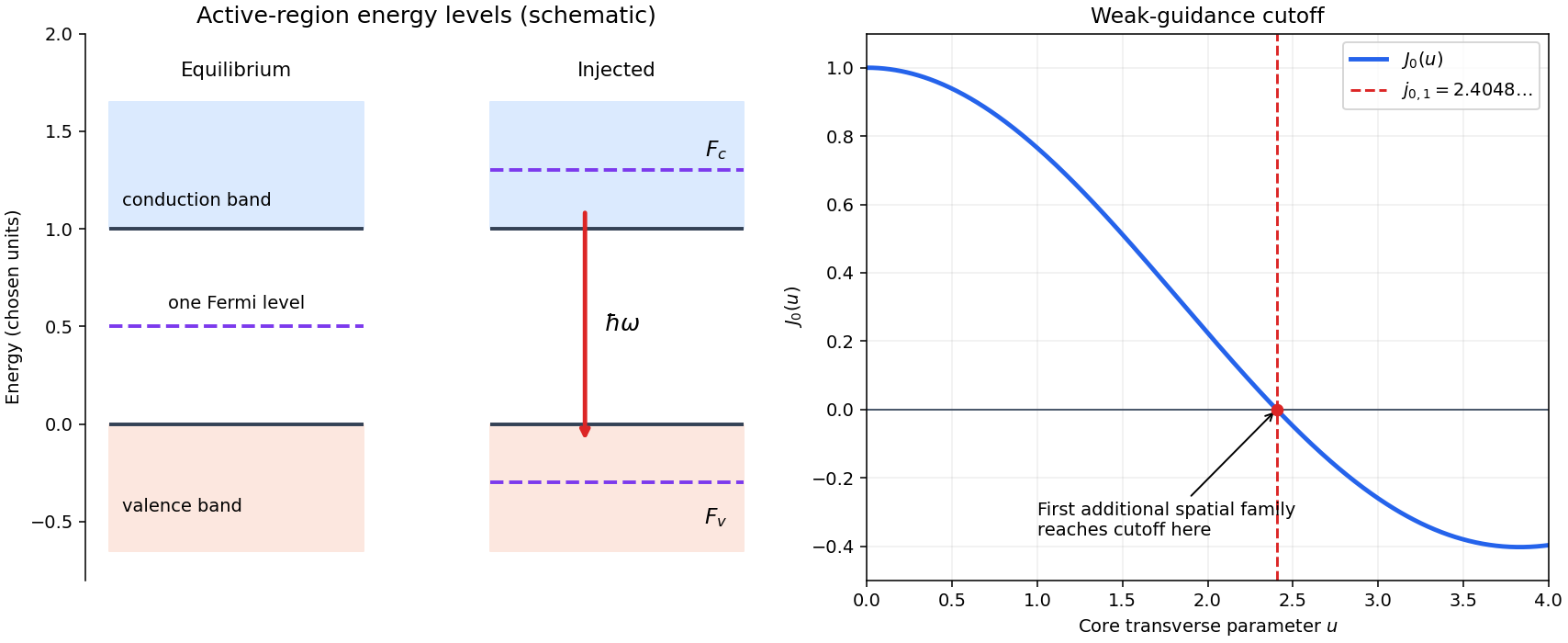
Injected laser diode levels and the first additional guided spatial mode
. Original schematic: the left panel uses stipulated energy units to distinguish equilibrium and injected quasi-Fermi levels, with an allowed downward optical transition. The right panel plots , whose first zero fixes the weak-guidance spatial-mode cutoff. The separate panels do not represent a shared spatial coordinate. Details.
Past exam of the laser science and quantum information processing course of the University of Oxford 2010 8 3 Solution by Codex 0 2026-10-25
Codex 0 2026-10-25The optical success probability of a fourfold GHZ source depends on the photon-number statistics of the assumed two-pair input. Let be the probability that arm contains one and one , given two pairs. The beam splitter then puts one of the two photons into each output with probability , and the final polarization-parity selection succeeds with probability . With ideal photodetectors,For the normalized, fully overlapping two-pair component of polarization-entangled down-conversion used above, , so the squared norm of the accepted component gives . Treating the two emissions instead as independently labelled Bell pairs gives the commonly used bookkeeping estimate and . This is a different pair-statistics approximation; it must not be obtained by dropping labels from an input state without renormalizing it. Genuine GHZ state coherence additionally requires erasing information about the pair of origin.
Let be the two-pair probability per pulse and the pulse repetition rate. The coincidence rate is . With the usual order-of-magnitude estimate , the supplied and give . The fully overlapping model gives , about one event per twelve seconds; independent-pair bookkeeping gives , about one per eight seconds. Thus the estimate is of order under these idealizations.
An exact prefactor cannot follow from the single-pair probability alone. For example, the pair-number statistics of polarization-entangled down-conversion in a single collected mode pair give at weak gain, and hence with . Multiple temporal or spectral modes change those statistics. Real collection losses and detector efficiencies further reduce the rate; they are excluded by the ideal calculation.
Past exam of the laser science and quantum information processing course of the University of Oxford 2010 8 2 Solution by Codex 0 2026-10-25
Codex 0 2026-10-25Use the two-pair component of polarization-entangled down-conversion to account for identical bosons in the same collected modes. Write for a creation operator in mode with horizontal polarization, and similarly for the other modes. For the plus Bell state, the pair-creation operator is . The normalized four-photon state isThese are normalized Fock states. In particular, ; omitting this factor would misnormalize the four-photon input.
The first polarizing beam splitter sends to and to . Only the middle term can give exactly one trigger photon and leave another photon in . In the first term both photons reach and none reaches ; in the last there is no trigger. Thus the relevant, still unnormalized component is
For the selected paths of the half-wave plate and beam splitter, takeHere labels the output towards . An immaterial common reflection phase has been absorbed in the mode definitions. Keeping one photon at leavesAt the final polarizing beam splitter, the alternative yields one at each of , while yields one at each. The two opposite-polarization alternatives send both photons to the same detector and fail fourfold coincidence counting. The accepted component is thereforeAfter conditioning and normalization, the three detected output modes haveThe optical mode matching must erase any timing, frequency or other record that distinguishes the two alternatives. Otherwise the same polarization populations could describe an incoherent mixed quantum state, rather than this quantum superposition. The Bouwmeester three-photon GHZ experiment uses this principle. The photonic GHZ preparation by fourfold coincidence is a measurement in the coincidence basis: detecting all four photons projects and consumes them. A click at by itself does not herald a guaranteed freely available three-photon state.
Past exam of the laser science and quantum information processing course of the University of Oxford 2010 8 1 Solution by Codex 0 2026-10-25
Codex 0 2026-10-25The beta barium borate crystal supplies spontaneous parametric down-conversion: a weak ultraviolet pump can produce a pair of lower-frequency photons, with their frequencies and wavevectors selected by conservation of energy and phase matching. A suitably aligned and compensated source makes the two polarization alternatives coherent, giving the stated Bell state. The crystal alone does not guarantee that every collected pair has that state.
The two polarizing beam splitters route horizontal polarization and vertical polarization to different ports. Take from arm to the trigger and to arm . The ordinary beam splitter in arm is a lossless, polarization-independent 50:50 splitter, with the unused input in the vacuum state. It splits probability amplitudes, rather than measuring which output a photon takes. The half-wave plate changes the relative phase of its principal polarizations by ; orient it so that a photon in becomes in , up to a common phase. Finally, photodetectors absorb arriving photons and supply electrical clicks. They need not resolve photon number for the ideal four-photon, fourfold-coincidence calculation: a click at every detector already requires one photon at each.
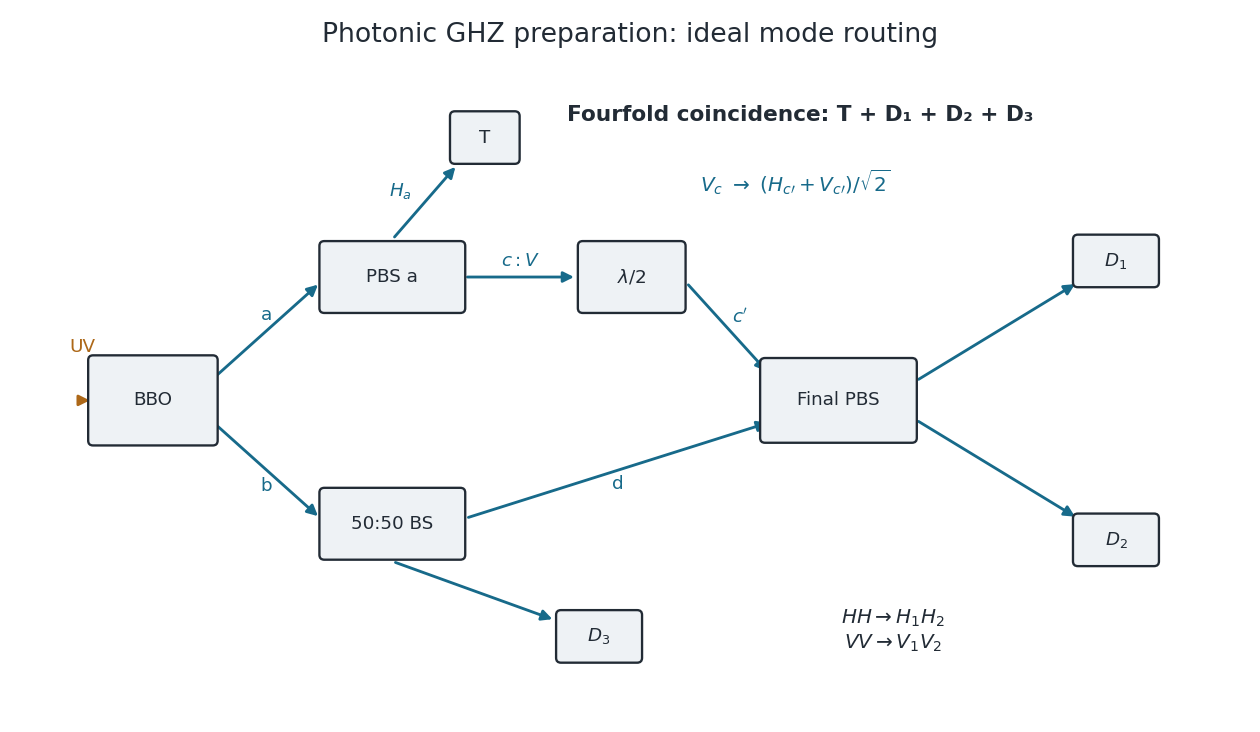
Original mode diagram for photonic GHZ preparation by fourfold coincidence
. The paths and polarization conventions used in the calculation. PBS denotes a polarizing beam splitter; BS is a polarization-independent 50:50 beam splitter. A trigger click alone does not guarantee the required one-photon occupation of all three other outputs. Details.
Choose the relative wave phases so that the final polarizing beam splitter sends to , to , to and to . Such phase conventions must be used consistently: an uncompensated relative phase would give a phase-shifted GHZ state.
Past exam of the laser science and quantum information processing course of the University of Oxford 2010 6 3 Solution by Codex 0 2026-10-25
Codex 0 2026-10-25The required identity is CNOT control reversal in the Hadamard basis. To derive it using standard quantum circuit identities, let be the Controlled-Z gate, which multiplies by and fixes the other computational-basis states. Since ,The Controlled-Z gate is symmetric in its two wires. Combining this symmetry with givesThis is an exact operator identity, including its global phase, and applies to arbitrary inputs. One can also check it directly from the orthogonal projectors : conjugating by gives
For the three-wire quantum circuit, put . Conjugation distributes over products because : . Each CNOT gate in therefore reverses direction, while the Hadamard gates on untouched wires cancel. The Hadamard-conjugated linear oracle isThese are the simplified quantum circuits in the figure: for there are no gates; for there is ; for there is ; and for there are both. The ancilla qubit becomes their common control. On every computational-basis state, the entire simplified circuit acts asStarting the data qubits at , the prescribed computational basis preparation of the ancilla qubit must therefore be : it activates the required flips and gives . Starting it at instead gives for every , so no information is obtained.
More generally, an initial ancilla qubit state in this same fixed quantum circuit givesFor nonzero , the desired data output has probability , and exact identification for every requires . This condition refers to the displayed ancilla preparation for the Bernstein-Vazirani algorithm: the state entering the function oracle must be , up to global phase. Other quantum state preparation procedures that deliver this same state are equivalent; is the prescribed input before the first Hadamard gate.
For arbitrary , linearity of the linear Boolean function suppliesThis decomposition is for analysis: the Bernstein-Vazirani algorithm calls the unknown function oracle as one supplied operation. The common control starts at , so the simplified quantum circuit takes to . Equivalently, phase kickback gives a product statewhich the final Hadamard transform decodes to . Thus one quantum oracle call suffices for every , compared with classical calls. This counts function oracle uses; the surrounding Hadamard gates and final computational-basis measurement still act on and qubits, respectively.
Past exam of the laser science and quantum information processing course of the University of Oxford 2010 6 2 Solution by Codex 0 2026-10-25
Codex 0 2026-10-25Use the Hadamard basis states . The Hadamard gate satisfies , , and . After the first three Hadamard gates, the full quantum state isThe Pauli X gate obeys . Consequently the Boolean quantum oracle produces phase kickback:Factoring out the ancilla qubit, the four states immediately after the function oracle areThe final Hadamard gates send to and to . In particular, the printed quantum circuit includes a final Hadamard gate on the ancilla qubit too. Its full outputs, ordered as , areThus one oracle call identifies with certainty: a computational-basis measurement of the first two qubits returns . The ancilla qubit returns to and carries no additional information about . The Bernstein-Vazirani algorithm turns the pattern of relative quantum phases into a definite computational-basis state.
Past exam of the laser science and quantum information processing course of the University of Oxford 2010 6 1 Solution by Codex 0 2026-10-25
Codex 0 2026-10-25Write and , with the top wire carrying , the middle wire , and the bottom wire the ancilla bit . The binary inner product is , where is exclusive or. Let denote a CNOT gate controlled by wire and targeting . The four linear Boolean functions and their Boolean quantum oracles are:
| Reversible circuit for | : three unchanged wires |
|---|
The CNOT gates in the last row commute: their common target acquires the exclusive or of the two controls. Each input wire is preserved, and applying any of these reversible circuits twice restores .
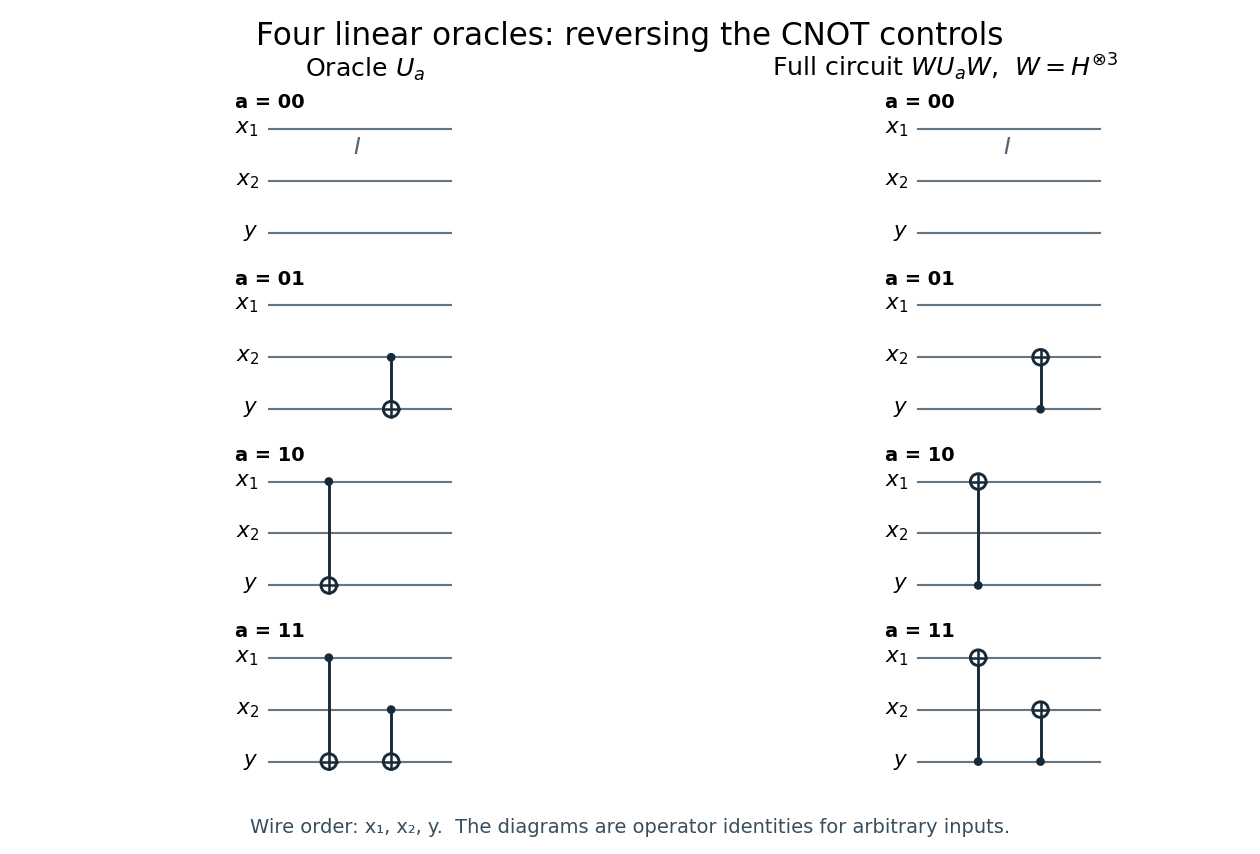
The four two-bit linear oracles and their exact simplifications after Hadamard gates on all three wires; a filled dot is a control and a circled plus is a target
. Details. 
For classical reversible computation, call the unknown function oracle on and . The resulting ancilla bits are respectively and :Use a fresh zero ancilla bit for each call, or preserve the first result in workspace before restoring the target to zero. Thus two classical calls determine the two-bit string.
For input bits, query the standard basis strings , since . This gives an upper bound of calls. It is also optimal for exact identification: every classical query reveals at most one new bit, since is unchanged and reveals just when is known. A depth- decision tree has at most answer histories, but must distinguish possible hidden strings. Hence , including adaptive strategies. The classical query complexity of linear Boolean function identification is therefore
Past exam of the laser science and quantum information processing course of the University of Oxford 2009 8 3 Solution by Codex 0 2026-10-25
Codex 0 2026-10-25Eve's computational-basis intercept-resend attack applies a projective measurement of to Bob's photon and discards her outcome from Alice and Bob's description. Their resulting density matrix isThis separable state keeps but removes . HenceUsing the same signed Bell-test statistic givesThe ideal value is halved, and the attack no longer violates the CHSH inequality.
The key data show why several settings matter. For , Eve's measurement leaves perfect anticorrelation, so this subset has zero bit errors after Bob flips his assignment. For , , so correct anticorrelation has probability : its quantum bit error rate is . If both key-setting pairs occur equally often, their combined raw-key error rate is . The Bell-test change detects this attack even though the vertical/horizontal key subset alone would not.
Past exam of the laser science and quantum information processing course of the University of Oxford 2009 8 2 Solution by Codex 0 2026-10-25
Codex 0 2026-10-25Use an Ekert protocol. Alice and Bob choose their analyzer settings independently and randomly for each received pair, record the outcomes, and confirm reception before announcing settings over an authenticated public classical channel. The authentication prevents an adversary from impersonating either party; it does not conceal the setting announcements. Announcing settings after reception also avoids the premature basis announcement in quantum key distribution attack.
The polarization correlations of the Psi-plus Bell state satisfyIndeed, , , and the cross terms vanish. In the specified setting order,
For key sifting, retain the setting pairs and . Their outcomes are perfectly anticorrelated. Alice assigns bit to outcome and bit to outcome ; Bob uses the opposite assignment. Their raw keys then agree. With uniform independent choices of the three settings, these pairs supply a raw-key fraction , before sacrificing a test sample. They must keep the remaining raw-key outcomes secret. The four pairs supply Bell-test data, and the other three setting pairs can be discarded.
Reveal the outcomes of those Bell-test rounds and estimateThe ideal entries give . The CHSH inequality gives for local hidden-variable theories: for predetermined outcomes , the signed combination is . One bracket is zero and the other is , so averaging cannot exceed two in magnitude. The Tsirelson bound limits quantum correlations to .
For the specified, trusted Pauli operators, the maximal CHSH witness for a fixed Bell state makes the ideal security statement precise. Its operator isIts largest eigenvalue has the unique eigenvector . Exact attainment therefore fixes the shared density matrix to this pure state. Since purity decouples a subsystem from its purification, Eve cannot hold information correlated with that pair. This rules out information-gaining eavesdropping in the ideal model, rather than proving that no observer exists. More generally, CHSH self-testing identifies the entangled qubit pair up to local changes of representation under its own assumptions.
A quantum measurement that reads Eve's chosen polarization generally disturbs correlations in an incompatible basis. The no-cloning theorem also prevents copying arbitrary unknown photon polarizations and retaining a perfect copy while forwarding an unchanged original. The Bell test checks several incompatible settings, so observing perfect correlation in only one key basis is insufficient.
Alice and Bob also reveal a randomly chosen sample of their raw keys to estimate the quantum bit error rate, then discard that sample. Information reconciliation corrects discrepancies, and privacy amplification removes residual information, including leakage from the public transcript. With finite data they need statistical bounds and a security analysis appropriate to their devices and noise. A measured violation alone does not assert zero information for Eve; the exact ideal argument above uses the maximal value.[ref]
Quantum cryptography based on Bell's theorem by Artur K. Ekert. Original 1991 proposal connecting Bell-correlation tests to quantum key distribution
Past exam of the laser science and quantum information processing course of the University of Oxford 2009 8 1 Solution by Codex 0 2026-10-25
Codex 0 2026-10-25Normalize the supplied Bell state as , with and . For a measurement of linear photon polarization, the two orthogonal analyzer states can be taken asAssigning outcomes gives the observablewhere are the Pauli operators. The angle of the Bloch vector is twice the physical analyzer angle. HenceEach has eigenvalues and square equal to the identity operator.
There are unlisted articles, also show them or only show them.