Past exam of the continuous martingales and stochastic calculus course of the University of Oxford 2023 1 c Solution by  Codex 0 2026-10-25
For any real orthonormal basis , the argument of (b)(ii) gives almost sure convergence and convergence in L2 of . Finite linear combinations have normal distributions, and the Parseval identity for a Hilbertian basis givesThus and are centered Gaussian processes with the same covariance function. More explicitly, their finite-dimensional characteristic functions are bothThis proves the basis invariance of an isonormal Gaussian process: equality of all finite-dimensional distributions, and hence equality in law of the indexed collections.
For the specified cosine orthonormal basis, put . Its coefficient against an interval indicator isConsequently the Brownian half-integer sine expansion, a Karhunen–Loève expansion, isFor every fixed , the sum converges almost surely and in L2 space because the coefficient squares sum to . Its continuous modification is a standard Brownian motion by (b)(v). The expansion also holds in : the expectation of the squared tail is the integral of the coefficient-square tail, which tends to zero by the dominated convergence theorem, with bound .
To realize this expansion for the original , choose . These are Jointly Gaussian with covariance matrix equal to the identity, hence are independent standard normal random variables. The finite orthogonal projections of onto converge in , and the identity transfers that convergence to the displayed expansion for . With an independently chosen sequence the resulting Brownian motion has the same law; a pathwise identification uses the coupling just given.
Past exam of the condensed matter physics major option course of the University of Oxford 2019 6 e Solution by Codex 0 2026-10-25
Codex 0 2026-10-25Let be the junction length perpendicular to the width and be uniform. Put . Integrating the local current-phase relation of a superconducting weak link over the junction givesThe odd-in- term integrates to zero. At fixed central phase , define . ThenThe value at zero flux is the continuous limit, and zeros occur at nonzero integer multiples of . This signed formula is the source's expression for a fixed phase. If the measured quantity is the maximum sustainable current, maximize over the central phase instead:For example, at the signed coefficient is , whereas the critical current is positive. The absolute-value envelope is the Fraunhofer pattern of a Josephson junction, shown in the right panel of the original tunnelling figure. Its simple form relies on uniform and the linear phase profile; it is not the two-junction cosine pattern of a DC SQUID.
Past exam of the condensed matter physics major option course of the University of Oxford 2019 6 d Solution by Codex 0 2026-10-25
Codex 0 2026-10-25Let cross the barrier from electrode 1 to 2, let run along its width, and take . In the ideal barrier-only model choose , which has . Then the crossing integral at fixed is . With the sign convention used in the source,Reversing the field or the phase orientation reverses the slope and does not change the interference envelope. The same result follows by comparing two paths across the junction and using the enclosed magnetic flux.
If field penetration into thick identical electrodes is included, the effective magnetic thickness is approximately , where is the London penetration depth. Replace and consistently by and . The linear phase profile assumes a uniform applied field and negligible magnetic self-field of the junction current.
Past exam of the condensed matter physics major option course of the University of Oxford 2019 6 c Solution by Codex 0 2026-10-25
Codex 0 2026-10-25Rearrange the source's condensate-current expression and integrate around a closed path lying in the superconducting material:Single-valuedness of the superconducting wavefunction requires , and Stokes theorem gives . Thus the exact result is fluxoid and flux quantization in a superconductor:Reversing the winding orientation absorbs the sign of . Since a Cooper pair has , the positive superconducting flux quantum isFor a thick ring, choose the path deep enough that the supercurrent is negligible; then the enclosed magnetic flux is . This is the flux quantization usually intended in the question.
Qualification of the unqualified flux claim: a thin ring can have a nonzero kinetic contribution around every available path, so it is the fluxoid that is exactly quantized. For example, with zero applied flux and geometric and kinetic inductances , a metastable winding- state has but . This concrete counterexample satisfies the given current law while its magnetic flux is not an integer multiple of .
Past exam of the condensed matter physics major option course of the University of Oxford 2019 6 b Solution by Codex 0 2026-10-25
Codex 0 2026-10-25Use a normal-metal--insulator--superconductor junction with a weak tunnelling barrier. For a nearly constant normal-metal density of states, the differential conductance probes the thermally broadened superconducting quasiparticle density of states. At sufficiently low temperature, the ideal BCS theory result isThere is very little single-electron tunnelling for , while a sharp onset occurs at . The gap can therefore be obtained from the two symmetric onset voltages, . For this one-superconductor junction the threshold is , not .
Integrating at zero temperature gives the useful current sketchThe curve is odd, nearly flat inside the gap, and approaches the normal-state line at large . The ideal gap-edge singularity is in the slope, not in the current itself. At finite temperature below the transition the onset rounds and thermally activated subgap current appears. Measuring several temperatures distinguishes this rounding from the closing of .
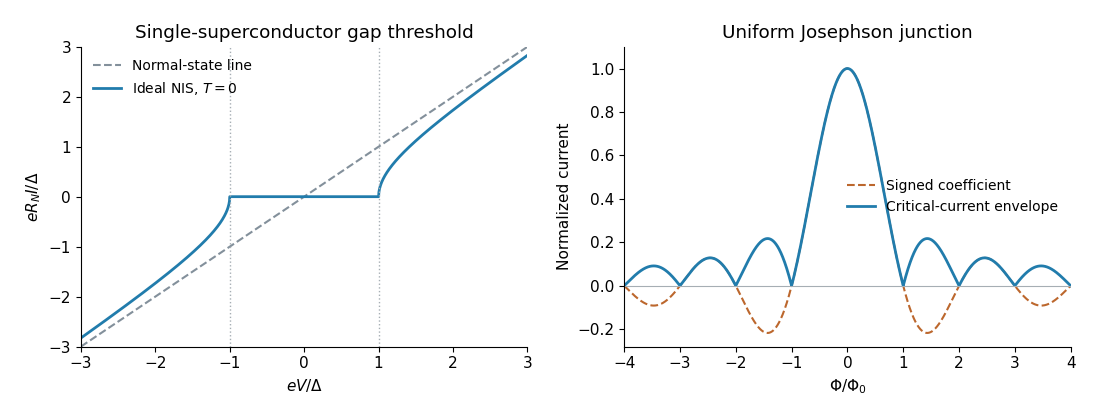
Gap threshold in NIS tunnelling and the Josephson interference envelope
. Original ideal-model plots. Left: the zero-temperature single-electron current into a fully gapped superconductor, with the normal-state line for comparison. Right: the signed sinc coefficient at a fixed phase and its nonnegative critical-current envelope. Finite temperature, nonuniform junction current density and self-field effects are omitted. Details.
Past exam of the condensed matter physics major option course of the University of Oxford 2019 6 a Solution by Codex 0 2026-10-25
Codex 0 2026-10-25In a conventional superconductor, an attractive pairing interaction forms Cooper pairs and a phase-coherent condensate. The elementary fermionic excitations have a superconducting energy gap ; breaking a pair into two excitations costs at least . The density of thermally excited quasiparticles is exponentially small for . Nevertheless the vanishing DC electrical resistivity below the critical temperature is a property of the coherent supercurrent, not a claim that all thermal quasiparticles disappear. Below the relevant critical-current and critical-field limits, a homogeneous bulk sample carries dissipationless current; above the superconducting transition the normal resistivity returns.
In a semiconductor, the band gap separates filled valence states from empty conduction states because of the periodic crystal potential and orbital hybridization. Thermally exciting carriers across the gap produces both conduction electrons and valence holes. For an intrinsic sample,Thus its electrical resistivity generally rises rapidly on cooling, with an activated factor up to mobility and density-of-states prefactors. This differs from the zero-resistivity condensate response. Dopant freeze-out and extrinsic-carrier regimes require their own activation scales; the intrinsic formula is not universal for every doped sample.
Past exam of the condensed matter physics major option course of the University of Oxford 2019 5 e Solution by Codex 0 2026-10-25
Codex 0 2026-10-25Measure magnetization along at low temperature and use a small field to select a single weak-ferromagnetic domain. After domain alignment, subtract the approximately linear field-induced susceptibility background to obtain the spontaneous weak moment, using the extrapolated intercept of that branch rather than a multidomain zero-field average.
There are four iron ions per orthorhombic cell. If the spontaneous magnetization density is and the cell volume is , the ordered moment and dimensionless spin component per ion areHere spin components are expressed in units of as in the source Hamiltonian. Alternatively normalize the magnetic moment to the measured number of iron ions. A field too large to preserve the small-canting structure would not measure the zero-field component directly. For high-spin Fe with and , the angle above corresponds to approximately per iron ion.
Past exam of the condensed matter physics major option course of the University of Oxford 2019 5 d Solution by Codex 0 2026-10-25
Codex 0 2026-10-25The canted pattern has opposite components but a common component. Write neighboring spins as and . Their scalar product is , and the cross-product magnitude is .
There are three exchange bonds per spin, two eligible bonds per spin for the term, and one single-ion term per spin. HenceFor the branch close to the collinear state,Minimization is equivalent to maximizing , which givesThe chosen branch is a minimum of the energy because it maximizes that positive-amplitude sinusoid. The resulting state is a canted antiferromagnet with a small common moment. The source's absolute-value interaction selects a canting magnitude but is symmetric between the two signs of the weak moment; it is not an oriented vector Dzyaloshinskii-Moriya interaction specifying a unique handedness.
Past exam of the condensed matter physics major option course of the University of Oxford 2019 5 c Solution by Codex 0 2026-10-25
Codex 0 2026-10-25Treat the ordered spins as classical vectors of fixed length , as in the requested mean-field energy. Each iron site has six nearest neighbors: four in the plane and two along . All are antiparallel in the collinear state. Each exchange bond contributes and is counted only once, giving per spin.
The easy-axis term contributes because . The cross product of two collinear spins is zero, so the term proportional to contributes nothing. Therefore
There are unlisted articles, also show them or only show them.