Past exam of the condensed matter physics major option course of the University of Oxford 2016 8 c Solution by  Codex 0 2026-10-25
The competition between magnetic screening over the London penetration depth and condensate recovery over the superconducting coherence length is measured by the Ginzburg-Landau parameter . In the single-component local theory the boundary is . For , a normal–superconducting interface has positive energy: a type-I superconductor favours macroscopic regions and a thermodynamic critical field . Demagnetizing fields may create an intermediate state of normal and superconducting domains.
For the interface energy is negative. A type-II superconductor admits flux vortices between the lower and upper critical fields, with normal-like cores of size and circulating screening currents over . Each singly quantized vortex carries ; a vortex lattice and pinning-controlled irreversible response can occur. Pairing strength, carrier density, Fermi velocity and impurity scattering affect these lengths; alone does not determine the type. The stated boundary is the standard Ginzburg–Landau result near .
Past exam of the condensed matter physics major option course of the University of Oxford 2016 8 b Solution by Codex 0 2026-10-25
Codex 0 2026-10-25Let denote pair mass, charge and number density, respectively. A uniform-phase condensate in the stated gauge has zero canonical momentum . ThereforeFor static fields, and . Taking a curl and using the vector identity for a double curl givesFor electronic pairs, and , while is the pair density, not twice that density. In a general gauge the canonical momentum is ; taking the curl away from vortices gives the same London equation.
Past exam of the condensed matter physics major option course of the University of Oxford 2016 8 a Solution by Codex 0 2026-10-25
Codex 0 2026-10-25In BCS theory, an electron distorts the positively charged lattice, and the retarded response can attract another electron. Within a phonon-energy shell around the Fermi surface, the effective attraction can overcome the screened Coulomb repulsion and destabilize the normal Fermi sea toward Cooper pairs. In conventional elemental superconductors the pairs predominantly join time-reversed states of opposite momentum and spin, forming a spin singlet.
In the weak-coupling approximation,Here is the appropriate single-spin density of states and the effective attractive interaction in a consistent normalization. Both the phonon scale and the exponential coupling matter. A large Fermi-level density of states, often associated with partially filled narrow bands, can raise ; weak coupling or a small density of states can suppress it even in a good conductor. With force constants and coupling fixed, gives the conventional isotope trend. This is not a universal monotonic ranking of elements by atomic mass: phonon stiffness, electron–phonon matrix elements, Coulomb effects and magnetism vary between elements. Magnetic pair breaking helps explain why some elements do not follow a naive density-of-states expectation.
Past exam of the condensed matter physics major option course of the University of Oxford 2016 5 b Solution by Codex 0 2026-10-25
Codex 0 2026-10-25The tight-binding model uses Bloch sums of localized atomic-like or Wannier orbitals,Including in the phase is an equivalent basis convention. Overlap and hopping between these localized orbitals create dispersive bands. Narrow transition-metal bands and the bonding/antibonding bands of covalent solids are natural examples; graphene's bands are another. The model can be accurate beyond weak hopping when enough orbitals and hopping integrals are retained.
Past exam of the condensed matter physics major option course of the University of Oxford 2016 5 a Solution by Codex 0 2026-10-25
Codex 0 2026-10-25The nearly-free electron model expands the Bloch state in plane waves,All basis functions have the same translation eigenvalues because . A weak periodic potential mixes them most strongly near Bragg degeneracies and opens band gaps. Delocalized conduction states of simple metals, such as sodium and aluminium, are typical applications; the approximation need not describe tightly bound core states.
Past exam of the condensed matter physics major option course of the University of Oxford 2016 3 c Solution by Codex 0 2026-10-25
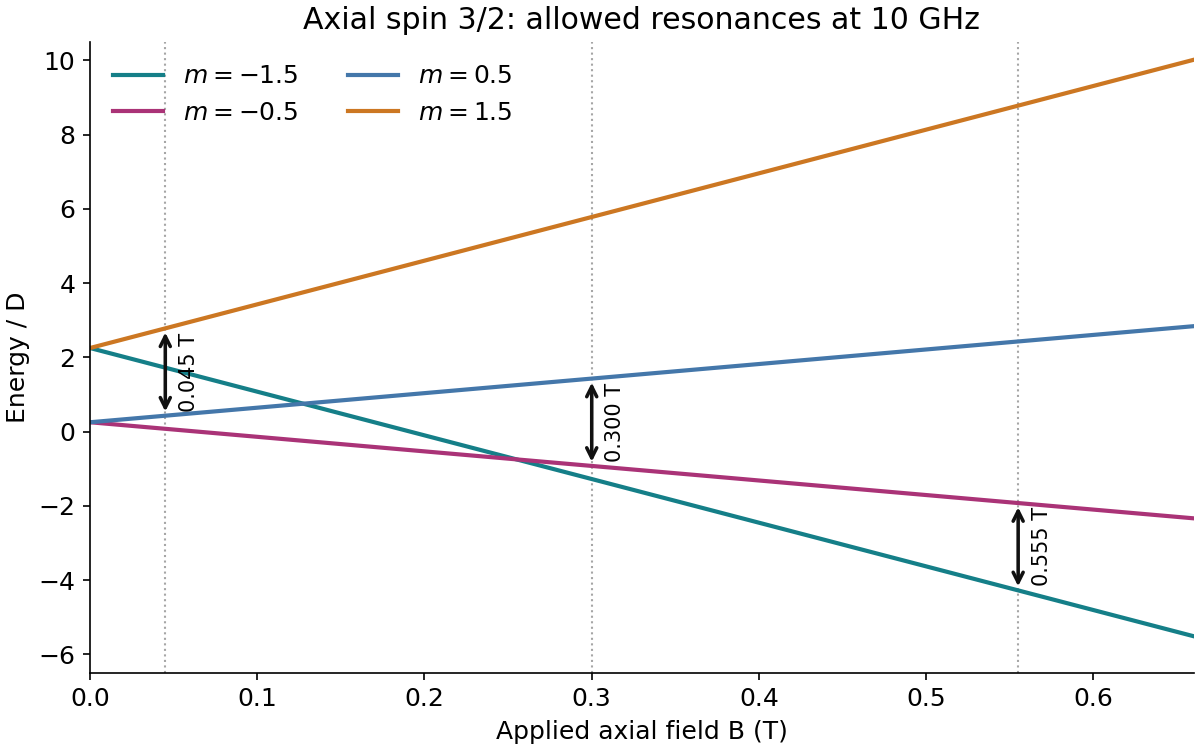
Codex 0 2026-10-25Take dimensionless spin operators and , with . The four wavefunctions are , , withAt zero field they form doublets at and . A transverse microwave magnetic field drives transitions. When , their positive resonance fields in ascending order areThey connect , , and , respectively. ThusHere and the zero-field doublet gap is .
At lower frequency it is essential to use absolute energy gaps, not discard a transition after its levels cross. For , the distinct candidate positive fields areThe first two coincide whenThis axial spin-three-halves resonance coincidence leaves two distinct resonance positions, at and , with two transitions superposed at the lower position. At there are also only two strictly positive-field lines, but an additional zero-field resonance remains; this is a different counting convention. Observable intensities also require thermal occupation of the relevant lower levels.

Past exam of the condensed matter physics major option course of the University of Oxford 2016 3 b Solution by Codex 0 2026-10-25
Codex 0 2026-10-25The tetrahedral crystal field splitting places the two orbitals below the three orbitals. In the weak-field, high-spin limit the occupancy is , with . Its lowest cubic term is : an orbital triplet, before spin degeneracy is counted. In the hypothetical sufficiently strong-field limit the occupancy is , with and an orbital doublet . This latter limit requires overcoming pairing/Hund energy; ordinary tetrahedral oxide complexes generally remain high-spin.
Both orbital degeneracies permit a Jahn-Teller effect, so a regular tetrahedron is not a stable static equilibrium in the elementary adiabatic treatment. The sign of a particular distortion requires an electron–lattice coupling model, not just the degeneracy count. To make that dependence explicit, let stretch while contracting . In a leading point-charge quadrupole model write the shiftsIn the high-spin configuration the two shifts cancel. For the remaining electron selects , gaining ; for it selects the doublet, gaining . Adding gives a tetragonally elongated minimum at , with energy gain , versus only along the compressed branch. The elongated branch has an orbital singlet. This is the usual elementary elongation argument; quantitative coupling includes higher crystal-field multipoles and configuration mixing.
For the strong-field configuration the lower orbital is doubly occupied. The shift of the three electrons is , so the same model has both an elongated and a compressed minimum, , with equal stabilization. Elongation favours double occupation of ; compression favours double occupation of . This tetrahedral doublet distortion-sign ambiguity prevents a unique choice from the supplied data. For example, a small symmetry-allowed cubic elastic invariant selects opposite tetragonal signs when changes sign, while leaving the regular-site electronic configuration unchanged. Higher couplings or host constraints are needed to choose. Dynamic motion between equivalent minima may also restore an average regular shape without stabilizing the undistorted adiabatic configuration.
Once a static axial distortion removes the orbital degeneracy, second-order spin-orbit coupling produces a time-reversal-even quadratic spin Hamiltonian operator. The residual tetragonal symmetry requires equal coefficients. Dropping a multiple of leaves for the weak-field state. The sign and magnitude of depend on excited-state splittings. For the strong-field Kramers doublet, is constant: this term cannot cause zero-field splitting, although the Zeeman g-factor can be anisotropic.
Past exam of the condensed matter physics major option course of the University of Oxford 2016 2 e Solution by Codex 0 2026-10-25
Codex 0 2026-10-25In equilibrium without hysteresis, the system selects the lower free-energy minimum. At the order parameter jumps between and , which identifies a first-order phase transition. Differentiating the minimized free energy does not add a contribution because . Thus the polarization-dependent entropy is , givingThe heat absorbed on heating from the ordered to the disordered phase isThe same amount is released on cooling. If is defined in the opposite direction, the signed transition heat is correspondingly negative.
Past exam of the condensed matter physics major option course of the University of Oxford 2016 2 d Solution by Codex 0 2026-10-25
Codex 0 2026-10-25The two nonzero stationary points merge when their discriminant vanishes, giving the upper spinodalAt a nonzero stationary point, , so its free energy reduces to . Equality with therefore requires . Substitution givesBoth have positive curvature at coexistence. The intervening maximum is at . For the positive-polarization minimum is metastable; for the zero-polarization minimum is metastable.
Past exam of the condensed matter physics major option course of the University of Oxford 2016 2 c Solution by Codex 0 2026-10-25
Codex 0 2026-10-25Differentiating the Landau theory free energy givesIts stationary values arewhen the discriminant is nonnegative. At , the curvature is : a local minimum above and a local maximum below it. Exactly at , , so the origin is a stationary inflection point, not a stable minimum.
At a nonzero stationary point, eliminating yields . Between and the upper spinodal, is a minimum and a maximum. Below , becomes another local minimum, while is the lower minimum. Thus loss of local stability at is distinct from the equilibrium transition temperature.
Past exam of the condensed matter physics major option course of the University of Oxford 2016 2 b Solution by Codex 0 2026-10-25
Codex 0 2026-10-25For the full prism point group, a threefold rotation eliminates any invariant basal component of a polar vector, while the horizontal mirror eliminates its axial component. Therefore the phase preserving all of is nonpolar, despite lacking inversion. A polar phase would have to break some of these symmetries.
The indicated six vertex directions comprise three basal directions and their horizontal-mirror partners. Crucially, this orbit does not contain the negatives of those vectors. Choose along the prism and toward one basal vertex. The cubic polynomialis invariant under the prism's rotations and mirrors. Along a vertex direction with a nonzero basal component, it is proportional to , so odd scalar terms are symmetry-allowed. Along the prism axis the horizontal mirror instead sends , forcing an even free energy. Merely omitting inversion is insufficient to decide either polarity or the allowed invariants.
Past exam of the condensed matter physics major option course of the University of Oxford 2016 2 a Solution by Codex 0 2026-10-25
Codex 0 2026-10-25Under spatial inversion the electric polarization, a polar vector, changes from to . Neumann's principle requires an equilibrium property of a phase retaining inversion symmetry to be unchanged. Thus , forcing : a centrosymmetric phase cannot itself be ferroelectric. A transition can, of course, remove that symmetry.
For an inversion-symmetric parent phase the Landau theory free energy satisfies . Every polynomial term of odd total degree changes sign and must have zero coefficient. Restricting to one fixed direction gives an even scalar expansion in .
Past exam of the condensed matter physics major option course of the University of Oxford 2016 1 d Solution by Codex 0 2026-10-25
Codex 0 2026-10-25With and ,For , the transformation in part c maps onto its Friedel pair with only a phase factor. Cyclic permutations give the same result when either other index vanishes. Friedel's law therefore survives for every such reflection, including any systematic absences.
For the reflection set . ThenSince the purely positional sums obey , the scalar resonant Friedel-pair intensity difference isup to the same positive experimental scale factor. In particular,Different positional phases can therefore produce a nonzero resonant intensity difference at , allowing the opposite structural handednesses to be distinguished. The claimed violation is generic, not an unconditional identity: the source supplies no numerical internal coordinates. For a concrete noncentrosymmetric counterexample, take and . Their orbit sums at are and , so the difference vanishes even if ; each generic chemical orbit is noncentrosymmetric, so this cancellation does not require inversion symmetry. Accidental cancellation, or , must be excluded before asserting a violation for a particular specimen.
Past exam of the condensed matter physics major option course of the University of Oxford 2016 1 c Solution by Codex 0 2026-10-25
Codex 0 2026-10-25Write , where the four-site orbit has structure factorA cyclic permutation of fixes the first term and permutes the remaining three. Thus . Substituting exchanges the first and second exponentials and the third and fourth, with the common coefficient :The two forms of this phase, and , agree for integer indices. Multiplication by a unit-modulus phase preserves intensity, irrespective of whether is real or complex. Since the phase is independent of and atomic species, it also multiplies the total structure factor of the crystal.
Past exam of the condensed matter physics major option course of the University of Oxford 2016 1 b Solution by Codex 0 2026-10-25
Codex 0 2026-10-25Use fractional coordinates and the structure factor conventionFor real atomic scattering factors, , immediately proving Friedel's law. If an inversion centre is chosen as origin, each site at has an identical partner at , with the same possibly complex atomic scattering factor. Each pair contributes ; sites fixed by inversion modulo a lattice translation also have even phase factors at reciprocal-lattice vectors. Henceeven for scalar anomalous X-ray scattering in a centrosymmetric structure. This last equality is an equality of amplitudes, not generally complex conjugacy.
Past exam of the condensed matter physics major option course of the University of Oxford 2016 1 a Solution by Codex 0 2026-10-25
Codex 0 2026-10-25Away from an absorption edge, the scalar atomic scattering factor is the Fourier transform of an approximately spherical, real atomic electron density. Opposite points contribute conjugate phases, so their sum is real. In Thomson scattering the electronic response is also effectively in phase with the driving field in this nonabsorbing approximation. Near an absorption edge, resonantly driven electronic excitations introduce a phase lag and absorption. The atomic scattering factor becomes , with describing the absorptive component and its dispersive companion. The sign of the imaginary part depends on the time and scattering-phase conventions; here it is the source's convention. This discussion concerns scalar charge scattering, without magnetic or tensor resonant contributions.
Past exam of the condensed matter physics major option course of the University of Oxford 2015 8 d Solution by Codex 0 2026-10-25
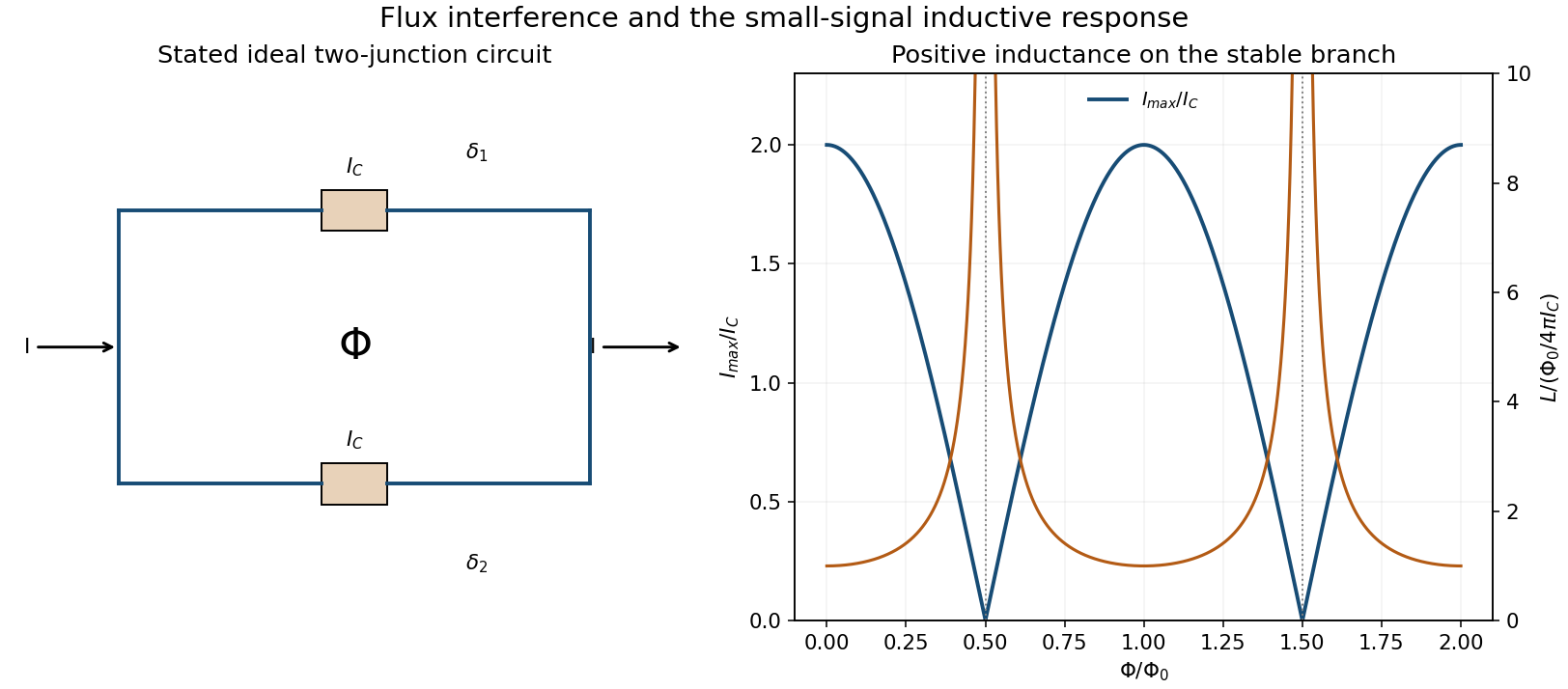
Codex 0 2026-10-25The AC Josephson effect is . Since the imposed flux is held fixed when defining a small-signal inductance, differentiate c to obtainOn the stable small-current branch with , and the result reduces to the printed expression,The stable small-signal inductance of a symmetric DC SQUID requires , stronger than near a half-integer flux quantum. If , the stable zero-current phase is and . Its inductance is positive:For example, makes the printed signed formula negative when expanded about , but that phase is an energy maximum. Expanding about the stable corrects the sign. At ideal half-integer flux the critical current vanishes and the linear inductance formally diverges; a finite transport current cannot satisfy the small-current approximation there. Geometric inductance and other nonidealities then have to be retained instead of extending the simple formula through its pole.
Past exam of the condensed matter physics major option course of the University of Oxford 2015 8 c Solution by Codex 0 2026-10-25
Codex 0 2026-10-25Let and be gauge-invariant phase drops across the two identical junctions, oriented between the same terminal phases. Their currents obey the DC Josephson effect: and . For negligible loop self-inductance and no additional phase drops in the arms, fluxoid consistency fixes their difference modulo :Define the mean terminal phase and . Then and the two parallel branch currents add:Consequently the maximum magnitude of the current is , not a negative critical current when the cosine changes sign. The phase shifts by between such stable branches. Junction asymmetry or appreciable self-generated flux modifies the simplest interference pattern, so the stated idealization is required before treating as an externally prescribed flux.
Two-junction superconducting interference and its stable inductive response
. Original circuit-level diagram of the stated ideal two-junction model, with a flux-dependent critical-current envelope and stable small-signal inductance. It does not reconstruct the missing source raster components. Details.
There are unlisted articles, also show them or only show them.